Gaming News and Headlines
  • All Technology
  • AI
  • Autonomy
  • B2B Growth
  • Big Data
  • BioTech
  • ClimateTech
  • Consumer Tech
  • Crypto
  • Cybersecurity
  • DevOps
  • Digital Marketing
  • Ecommerce
  • EdTech
  • Enterprise
  • FinTech
  • GovTech
  • Hardware
  • HealthTech
  • HRTech
  • LegalTech
  • Nanotech
  • PropTech
  • Quantum
  • Robotics
  • SaaS
  • SpaceTech
AllNewsDealsSocialBlogsVideosPodcastsDigests

Gaming Pulse

EMAIL DIGESTS

Daily

Every morning

Weekly

Sunday recap

NewsDealsSocialBlogsVideosPodcasts
GamingNewsLooking Back at Catacomb 3D, the Game that Led to Wolfenstein 3D
Looking Back at Catacomb 3D, the Game that Led to Wolfenstein 3D
Gaming

Looking Back at Catacomb 3D, the Game that Led to Wolfenstein 3D

•February 2, 2026
0
Ars Technica – Gaming
Ars Technica – Gaming•Feb 2, 2026

Why It Matters

Catacomb 3D’s technical breakthroughs and strategic shift proved pivotal in establishing id Software’s dominance in first‑person shooters, influencing industry standards for decades.

Key Takeaways

  • •Texture‑mapped walls pioneered on low‑end PCs
  • •Mouse support enabled precise first‑person aiming
  • •Low earnings spurred focus on higher‑impact titles
  • •Abandoned Commander Keen 7 for Wolfenstein prototype
  • •Catacomb 3D laid groundwork for Doom era

Pulse Analysis

The early 1990s were a crucible for first‑person gaming, and Catacomb 3D stands out as a hidden catalyst. By adapting texture‑mapping concepts from high‑end SGI workstations to an EGA‑based PC, John Carmack demonstrated that immersive 3D environments could run at playable speeds on consumer hardware. This breakthrough, coupled with mouse‑driven aiming and wall‑shooting mechanics, gave developers a practical template for the fast‑paced action that would later define the genre.

From a business perspective, Catacomb 3D’s modest $5,000 contract with Softdisk starkly contrasted with the ten‑fold revenue of the Commander Keen series. The financial disparity forced id Software to evaluate long‑term viability, ultimately choosing to invest in the technology that showed the most promise. The decision to scrap a seventh Commander Keen installment in favor of a Wolfenstein 3D prototype illustrates how a single technical success can redirect a company’s strategic trajectory, turning a niche experiment into a market‑changing product line.

Today, Catacomb 3D’s legacy is evident in every modern shooter that relies on texture‑mapped environments and precise mouse control. The game’s influence extends beyond nostalgia; it underscores the importance of rapid prototyping and willingness to pivot when a new mechanic proves compelling. For developers and investors alike, the story serves as a reminder that groundbreaking technology, even from a low‑budget title, can reshape an entire industry.

Looking back at Catacomb 3D, the game that led to Wolfenstein 3D

Romero, Carmack, and colleagues discuss an oft‑forgotten piece of PC gaming history. · By Kyle Orland · Senior Gaming Editor, Ars Technica

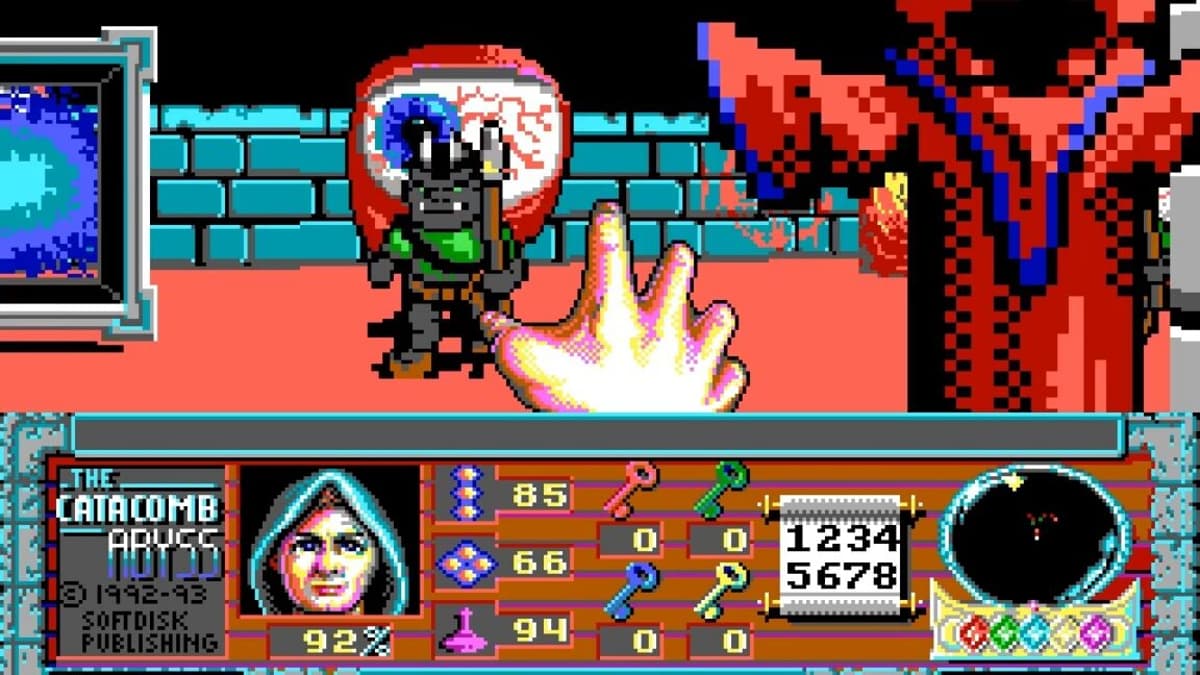
If you know anything about the history of id Software, you know how 1992’s Wolfenstein 3D helped establish the company’s leadership in the burgeoning first‑person shooter genre, leading directly to subsequent hits like Doom and Quake. But only the serious id Software nerds remember Catacomb 3D, id’s first‑person adventure game that directly preceded and inspired work on Wolfenstein 3D.

Now, nearly 35 years after Catacomb 3D’s initial release, id co‑founder John Romero brought the company’s founding members together for an informative retrospective video on the creation of the oft‑forgotten game. The pioneering game—which included mouse support, color‑coded keys, and shooting walls to find secrets—almost ended up being a gimmicky dead end for the company.


Texture maps and “undo” animation

Catacomb 3D was a follow‑up to id’s earlier Catacomb, which was a simplified clone of the popular arcade hit Gauntlet. As such, the 3D game still has some of that “quarter eater” mentality that was not very fashionable in PC gaming at the time, as John Carmack remembered.

“It didn’t have the kind of overarching story and depth and the other things that people felt that the PC was better suited for,” Carmack said. “And we were still kind of striking out saying no, you know, action, fast, twitch, that still is a great viable gaming thing to do.”

Technologically, id wanted Catacomb 3D to build on the success of Hovertank One, a fast‑paced first‑person game the company had released a few months earlier. Catacomb 3D’s major graphical breakthrough over Hovertank would be texture‑mapped walls, a concept Carmack said he had been interested in since seeing a texture‑mapped cube on the cover of his trusty copy of The Fundamentals of Computer Graphics.

Romero said he heard about texture mapping from a conversation with Paul Neurath, who was using the technique successfully in his work on the yet‑to‑be‑released Ultima Underworld. Romero told Carmack about Neurath’s success, leading Carmack to pause for a second and then reply with “Yeah, I think I can do that.”

Carmack explained that getting a “fully general” version of texture‑mapped surfaces working was limited at the time to high‑end SGI workstations, but he was able to develop “a simplification of that and could still go kind of fast” on home PCs. That was in part thanks to an EGA graphics trick that lets programmers write multiple columns of graphics data at a time.

“When the walls are really tall, you can slap down as many as eight pixels at a time in some cases,” Carmack said.

The decision to go for a first‑person viewpoint in Catacomb 3D, rather than an over‑the‑shoulder third‑person system, was largely because “it was very costly to draw large things [like the player character] on screen,” id co‑founder Tom Hall says in the video. The first‑person perspective also helped simplify aiming and added a real sense of immersion.

“This is me,” Hall said of the impact. “It really changes how you feel about things.”

Hall also reminisced about drawing extremely simplistic “6‑year‑old child‑like drawings” to sketch out his concept for Catacomb 3D’s characters, then giving them to Adrian Carmack for conversion into “majestic art pieces that stand the test of time.” Carmack, for his part, says he would “try to interpret [Hall’s drawings] as best I could” for the game’s 16‑color, 320 × 200 resolution framework.

Adrian Carmack also recalled working in DOS’s DeluxePaint II and not having access to any good animation software at the time. He would end up using the drawing software’s undo command to flip back and forth between two different “frames” of animation quickly, to see how the movement would look in the final product.

“If you use the undo key [like that], you learn really rapidly that you need to save often,” Carmack quipped in the video.


No longer keen on more Commander Keen

While id’s decision to lean into fast, action‑oriented first‑person games might seem obvious in retrospect, the video reveals that it was far from an easy decision. Catacomb 3D earned the team just $5,000 (about $11,750 in December 2025 dollars) through a contract to deliver bi‑monthly games for Softdisk’s Gamer’s Edge magazine‑on‑a‑disk. Each episode of the Commander Keen series of run‑and‑gun 2D games, on the other hand, was still earning “10 times that amount” at the time, Romero said.

That made sticking with Commander Keen seem like the “obvious business decision,” Romero says in the video. The team even started work on a seventh Commander Keen game—with parallax scrolling and full VGA color support—right after Catacomb 3D’s release. At the time, it felt like Catacomb 3D might be “just like a weird gimmick thing that we did for a little bit because we wanted to play with a different technology,” as John Carmack put it.

A tech demo shows early work on Commander Keen 7 that was abandoned in favor of Wolfenstein 3D.

That feeling started to fade away after Adrian Carmack had an “almost falling out of his seat” moment while pivoting toward an in‑game troll in Catacomb 3D.

“It automatically sucked you in,” Adrian Carmack said. “You’re trying to look behind walls, doors, whatever… you get a pop‑out like that, and it was just one of the craziest things in a video game I had ever seen.”

That kind of reaction eventually convinced the team to abandon two weeks of work on Keen 7 to focus on what would become Wolfenstein 3D.

“It kind of felt [like] that’s where the future was going,” Carmack said. “We wanted to take it to some place that it wouldn’t happen staying in the existing conservative lane.”

“Within two weeks, I was up at one in the morning and I’m just like, ‘Guys, we need to not make this game [Keen],’” Romero told Ars in 2024. “‘This is not the future. The future is getting better at what we just did with Catacomb. … And everyone… immediately was like, ‘Yeah, you’re right. That is the new thing, and we haven’t seen it, and we can do it, so why aren’t we doing it?’”


The original version of this story incorrectly suggested that John and Adrian Carmack were siblings. Ars regrets the error.

Read Original Article
0

Comments

Want to join the conversation?

Loading comments...