Companies Mentioned

Why It Matters
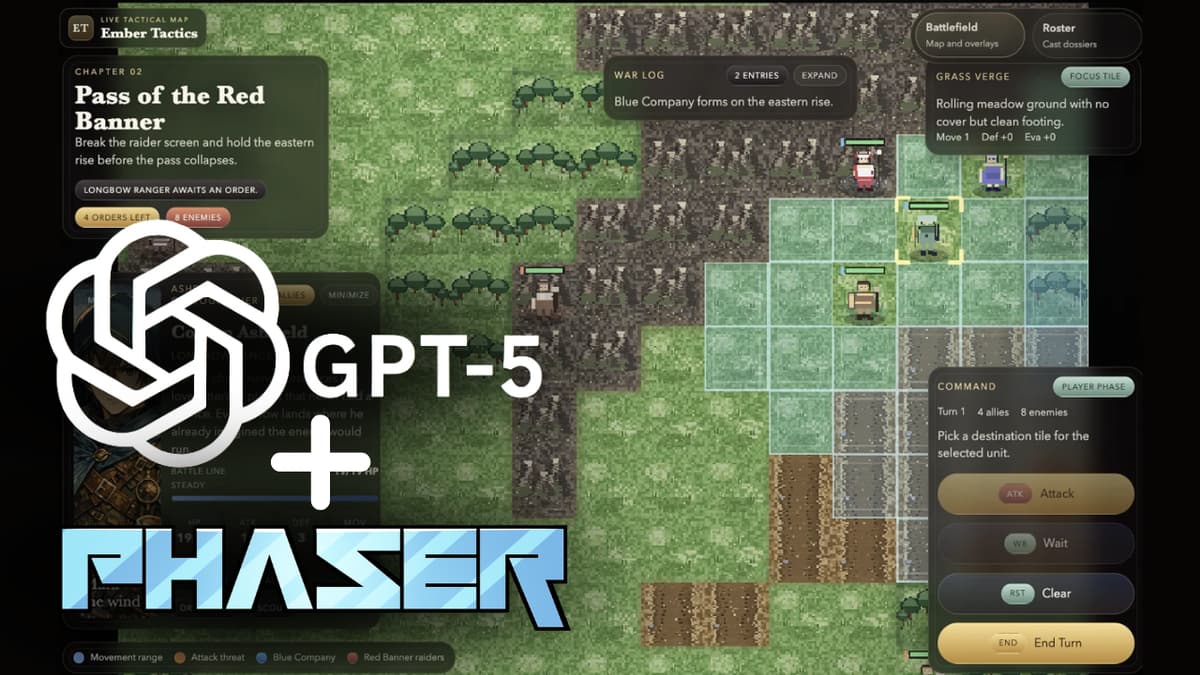
The demo proves AI can dramatically accelerate game development cycles, lowering entry barriers for indie studios and expanding Phaser’s utility. It signals a shift toward AI‑driven content creation across the interactive entertainment industry.
Key Takeaways
- •GPT‑5.4 generated a full tactical RPG in hours.
- •Built entirely on the open‑source Phaser framework.
- •AI wrote, tested, and refined code iteratively.
- •Demo accessible instantly via web browser.
- •API access enables developers to replicate workflow.
Pulse Analysis
The release of GPT‑5.4 marks a notable leap in generative AI, extending beyond natural language to full‑stack software creation. By integrating Codex for code synthesis and Playwright for automated testing, OpenAI demonstrated that a sophisticated turn‑based RPG can be assembled in a matter of hours rather than weeks. This capability reflects advances in model size, contextual understanding, and multimodal output, allowing developers to request not just snippets but complete, runnable applications with visual assets generated on the fly.
For the Phaser community, the showcase serves as both a proof of concept and a practical template. Phaser, known for its lightweight, HTML5‑centric architecture, now benefits from an AI partner that can draft gameplay mechanics, UI layouts, and asset pipelines without manual coding. Indie teams can prototype mechanics overnight, iterate based on AI feedback, and reduce reliance on specialized programmers. The open‑source nature of Phaser combined with GPT‑5.4’s API access creates a feedback loop where developers can fine‑tune prompts to match their artistic vision, accelerating time‑to‑market and fostering experimentation.
Beyond individual frameworks, GPT‑5.4 hints at a broader industry transformation where AI assistants become co‑developers. Studios may allocate human talent toward design and narrative while delegating repetitive coding tasks to models, reshaping project budgets and timelines. However, this shift raises questions about code quality, maintainability, and intellectual property. As AI‑generated code proliferates, standards for verification and ethical use will become critical. Nonetheless, the tactical RPG demo underscores a future where AI‑augmented development is not a novelty but a mainstream productivity engine.
OpenAI built a Tactical RPG with Phaser
0
Comments
Want to join the conversation?
Loading comments...