Companies Mentioned

Why It Matters
The demo proves AI‑driven development can compress months of work into hours, reshaping game production timelines and lowering entry barriers for indie creators.
Key Takeaways
- •Live AI-driven game built in six hours.
- •Rust backend with SpacetimeDB enables real-time sync.
- •Gemini AI creates sprites, reducing art time.
- •GPT‑5.2 handles bug fixes and code reviews.
- •Multi‑agent workflow showcases future dev automation.
Pulse Analysis
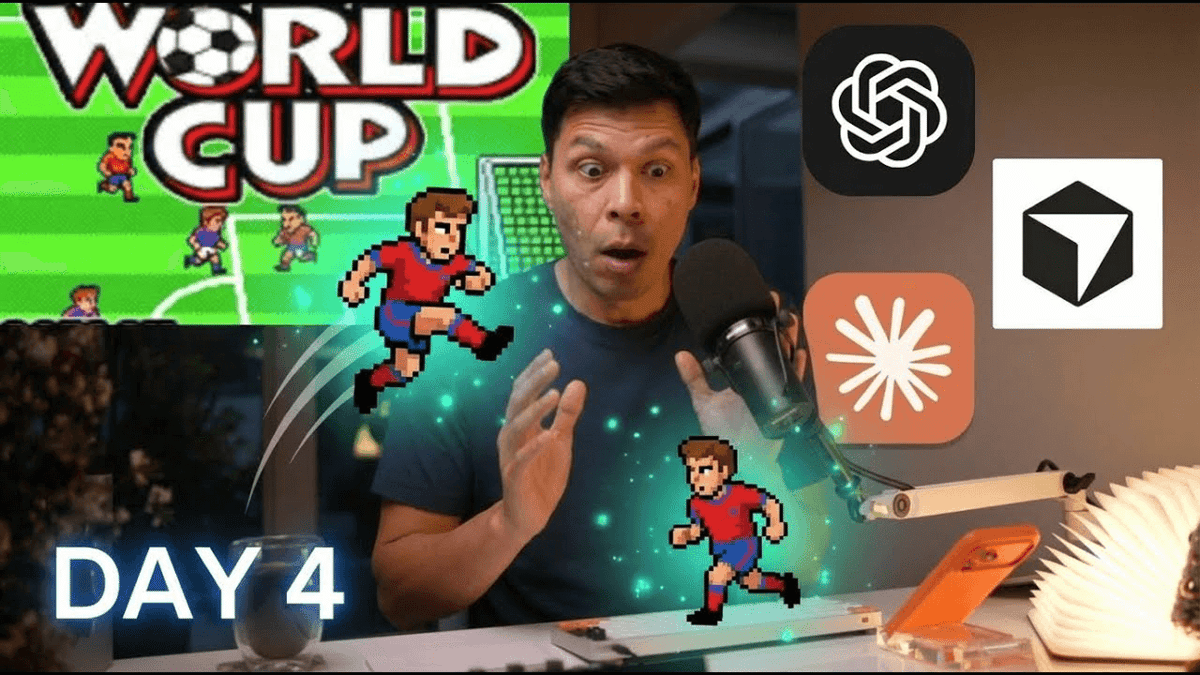
The convergence of generative AI and real‑time streaming is redefining how interactive experiences are built. Ray’s six‑hour live coding session demonstrated that sophisticated multiplayer titles no longer require a seasoned team; instead, a coordinated network of specialized agents can handle design, coding, and testing on the fly. By broadcasting the entire process, the project also highlighted the educational potential of transparent, AI‑augmented development, inviting viewers to witness and learn from each decision point.
Technically, the game’s architecture blends modern web frameworks with high‑performance backend services. A Next.js front end delivers a responsive UI, while Phaser 3 handles the physics‑rich rendering of soccer mechanics. The Rust server, synchronized through SpacetimeDB, ensures low‑latency state sharing for up to hundreds of concurrent players. AI agents play distinct roles: Gemini generates pixel‑perfect sprites, reducing art pipelines; Cursor and Droid translate feature specs into code; GPT‑5.2 autonomously identifies bugs, proposes patches, and conducts code reviews; Opus 4.5 crafts a comprehensive architecture blueprint, streamlining project scope and dependencies.
Industry observers see this as a harbinger of AI‑first development pipelines. By offloading routine coding and asset creation to models like GPT‑5.2 and Gemini, studios can accelerate prototyping, cut costs, and iterate faster on gameplay concepts. However, reliance on AI also raises questions about code quality, intellectual property, and the need for human oversight. As AI agents become more capable, the balance between automation and creative direction will shape the next generation of game development workflows.
Opus + GPT-5.2 Game Build
0
Comments
Want to join the conversation?
Loading comments...