Why It Matters
The beta equips developers with AI‑assisted tooling and seamless Phaser 4 migration, accelerating game creation and reducing technical debt for enterprises and indie teams alike.
Key Takeaways
- •Full Phaser 4 support with new filters, Spine runtime, templates.
- •AI integration via MCP connects Claude, Cursor, VS Code instantly.
- •Unbox prefab instances to edit objects independently of originals.
- •Enterprise constraints enforce object relationship rules for large projects.
- •Improved outline performance and new user property types boost productivity.
Pulse Analysis
Phaser Editor v5’s beta launch marks a pivotal moment for the HTML5 game ecosystem, bridging the gap between legacy Phaser 3 projects and the modern capabilities of Phaser 4. By embedding full compatibility, the editor allows studios to adopt the latest engine features—such as advanced filter pipelines and an updated Spine runtime—without forcing a wholesale rewrite. This dual‑track approach reduces migration risk, encouraging broader adoption of newer standards while safeguarding existing codebases.
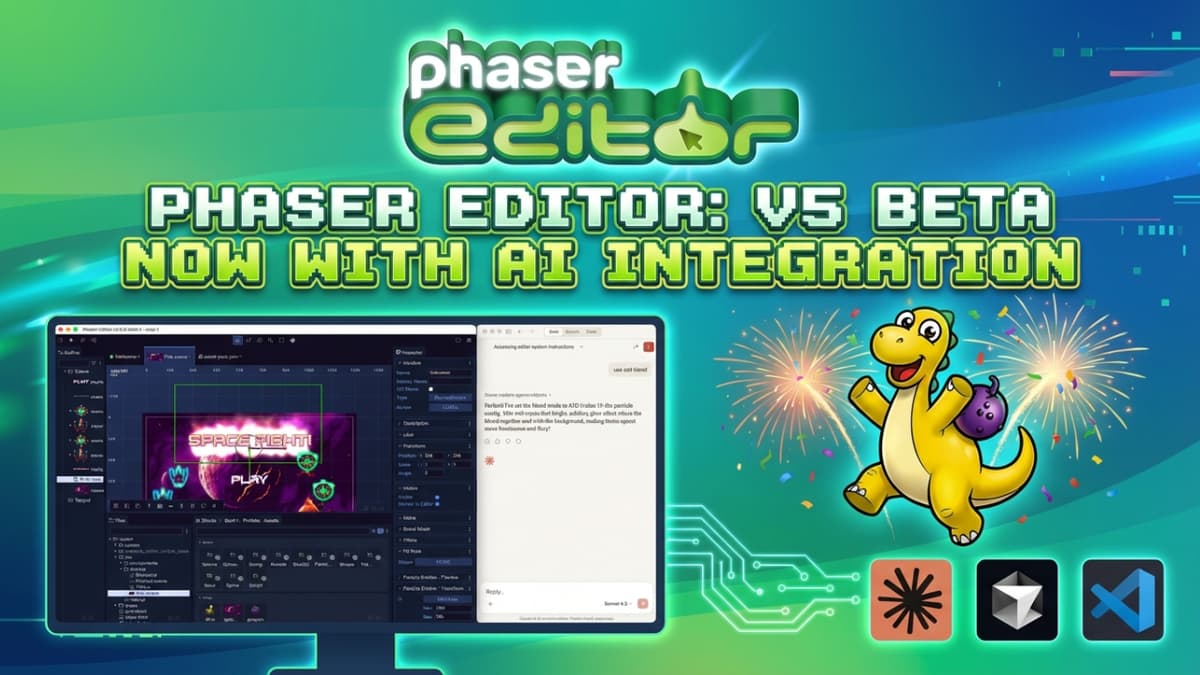
The integration of the Model Context Protocol (MCP) introduces AI‑driven assistance directly into the development workflow. Developers can now summon Claude, Cursor, or VS Code agents to generate particle emitters, suggest object names, or even restructure scenes with a single click. Early tests show these agents can transform prototype sketches into functional gameplay loops, cutting iteration cycles dramatically. As AI tools mature, the editor positions itself as a testbed for next‑generation, code‑augmented design, offering a competitive edge to studios that leverage these capabilities.
Beyond AI, Phaser Editor v5 addresses enterprise needs through robust constraint systems, custom user property types, and performance‑optimized outlines for massive projects. Features like unboxing prefab instances and granular component constraints streamline asset management and enforce architectural consistency across large teams. Coupled with workflow niceties—particle animation editors, tilemap info tools, and enhanced logging—the platform promises measurable efficiency gains. For the broader market, these advancements signal a shift toward more integrated, AI‑enhanced development environments that can scale from indie prototypes to high‑budget productions.
Phaser Editor v5 Beta Now Available
0
Comments
Want to join the conversation?
Loading comments...