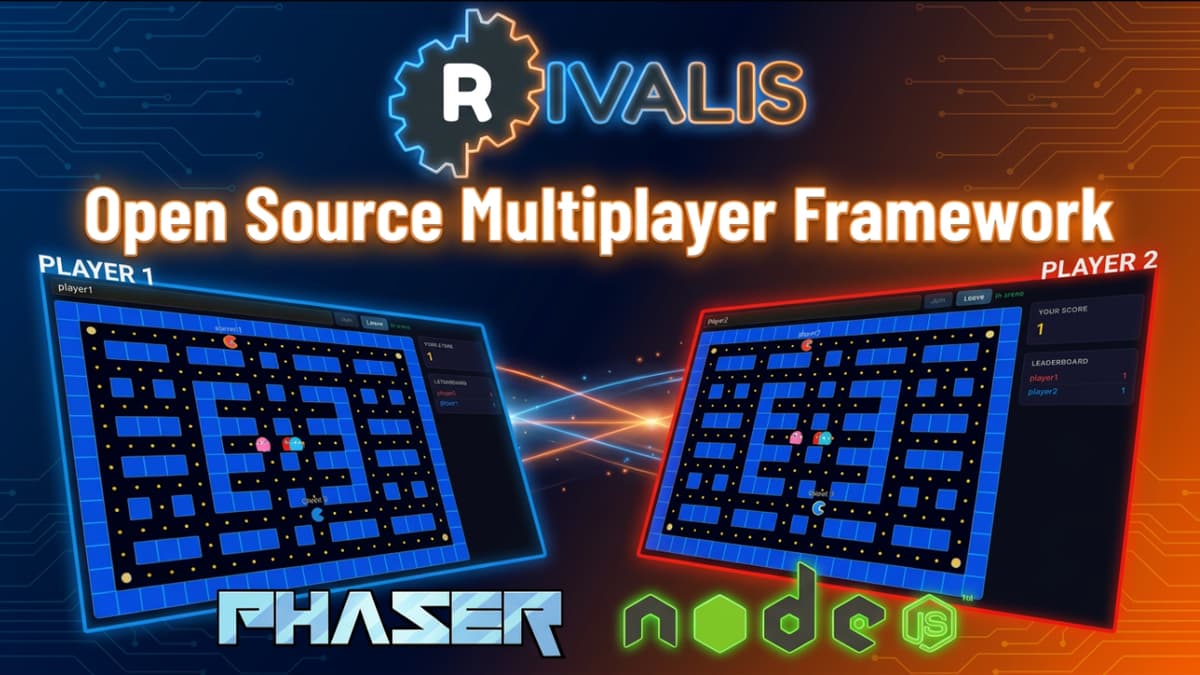
Rivalis: Open Source Multiplayer Framework for Phaser and Node.js
Companies Mentioned
Why It Matters
By abstracting server‑side plumbing, Rivalis lets indie and studio teams launch real‑time multiplayer experiences faster and with fewer security pitfalls. Its open‑source nature lowers entry barriers and encourages community‑driven improvements.
Key Takeaways
- •Rivalis offers rooms, actors, typed messages for real‑time games
- •Built‑in heartbeats, rate limiting, and auto‑reconnect reduce server bugs
- •MIT license ensures free, perpetual use for any project
- •Lower‑level design gives developers full control over payloads
- •AI skill file enables seamless integration with Claude and Cursor
Pulse Analysis
Multiplayer has long been the Achilles’ heel for Phaser developers, who excel at client‑side rendering but often stumble over server‑side state management, authentication, and connection reliability. Rivalis arrives as a purpose‑built Node.js layer that strips away that complexity, offering a clean API centered on rooms and actors. By treating every message as a binary frame with a developer‑defined payload, the framework sidesteps heavyweight schema synchronization while still delivering essential features like token‑bucket rate limiting and heartbeat‑driven disconnect detection. This approach lets teams focus on game mechanics rather than networking boilerplate.
The framework’s architecture mirrors the simplicity of Phaser’s scene system: rooms encapsulate game logic, while actors represent connected players carrying typed authentication data. The @rivalis/browser client automatically handles reconnection with exponential back‑off, ensuring a smooth player experience even on flaky networks. Compared with Colyseus, which leans on automatic state syncing via schemas, Rivalis opts for a more hands‑on model, granting developers granular control over when and how data is transmitted. This makes it especially attractive for titles that require custom compression, proprietary protocols, or tight latency budgets.
Beyond the technical merits, Rivalis’ open‑source MIT license and active GitHub community lower the cost of entry for indie studios and hobbyists. The inclusion of an AI‑ready skill file means developers can leverage tools like Claude Code or Cursor to generate boilerplate or troubleshoot integration issues, accelerating time‑to‑market. As real‑time features such as live leaderboards, collaborative editors, and multiplayer dashboards become standard expectations, frameworks like Rivalis are poised to become foundational building blocks in the modern web‑game ecosystem.
Rivalis: Open Source Multiplayer Framework for Phaser and Node.js
Comments
Want to join the conversation?
Loading comments...