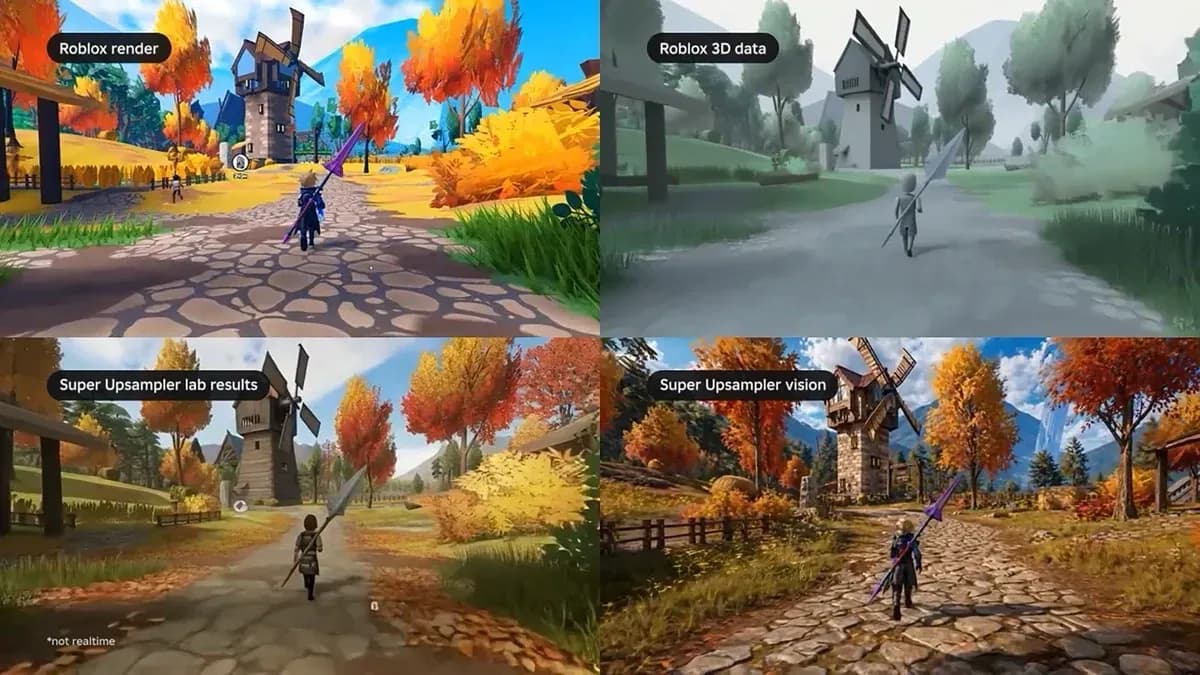
Roblox’s New Reality Mode Shows How Far NVIDIA’s DLSS 5 AI Upscaling Can Push a Simple Game
Companies Mentioned
Why It Matters
By democratizing photorealistic rendering, Roblox could lower development costs and broaden the appeal of high‑quality games to younger, budget‑constrained creators, while signaling broader industry adoption of AI upscaling.
Key Takeaways
- •Roblox Reality combines cloud‑edge GPU upscaling with on‑device rendering.
- •DLSS 5 Lite aims for photorealism without high‑end consumer hardware.
- •Project still in testing; launch expected late 2024 or early 2025.
- •AI upscaling could lower creation costs for indie and youth developers.
Pulse Analysis
NVIDIA’s fifth‑generation Deep Learning Super Sampling (DLSS 5) sparked controversy when it debuted, with many gamers dismissing the AI‑generated visuals as a gimmick. Nonetheless, the technology represents a genuine leap: it reconstructs frames using a neural network trained on high‑resolution data, delivering sharper images while cutting the rasterization workload. Early demos showed dramatic transformations that resembled AI art more than traditional rendering, prompting skeptics to label it the “GPT moment for graphics.” Despite the backlash, the underlying model has proven scalable, prompting developers to explore practical integrations.
Roblox’s “Reality” mode adapts that concept into a hybrid cloud‑edge pipeline. High‑detail assets are rendered on powerful remote GPUs, passed through a Super Upsampler that applies DLSS‑style reconstruction, and delivered via a content‑delivery network as a video stream. The local client then composites the feed with low‑latency avatar updates, preserving interactive responsiveness. By offloading the heavy lifting, the platform can offer near‑photoreal graphics on devices that would otherwise be limited to blocky, low‑poly visuals. The company says the approach could slash development time and compute costs for its creator community, though the service remains in beta.
If Roblox succeeds, AI‑driven upscaling could become a standard tool for any multiplayer platform that relies on user‑generated content. The model promises to level the playing field, allowing indie studios and teenage developers to produce visually competitive experiences without investing in expensive hardware or large art teams. Moreover, the cloud‑edge architecture aligns with the broader industry shift toward streaming‑based game services, where rendering is decoupled from the end‑user device. Expect further experiments from other engines as the line between real‑time graphics and AI‑enhanced post‑processing continues to blur.
Roblox’s new Reality mode shows how far NVIDIA’s DLSS 5 AI upscaling can push a simple game
Comments
Want to join the conversation?
Loading comments...