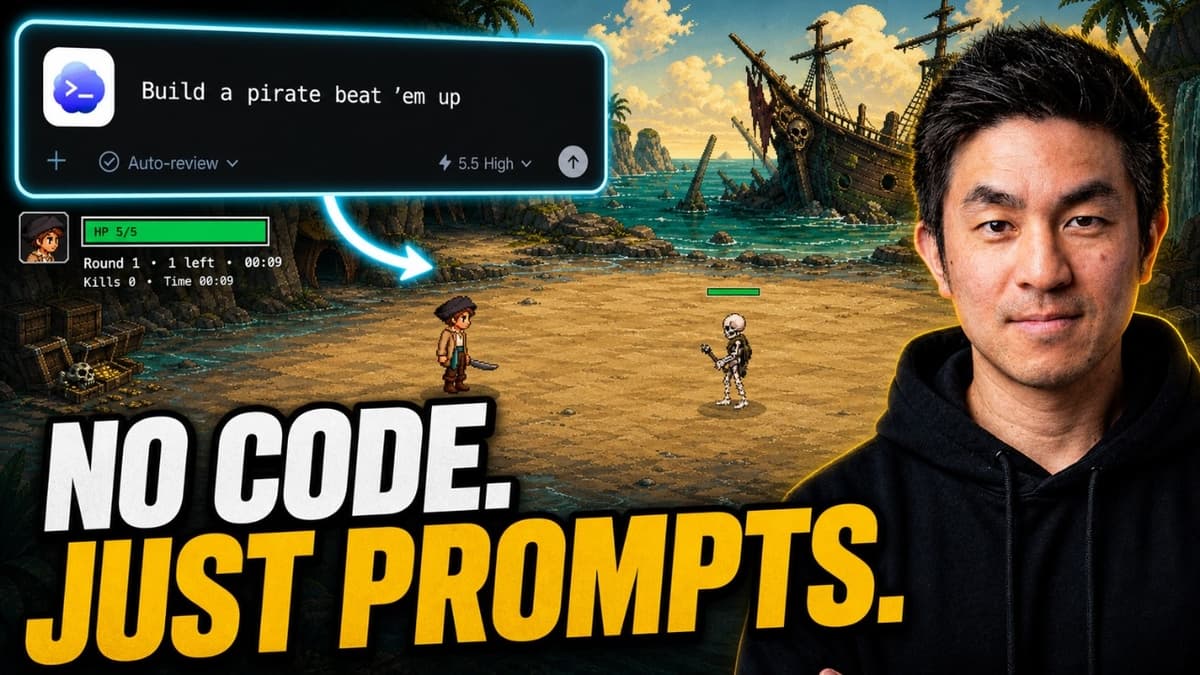
Vibe Code a Complete 2D Beat Em Up Game with Phaser 4 and Codex
Why It Matters
The AI‑first approach slashes development time and lowers technical barriers, signaling a shift toward more accessible indie game creation and faster iteration cycles in the broader gaming industry.
Key Takeaways
- •AI-generated art and sound cut asset creation time dramatically
- •Phaser 4 skill files give Codex precise API context, reducing prompt errors
- •Fibonacci wave scaling creates mathematically balanced difficulty progression
- •Entire game built without hand‑written code, showcasing AI‑first workflow
- •Free tutorial and assets lower entry barrier for indie developers
Pulse Analysis
Artificial intelligence is rapidly reshaping how games are built, and the Vibe Coding tutorial is a prime example of that evolution. By leveraging OpenAI’s Codex alongside Phaser 4’s modular skill files, developers can feed the model exact API knowledge, dramatically reducing trial‑and‑error prompting. The result is a streamlined pipeline where backgrounds, sprites, sound effects, and even music are generated on demand, eliminating the traditional bottleneck of asset creation and allowing teams to focus on design and gameplay loops.
The tutorial also introduces clever technical concepts that enhance both playability and development efficiency. Enemy waves grow using a Fibonacci sequence, delivering a mathematically smooth difficulty curve that feels natural to players. Integrated debugging overlays for hitboxes and attack boxes provide instant visual feedback, while polished touches—screen shake, freeze frames, and particle bursts—are added with minimal code thanks to AI‑generated snippets. This blend of procedural content and precise AI guidance showcases how modern frameworks can deliver high‑quality, production‑ready games without manual coding.
For indie studios and solo creators, the implications are profound. Free access to the full source code and a comprehensive video walkthrough lowers the entry threshold, democratizing game development in a way that mirrors the open‑source software movement. As AI tools become more sophisticated, we can expect a surge in rapid prototyping, shorter time‑to‑market, and a broader diversity of game experiences. Developers eager to stay competitive should explore AI‑augmented workflows now, positioning themselves at the forefront of the next wave of interactive entertainment.
Vibe Code a Complete 2D Beat Em Up Game with Phaser 4 and Codex
Comments
Want to join the conversation?
Loading comments...