Gaming News and Headlines
  • All Technology
  • AI
  • Autonomy
  • B2B Growth
  • Big Data
  • BioTech
  • ClimateTech
  • Consumer Tech
  • Crypto
  • Cybersecurity
  • DevOps
  • Digital Marketing
  • Ecommerce
  • EdTech
  • Enterprise
  • FinTech
  • GovTech
  • Hardware
  • HealthTech
  • HRTech
  • LegalTech
  • Nanotech
  • PropTech
  • Quantum
  • Robotics
  • SaaS
  • SpaceTech
AllNewsDealsSocialBlogsVideosPodcastsDigests

Gaming Pulse

EMAIL DIGESTS

Daily

Every morning

Weekly

Sunday recap

NewsDealsSocialBlogsVideosPodcasts
GamingNewsVulkan-Based Translation Layer D7VK Officially Expands to Include Direct3D 5 Support
Vulkan-Based Translation Layer D7VK Officially Expands to Include Direct3D 5 Support

Gaming

Vulkan-Based Translation Layer D7VK Officially Expands to Include Direct3D 5 Support

•February 9, 2026
0
GamingOnLinux
GamingOnLinux•Feb 9, 2026

Why It Matters

The addition of D3D5 support broadens the library of playable legacy games on Linux, strengthening the open‑source gaming ecosystem and reducing reliance on Windows emulation. This enhances both developer confidence and user experience for retro‑gaming enthusiasts.

Key Takeaways

  • •D7VK v1.3 adds Direct3D 5 support.
  • •Supports D3D5, D3D6, D3D7 for legacy games.
  • •FSAA emulation now optional, reduces memory bandwidth.
  • •Fixed FPU mode bug improving rendering in D3D5/6 titles.
  • •Enables smoother texture loading and reduces corruption.

Pulse Analysis

The rise of Vulkan‑based translation layers has reshaped Linux gaming by converting legacy Direct3D calls into modern GPU instructions. D7VK, a fork of the popular DXVK project, targets the older Direct3D 5‑7 APIs that many late‑90s and early‑2000s titles rely on. By leveraging Vulkan’s cross‑platform efficiency, D7VK enables these games to run with lower overhead than traditional Wine implementations, offering a more native feel for enthusiasts who prefer open‑source stacks.

Version 1.3 brings several technical refinements that matter to power users. Optional FSAA emulation now activates only when a game explicitly requests it, cutting memory bandwidth consumption and avoiding unnecessary multisample overhead. Logging variables have been namespaced with the D7VK_ prefix, simplifying diagnostics alongside DXVK. Crucially, a long‑standing FPU mode bug affecting D3D5/6 titles has been patched, eliminating visual artifacts in games like Legacy of Kain: Soul Reaver and Homeworld: Emergence. Texture‑loading pathways have also been optimized, reducing corruption and boosting frame rates in demanding classics such as Drakan and Freespace 2.

From a market perspective, expanding D7VK’s API coverage strengthens Linux’s appeal to retro‑gaming communities and developers seeking broader audience reach. As more titles become playable without Windows, the ecosystem gains credibility, encouraging further investment in compatibility layers and driver support. The momentum generated by D7VK’s updates signals a maturing open‑source gaming stack that can rival proprietary solutions for both nostalgia‑driven and niche commercial projects.

Vulkan-based translation layer D7VK officially expands to include Direct3D 5 support

By Liam Dawe · 9 Feb 2026 at 11:11 am UTC

The Vulkan‑based translation layer D7VK has version 1.3 out now, which officially expands it to also cover Direct3D 5 support for running more games on Linux. So now it supports Direct3D 5, 6 and 7. Impressive work for the DXVK fork focusing on older versions of Direct3D!

You would pair this up with Wine / Proton, to hopefully give improved accuracy and performance in certain older games compared to plain Wine.

As announced by the developer:

I'm afraid we've run out of 3DMark versions at this point, and the Final Reality benchmark isn't yet workable, however this release officially introduces support for D3D5. Don't worry, you won't run into any GPU‑related performance limitations in this cursed land of our 3D forefathers, no matter what you use for translation to more modern APIs. Mind you, in the vast majority of cases you're better off using the Glide renderers that nearly all such late last century games offer as an alternative.

In addition to that, the D3D7/D3D6 sides have also seen a fair share of fixes and improvements (see below).

Fixes/additions:

  • Starting with v1.3 we are opting in to FSAA emulation, rather than enabling it globally by default and keeping it disabled until the game decides to use it (or not). That will save quite a bit of memory bandwidth, since it does away with multi‑sampled surface use, unless a game is known to offer support for FSAA. You can still force‑enable FSAA emulation at your leisure, of course, however note that AMD users may run into issues with it in some cases due to a known driver limitation around 16‑bit texel buffers.
  • Also starting with v1.3 logging verbosity and log file path environment variables are prefixed with D7VK_, to allow for better logging segregation between D7VK and DXVK.
  • Thanks to @CkNoSFeRaTU, an obscure FPU mode setup bug that affected all D3D6/5 titles was spotted and fixed. The new way of handling things has done away with glaring rendering issues in titles such as Legacy of Kain: Soul Reaver (yes, Raziel is finally play‑worthy, as he should be!), Homeworld: Emergence (aka Cataclysm) and subtle precision issues in many others.
  • Fixed a D3D6/5 texture‑loading oversight which prevented us from hitting an optimal level of performance in many D3D6 titles (e.g. Drakan: Order of the Flame, Freespace 2 and Arabian Nights) and sometimes caused texture corruption.
  • Thanks again to the now‑notorious detective skills of @CkNoSFeRaTU, we've managed to do away with our proxy‑interface workaround, which technically enables various games to run under Windows (e.g. Gothic 1/2, Ground Control, No One Lives Forever, Blood 2: The Chosen and other LithTech engine games) and ensures intro videos and other back‑buffer surfaces used by these games are displayed properly.
  • Finalized an assortment of DDraw legacy‑surface groundwork, which was needed to properly support various D3D5 games.

A few of the titles noted to work well with it include:

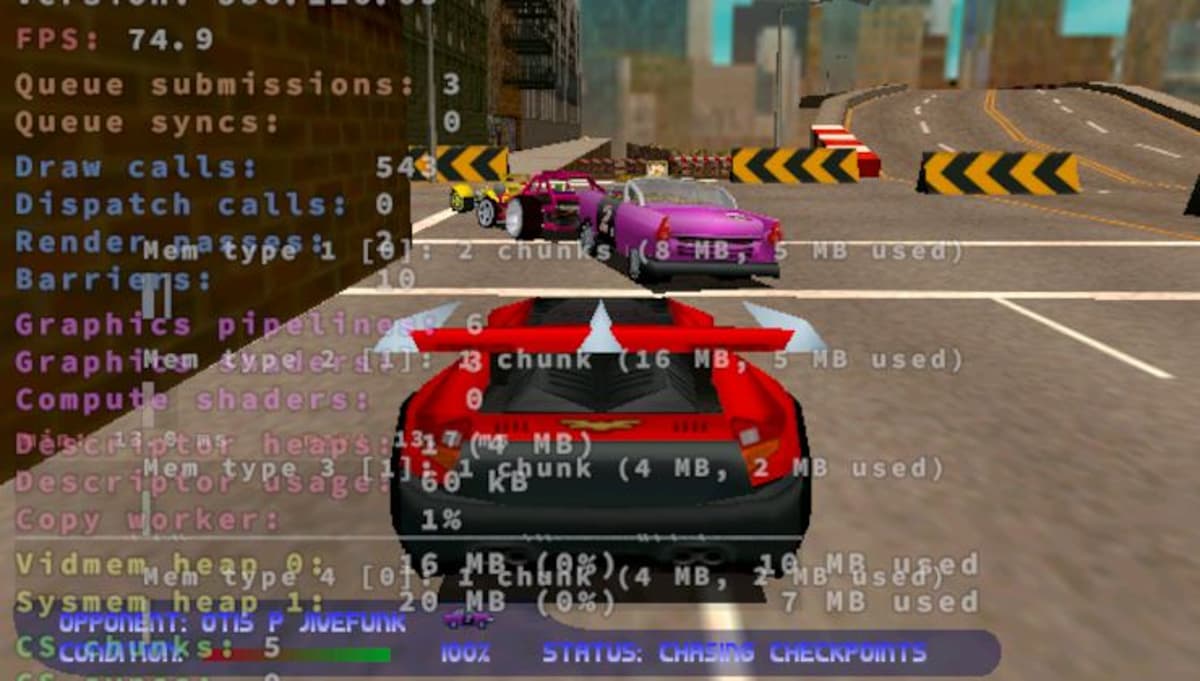
  • Carmageddon II: Carpocalypse Now

  • Tomb Raider II

  • Mortal Kombat 4

  • Nightmare Creatures

  • N.I.C.E 2

  • Mobil 1 Rally Championship

  • Deathtrap Dungeon

  • Lands of Lore III

Screen capture from a racing game featuring an NVIDIA GeForce RTX 4070, showing game statistics overlaid on the game world, with cars racing on an urban track

Pictured – Carmageddon II: Carpocalypse Now

Source: GitHub

Read Original Article
0

Comments

Want to join the conversation?

Loading comments...