CONTEXT Report Shows Decline in Professional 3D Printers as Entry-Level Segment Surges
Key Takeaways
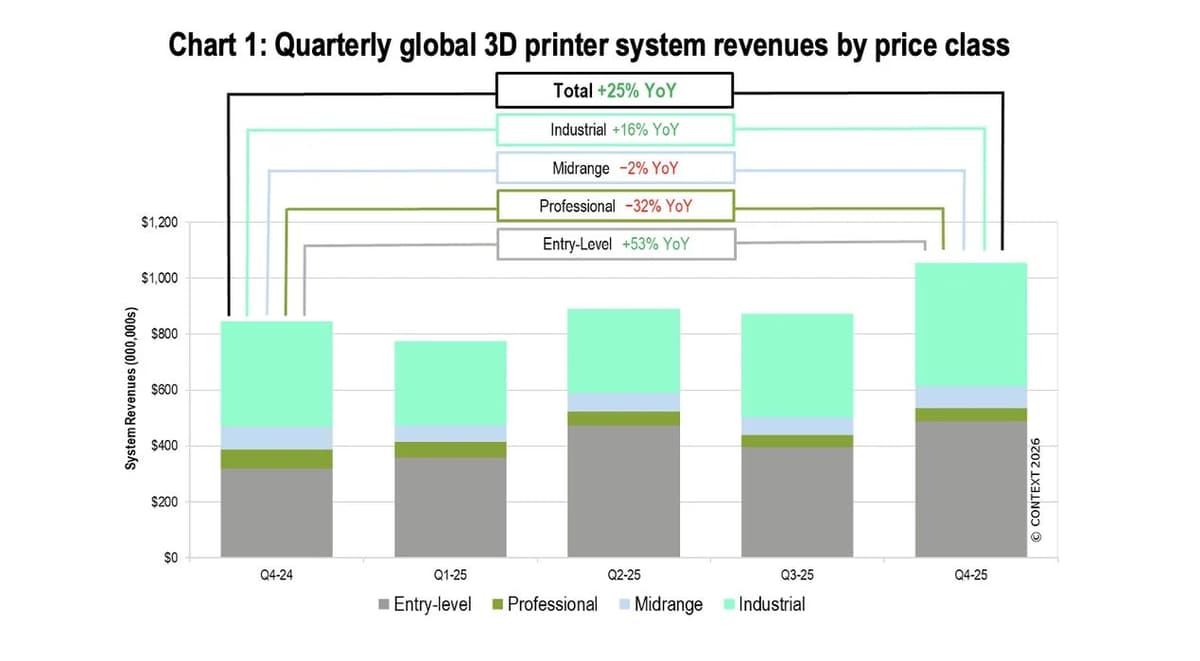
- •Professional 3D printer sales fell >30% YoY.
- •Entry‑level printers grew >50% in same period.
- •Industrial segment topped $1 billion in Q4‑25.
- •Midrange sales stayed flat over the past year.
- •Professional resin printers held steady while extrusion fell.
Pulse Analysis
The latest CONTEXT data underscores a structural realignment in additive manufacturing. Entry‑level printers, now priced under $2,500, have become sophisticated enough to perform tasks once reserved for professional machines, prompting a 50%+ sales surge. This democratization is fueled by user‑friendly interfaces and broader consumer awareness, eroding the traditional price‑performance gap. Consequently, the professional segment—historically anchored by material‑extrusion (FFF) systems—has seen a 30% decline, signaling a market correction rather than a temporary dip.
Industrial adopters, particularly in aerospace and defense, continue to drive robust growth, pushing the segment above the $1 billion threshold in the most recent quarter. Metal 3D printing and high‑volume production capabilities remain exclusive to this tier, reinforcing its strategic importance despite overall market turbulence. Meanwhile, the midrange bracket (US$20,000‑$100,000) has plateaued, reflecting a migration of budget‑constrained buyers toward cheaper alternatives and a concentration of high‑value contracts within the industrial space.
For professional‑grade manufacturers, the outlook demands rapid innovation or consolidation. Companies that can integrate advanced features—such as multi‑material extrusion or high‑resolution resin processing—into cost‑effective platforms may survive the transition. Others risk obsolescence as consumer‑grade devices encroach on their niche. Buyers, however, stand to benefit from increased capability at lower prices, accelerating adoption across education, prototyping, and small‑scale production. Stakeholders should monitor how the professional category evolves, as its potential disappearance could reshape supply chains and competitive dynamics in the broader 3D‑printing ecosystem.
CONTEXT Report Shows Decline in Professional 3D Printers as Entry-Level Segment Surges
Comments
Want to join the conversation?