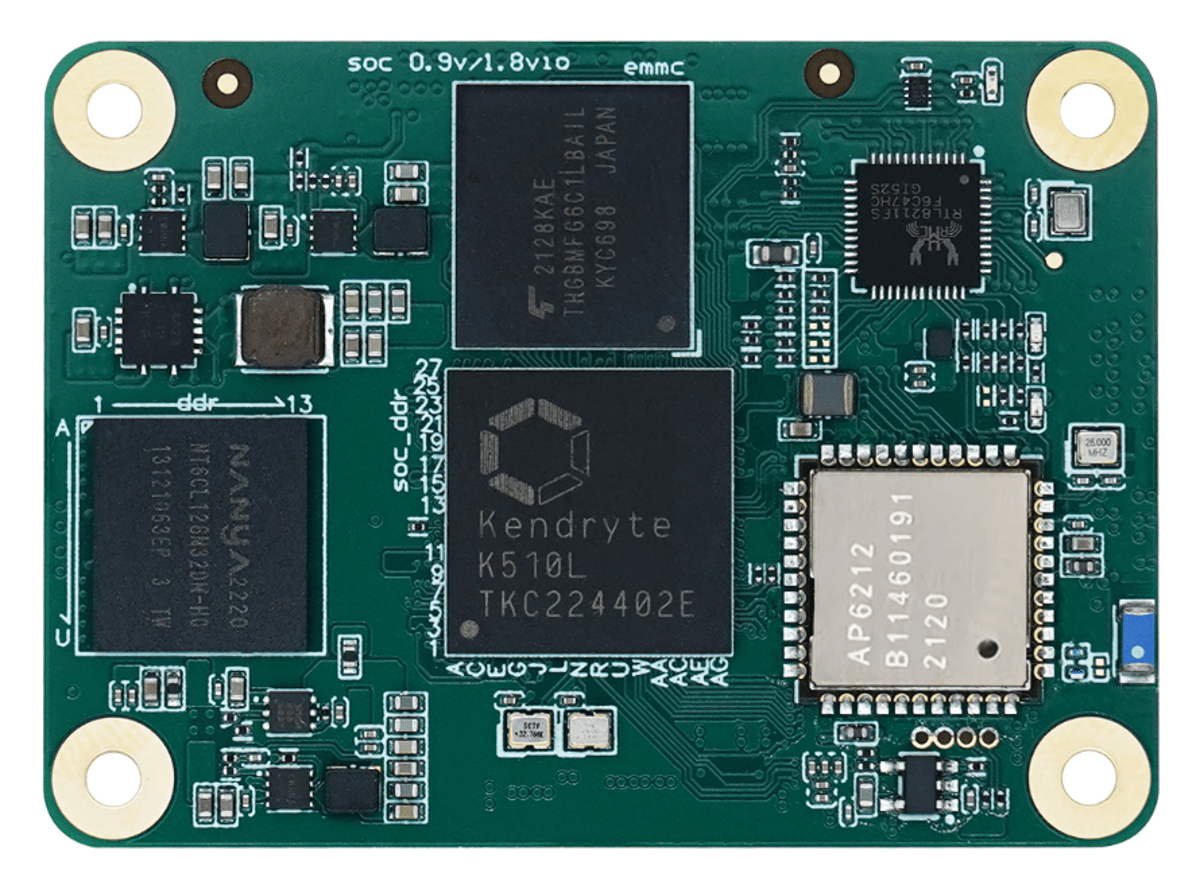
DongshanPI K510 SoM Appears with Dual RISC-V Cores and AI Acceleration
Key Takeaways
- •Dual‑core 64‑bit RISC‑V CPUs run up to 800 MHz.
- •Second‑gen KPU delivers up to 1.22 TOPS INT8 performance.
- •Supports LPDDR3/4, MIPI CSI/DSI, Gigabit Ethernet, Wi‑Fi, Bluetooth.
- •Hardware security includes AES, SHA, TRNG, and OTP.
Pulse Analysis
RISC‑V’s open‑source architecture is rapidly maturing into a mainstream choice for edge computing, and DongshanPI’s K510 System‑on‑Module exemplifies that shift. By pairing two 800 MHz 64‑bit cores with a dedicated DSP, the board offers a balanced mix of general‑purpose processing and signal‑processing capabilities, essential for real‑time video and audio pipelines. The inclusion of LPDDR3/4 memory and flexible camera interfaces such as MIPI CSI and DVP means developers can integrate high‑resolution sensors without additional bridge chips, streamlining product design cycles.
The standout feature is the second‑generation KPU, which pushes 1.22 TOPS of INT8 or 1.22 TFLOPS of BF16 compute. Compared with competing AI accelerators from Nvidia Jetson or Google Coral, the KPU delivers comparable inference throughput at a fraction of the power budget, making it ideal for battery‑operated devices and remote installations. Its on‑chip 2 MB SRAM dedicated to AI workloads reduces memory bottlenecks, enabling smoother execution of convolutional neural networks for tasks like object detection, speech recognition, and anomaly detection.
From a market perspective, the K510 SoM could accelerate adoption of RISC‑V in sectors traditionally dominated by ARM‑based solutions. Its extensive I/O suite—including Gigabit Ethernet, USB 2.0 OTG, Wi‑Fi, and Bluetooth—covers the connectivity needs of smart cameras, industrial sensors, and autonomous edge nodes. While pricing remains unknown, the module’s feature set positions it as a cost‑effective alternative for OEMs seeking to differentiate products with on‑device AI while maintaining security through built‑in AES, SHA, TRNG, and OTP modules. As the AIoT ecosystem expands, developers will likely gravitate toward such integrated solutions that lower bill‑of‑materials and simplify firmware development.
DongshanPI K510 SoM appears with dual RISC-V cores and AI acceleration
Comments
Want to join the conversation?