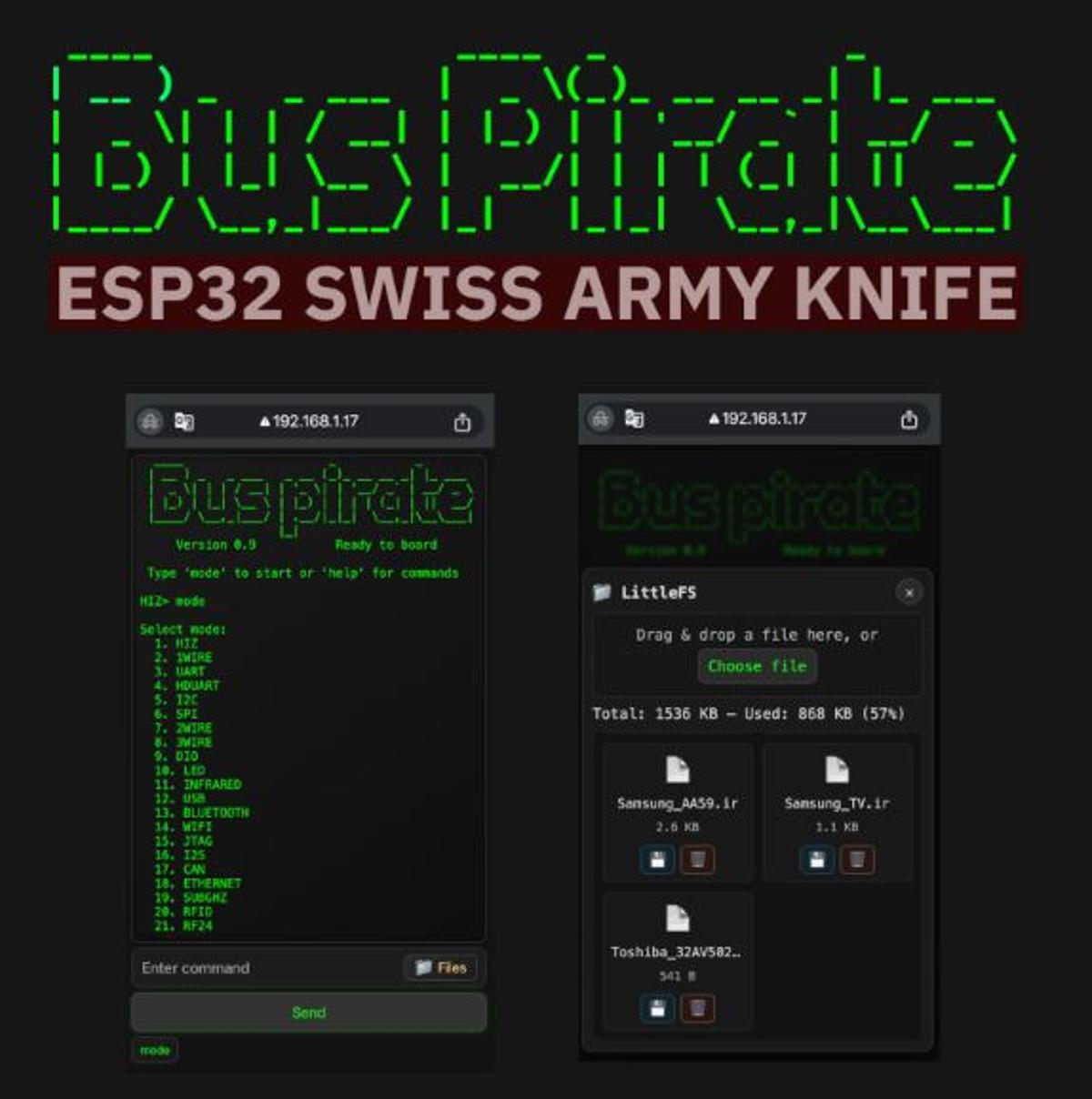
ESP32 Bus Pirate Update Adds RF Tools, USB Host Mode, Signal Analysis, and Cellular Plans
•February 20, 2026
0
Why It Matters
The expanded capabilities turn a cheap ESP32 board into a multi‑protocol debugger and RF experimenter, reducing reliance on expensive dedicated equipment. This accelerates prototyping cycles and broadens accessibility for hardware engineers.
Key Takeaways
- •New profile system saves pin configurations.
- •Wizard tool analyzes pin activity and signal patterns.
- •UART now auto-detects lines, autobaud, emulates devices.
- •Firmware supports ESP32S3-DevKit N16R8 and M5Stack StickS3.
- •Upcoming FM, cellular, 5 GHz Wi‑Fi, voltage adapter.
Pulse Analysis
The classic Bus Pirate has long been a staple for hobbyists and professionals needing a simple, open‑source interface to probe I²C, SPI, UART, and 1‑Wire buses. By re‑imagining the tool on an ESP32‑S3, the community gained a programmable, Wi‑Fi‑enabled platform that can be flashed with custom firmware, dramatically lowering the entry barrier for hardware debugging and education. As embedded systems grow more complex, affordable, software‑driven test equipment becomes a strategic asset for startups and large enterprises alike.
The latest firmware release pushes the ESP32 Bus Pirate beyond basic bus sniffing. A new profile system lets users store complete pin configurations, enabling rapid swaps between test rigs. The Wizard analyzer visualizes pin activity, automatically flagging PWM bursts, noise spikes, or data frames, while the enhanced UART stack now detects line parameters, performs autobaud, and can emulate peripherals such as GPS modules. Expanded flash (4.5 MB) and support for additional dev kits like the ESP32S3‑DevKit N16R8 and M5Stack StickS3 broaden the hardware ecosystem, making the tool suitable for both classroom labs and professional R&D labs.
Looking ahead, the roadmap includes FM radio, 2G/3G/4G cellular modules, and 5 GHz Wi‑Fi, effectively turning the Bus Pirate into a multi‑modal RF sandbox. These additions align with the rapid growth of IoT devices that require on‑the‑fly connectivity testing and spectrum analysis. By integrating cellular and high‑frequency Wi‑Fi capabilities, developers can validate end‑to‑end communication stacks without purchasing separate analyzers, accelerating time‑to‑market and reducing capital expenditure. The ESP32 Bus Pirate’s evolution exemplifies how open‑source hardware can challenge traditional, costly test equipment while fostering a collaborative ecosystem.
ESP32 Bus Pirate Update Adds RF Tools, USB Host Mode, Signal Analysis, and Cellular Plans
0
Comments
Want to join the conversation?
Loading comments...