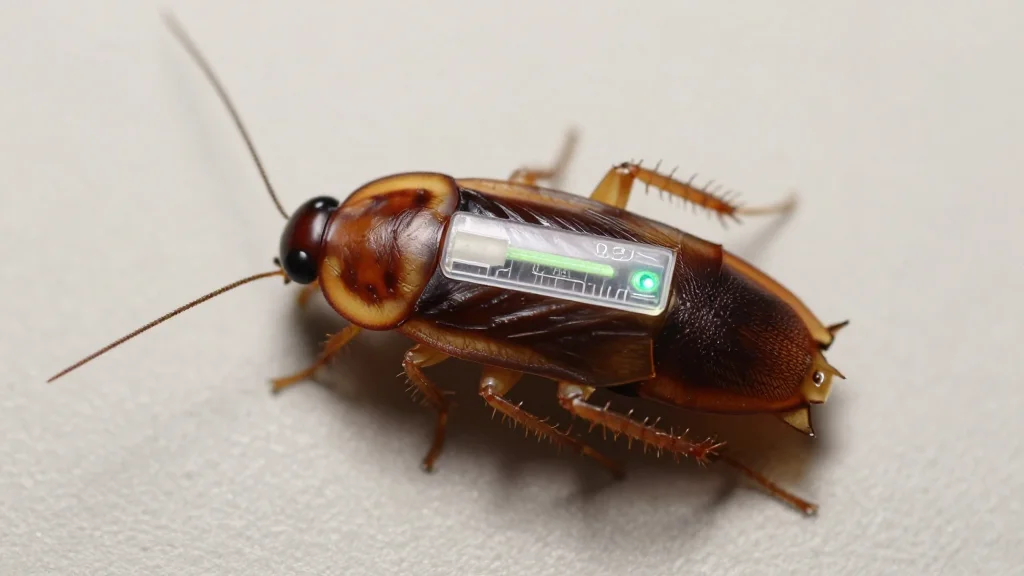
Fully Implanted Miniature Radio Controller Boosts Cyborg Insect Mobility in Challenging Terrains
Key Takeaways
- •Implant size 10 mm × 10 mm × 3 mm, weight 0.5 g.
- •Success rate 90% in obstacle course, matching intact insects.
- •Backpack version drops success to 15% on simple gap.
- •Implant improves survivorship to 86% after surgical refinement.
- •Automated navigation algorithm achieves 90.9% target reach in trials.
Pulse Analysis
The field of bio‑robotics has long wrestled with the trade‑off between sensor payload and the animal’s innate mobility. By embedding a sub‑1 GHz radio controller and battery directly into a cockroach’s abdomen, the researchers eliminated external bulk that traditionally disrupts the insect’s streamlined profile. The silicone‑coated board is biocompatible, and the implantation process—performed by a custom robotic arm in just 25 seconds—achieves a 100% insertion success rate, setting a new benchmark for minimally invasive bio‑augmentation.
Performance data underscore the practical advantage of full implantation. In a series of terrain challenges, implanted cockroaches navigated an 8‑mm vertical gap with a 90% success rate, comparable to unmodified insects and markedly superior to the 15% success observed when the same hardware was carried as a backpack. Across more complex obstacles—stacked bricks, tangled cables, and narrow slits—implants maintained high traversal rates (up to 95%) and faster completion times, confirming that preserving the insect’s natural gait translates directly into operational reliability. The integrated navigation algorithm, which triggers antenna or cerci stimulation based on speed and heading, achieved a 90.9% target‑reach success across 66 trials, illustrating the system’s potential for autonomous mission execution.
Looking ahead, the team plans to shrink the electronics further, explore bio‑fuel cells or flexible solar films for extended endurance, and embed sensors such as infrared cameras or inertial measurement units. These enhancements could transform cyborg insects into self‑sufficient scouts for post‑disaster structural assessments, underground pipe inspections, or hazardous environment monitoring. As regulatory frameworks evolve around bio‑integrated devices, the demonstrated survivorship boost to 86% and multi‑day operational window position this technology as a commercially viable solution for industries seeking agile, low‑cost, and resilient inspection platforms.
Fully implanted miniature radio controller boosts cyborg insect mobility in challenging terrains
Comments
Want to join the conversation?