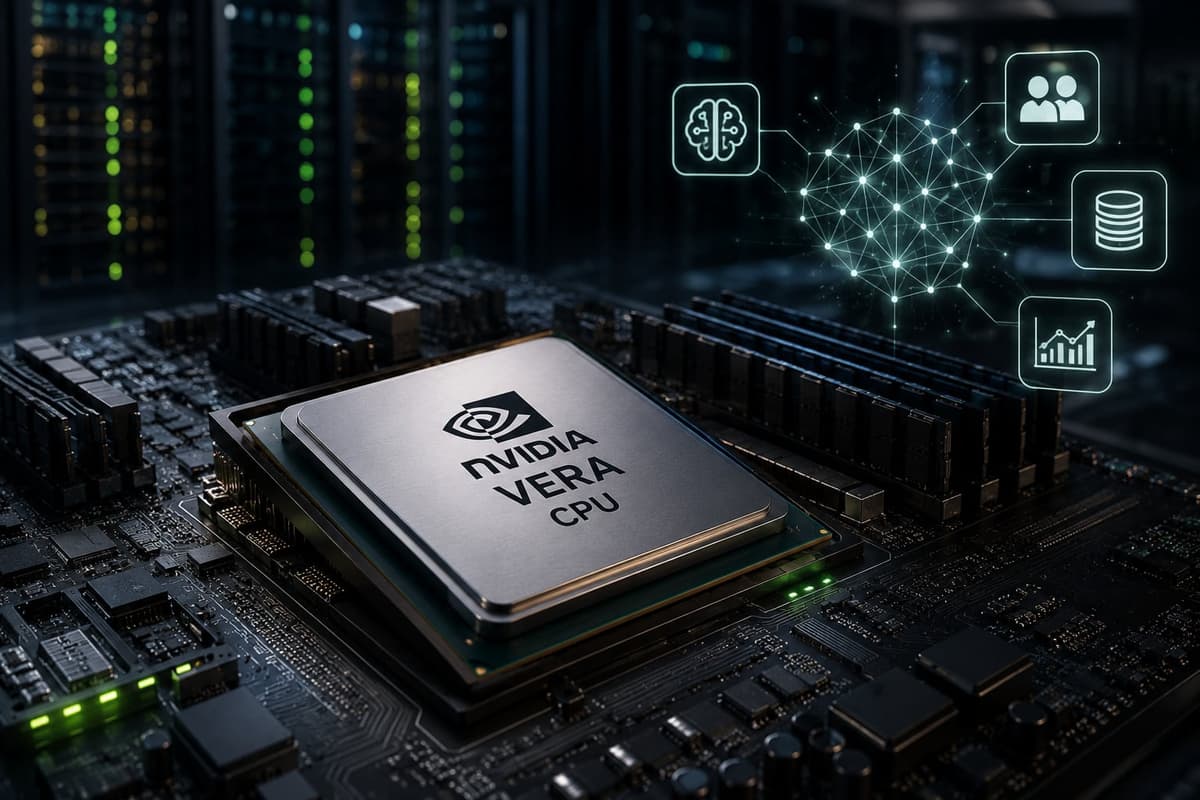
NVIDIA Vera: First In-House CPU Effort Lands with Leading AI Labs
Key Takeaways
- •NVIDIA delivered Vera CPUs to Anthropic, OpenAI, Oracle Cloud, SpaceXAI.
- •Vera features 88 Olympus cores, up to 1.2 TB/s memory bandwidth.
- •Designed for latency‑critical agentic AI workloads, not just GPU acceleration.
- •Supports up to 256 CPUs per rack and 22,500 concurrent environments.
- •Marks NVIDIA’s push to sell complete AI data‑center stacks.
Pulse Analysis
The arrival of NVIDIA’s Vera CPU marks a strategic inflection point for AI infrastructure. While GPUs excel at raw tensor math, modern agentic models require rapid context switches, tool invocation, and sandbox management—tasks traditionally handled by CPUs. Vera’s 88 high‑single‑thread Olympus cores, paired with 1.5 TB of LPDDR5X memory and a 3.4 TB/s scalable coherency fabric, are engineered to keep latency low for these control‑plane operations. By delivering the first systems to leading AI labs, NVIDIA is effectively field‑testing a processor that could become the de‑facto standard for AI‑first data centers.
From a technical perspective, Vera’s architecture diverges from conventional server CPUs. Its spatial multithreading delivers 176 concurrent threads per socket, and the platform can scale to 256 CPUs per rack, supporting more than 22,500 isolated CPU environments. This density targets hyperscale cloud providers that need to run thousands of independent agent instances side‑by‑side with NVIDIA’s own GPUs. The claimed 1.2 TB/s memory bandwidth and massive bisection bandwidth aim to eliminate data‑movement stalls that have plagued mixed CPU‑GPU workloads. Competitors such as AMD’s EPYC and Intel’s Xeon will need to respond with comparable latency‑focused designs or risk losing relevance in the emerging AI‑agent market.
For the broader industry, Vera’s rollout signals that the CPU will regain visibility in AI economics. Companies that adopt Vera may achieve tighter integration between compute and control layers, potentially reducing total cost of ownership if power efficiency and software tooling mature. However, the lack of independent benchmarks means customers must weigh the promise against the risk of higher operational bills. As AI agents become more autonomous, the balance of GPU and CPU performance will dictate the next wave of data‑center architecture, and NVIDIA’s move positions it to capture a larger slice of that future market.
NVIDIA Vera: First in-house CPU effort lands with leading AI labs
Comments
Want to join the conversation?