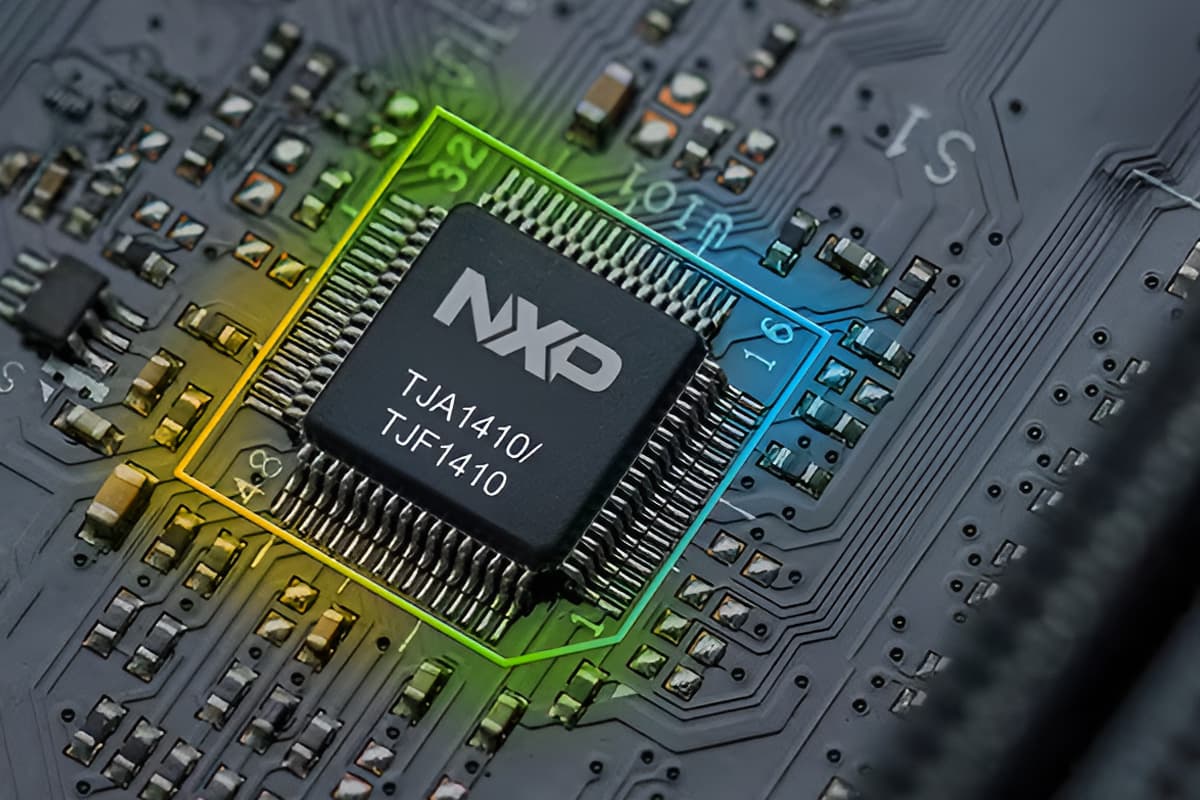
NXP TJA1410 and TJF1410 PMD Transceivers Enable “CAN-Like” Single Pair Ethernet (SPE) Connectivity
•February 25, 2026
0
Why It Matters
The chips enable low‑cost, single‑pair Ethernet that can replace legacy CAN, Modbus and point‑to‑point wiring, accelerating Ethernet adoption at the sensor and actuator layer in automotive and industrial IoT.
Key Takeaways
- •Analog PMD only; digital PHY in host MCU
- •10 Mbps multi‑drop bus up to 32 nodes
- •Supports 100 m single‑pair cable, PoDL compatible
- •Automotive variant ISO 26262 ASIL B compliant
- •Pricing under $1 per unit for 1 K orders
Pulse Analysis
Single‑pair Ethernet (SPE) has emerged as a bridge between traditional field‑bus protocols and full‑blown Ethernet, offering the bandwidth of 10 Mbps while preserving the simplicity of a single twisted‑pair cable. NXP’s decision to split the physical layer into an analog PMD and a host‑integrated digital PHY mirrors a broader industry trend toward modular silicon, allowing system designers to reuse existing microcontrollers or switches rather than adopting monolithic PHYs. This approach reduces component count, eases thermal management, and opens the door for customized firmware optimizations that can be tailored to specific automotive or industrial workloads.
The TJA1410 and TJF1410 transceivers bring concrete advantages to edge networks. Their three‑pin OPEN Alliance interface simplifies board layout and supports power‑over‑data‑line (PoDL), enabling truly low‑power nodes that can be powered from the same pair used for data. Multi‑drop capability—up to 32 devices on a single bus—eliminates the need for costly star topologies and switches at the network edge, making daisy‑chained sensor arrays and actuator clusters more economically viable. Combined with advanced diagnostics such as topology discovery and wake‑up signaling, these PMDs provide the robustness required for automotive safety‑critical systems and harsh industrial environments.
From a market perspective, the sub‑$1 pricing and compliance with ISO 26262 ASIL B position the TJA1410 as an attractive upgrade path for OEMs looking to transition from CAN to Ethernet without inflating bill‑of‑materials. Meanwhile, the industrial‑focused TJF1410 offers a straightforward migration route from Modbus or RS‑485 to Ethernet, facilitating unified data acquisition across legacy equipment. As NXP’s upcoming MCX A microcontrollers embed 10BASE‑T1S digital PHYs, the ecosystem around these PMDs will expand, likely accelerating SPE deployment in next‑generation vehicles, factory automation, and smart‑infrastructure projects.
NXP TJA1410 and TJF1410 PMD transceivers enable “CAN-like” Single Pair Ethernet (SPE) connectivity
0
Comments
Want to join the conversation?
Loading comments...