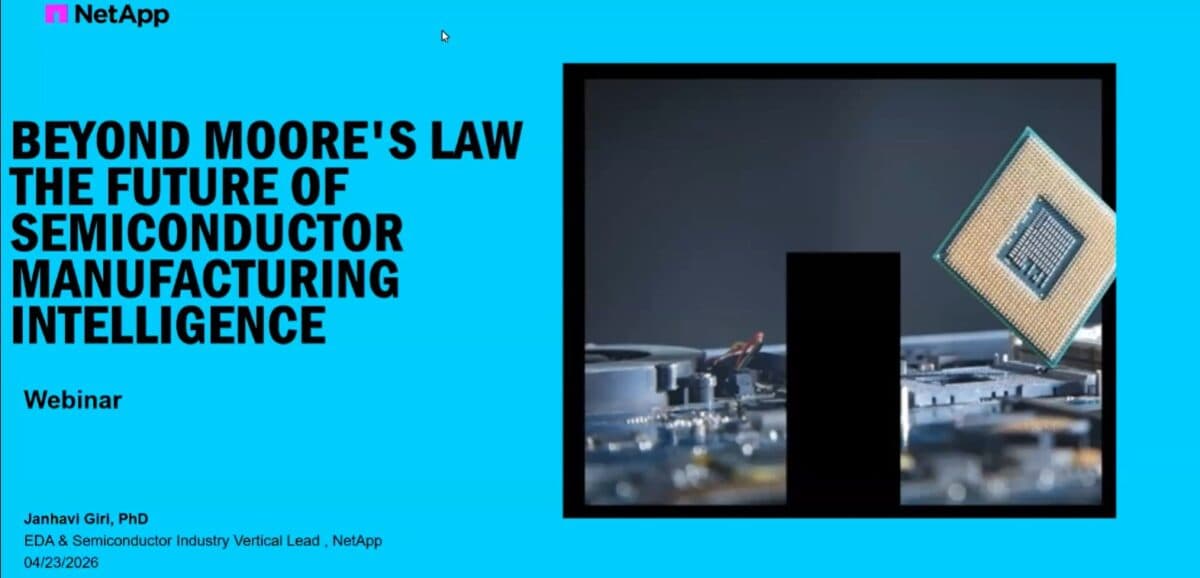
Panel Discission: Beyond Moore’s Law and the Future of Semiconductor Manufacturing
Key Takeaways
- •AI/ML now core to wafer yield optimization.
- •Advanced packaging replaces scaling for AI workloads.
- •Design‑technology co‑optimization shortens chip development cycles.
- •Digital twins enable virtual fab process experimentation.
- •Cybersecurity and supply‑chain visibility critical for AI‑driven fabs.
Pulse Analysis
The end of traditional Moore’s Law scaling is prompting fabs to treat data as a strategic asset. As transistor dimensions approach atomic limits, leakage, thermal and variability issues make further shrink impractical. Modern fabs generate terabytes of sensor and metrology data each day, and machine‑learning models are being deployed to uncover hidden process correlations, predict equipment failures, and dynamically adjust recipes. This data‑centric approach not only lifts overall equipment effectiveness but also reduces costly downtime, keeping capital expenditures in check.
Simultaneously, the industry is betting on advanced packaging and heterogeneous integration to deliver performance gains. Chiplet‑based designs, 2.5D interposers, and 3D‑stacked dies allow manufacturers to combine CPUs, GPUs, memory and accelerators into tightly coupled systems without relying on smaller transistors. For AI and high‑performance computing workloads, bandwidth and latency often matter more than raw transistor count, making these packaging innovations a direct continuation of Moore’s Law. Design‑technology co‑optimization, powered by AI‑assisted EDA tools, accelerates place‑and‑route, power‑integrity and timing closure, shortening development cycles and improving yield.
To unlock the full potential of AI‑driven fabs, robust data infrastructure and security are indispensable. Cloud‑integrated storage, petabyte‑scale parallel file systems, and low‑latency networks support real‑time analytics, digital twins, and collaborative simulation across global engineering teams. Digital twins let manufacturers model process changes virtually, testing scenarios before committing to silicon. At the same time, heightened cyber‑risk and a globally dispersed supply chain demand AI‑enabled visibility and hardened protection of intellectual property. Companies that master this convergence of AI, data engineering, advanced packaging, and security will define the next generation of semiconductor innovation.
Panel Discission: Beyond Moore’s Law and the Future of Semiconductor Manufacturing
Comments
Want to join the conversation?