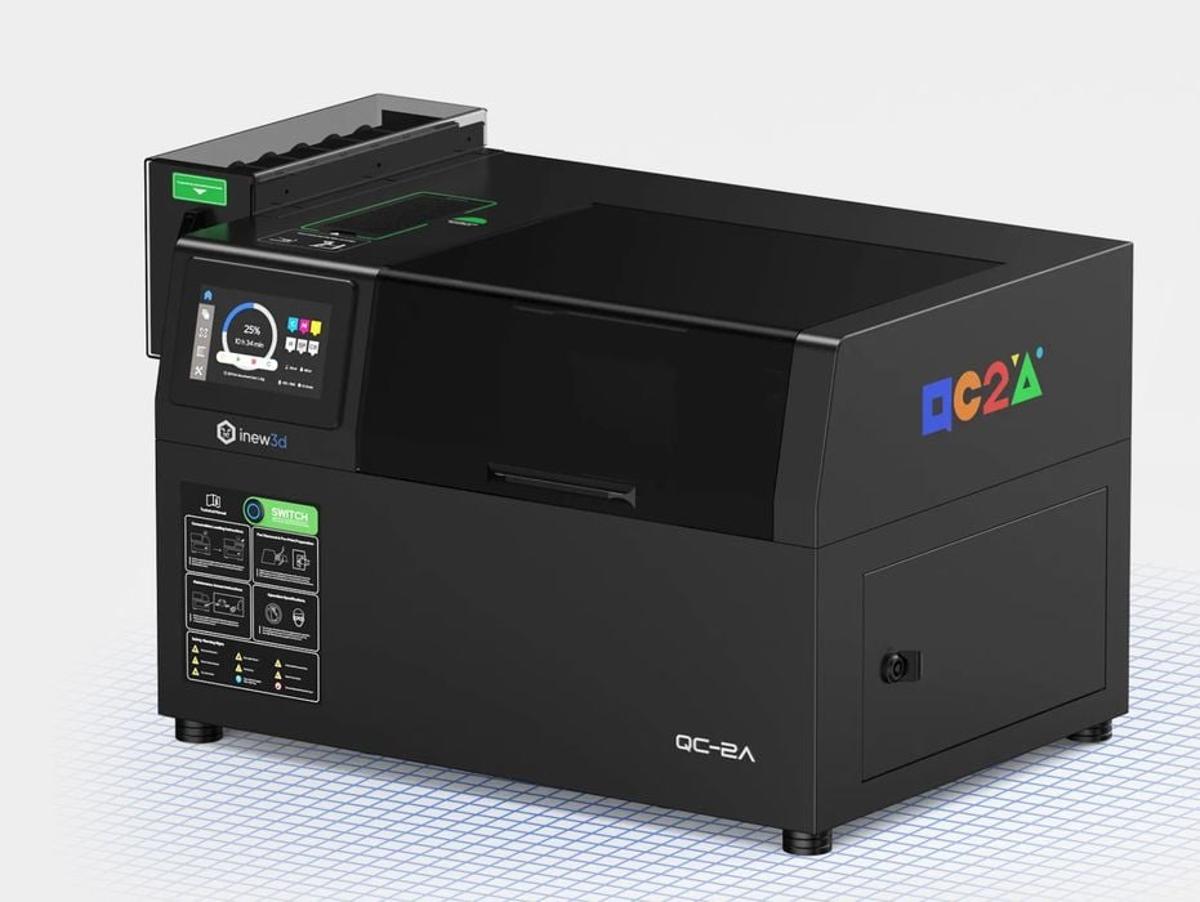
QC2A Desktop 3D Printer Brings Full-Color 3D Printing Below US$10K
•March 9, 2026
0
Key Takeaways
- •QC2A offers full‑color photopolymer jetting under $10K
- •Resolution 720×2880 dpi yields ~0.035 mm detail
- •Six material channels include CMY, white, transparent, soluble support
- •Print cost $1.5–3.5 per unit, resin cheaper
- •Kickstarter launch mitigates risk via prior MSLA experience
Summary
The inew3d QC2A desktop printer, launched on Kickstarter, brings true full‑color photopolymer jetting to the desktop market for under US $10,000. It delivers an unprecedented 720 × 2880 dpi resolution, translating to roughly 0.035 mm detail, and supports six material channels including CMY, white, transparent and water‑soluble support. Pricing targets small businesses, with per‑part resin costs estimated between $1.5 and $3.5. Backed by SIMBA 3D’s existing MSLA experience, the campaign aims to democratize high‑resolution colour printing.
Pulse Analysis
Full‑color 3D printing has long been the domain of industrial giants like Stratasys and Mimaki, whose PolyJet and ink‑jet resin systems command six‑figure price tags. Those platforms excel at voxel‑by‑voxel colour mixing but remain out of reach for most designers, educators, and small manufacturers. The QC2A’s sub‑$10K price point represents a potential inflection moment, positioning true colour gradients alongside more affordable FFF and MSLA technologies and expanding the market’s creative envelope.
Technically, the QC2A adopts photopolymer jetting, a process that deposits micro‑droplets of coloured resin before UV curing. Its 720 × 2880 dpi specification translates to sub‑0.04 mm voxel precision, rivaling high‑end 2D printing optics. Six distinct material channels—CMY, white, transparent, and a water‑soluble support—enable over half a million colour permutations and eliminate the need for toxic solvents. An integrated AI model generator further streamlines workflow, allowing users to create printable colour models on demand, a feature that could accelerate prototyping cycles in product design and custom merchandising.
From a business perspective, the QC2A’s pricing strategy narrows the gap between hobbyist and enterprise. At a Kickstarter price of $7,199 and per‑part resin costs as low as $1.50, small firms can produce bespoke trophies, decorative figurines, and colour‑rich prototypes without outsourcing. While Kickstarter introduces typical launch risk, SIMBA 3D’s track record with MSLA printers and incremental development of microfluidic jetting chips bolsters confidence. If the platform scales, we may witness a cost‑reduction trajectory similar to that of FFF and SLS, ultimately making full‑color additive manufacturing a mainstream capability across diverse industries.
Comments
Want to join the conversation?