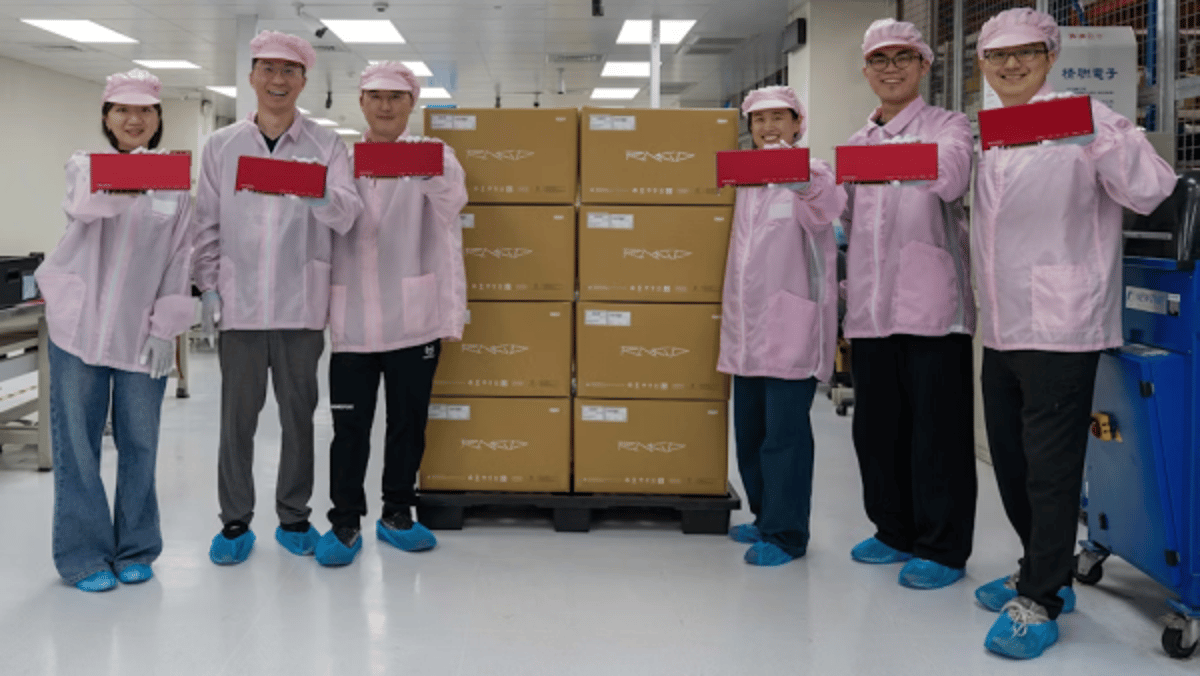
RNGD Enters Mass Production: 4,000 High-Performance AI Accelerators Shipped by TSMC
•February 27, 2026
0
Why It Matters
RNGD provides a power‑efficient alternative to legacy GPUs, lowering data‑center upgrade costs and accelerating enterprise AI inference adoption. Its performance‑per‑watt advantage could reshape the competitive landscape for AI hardware.
Key Takeaways
- •4,000 RNGD chips shipped, first volume silicon run.
- •512 INT8 TFLOPS, 180 W TDP per card.
- •3.5× compute density vs Nvidia H100 in same rack.
- •2.25× better performance‑per‑watt than comparable GPUs.
- •Enables 20 petaFLOPS per rack with five servers.
Pulse Analysis
The AI hardware market has been dominated by power‑hungry GPUs, forcing enterprises to invest heavily in cooling, power delivery, and rack retrofits. As large language models grow in size, the operational cost of running inference workloads on traditional accelerators has become a bottleneck. Furiosa’s RNGD accelerator directly addresses this gap by delivering frontier‑model performance while staying within the power envelope of standard air‑cooled racks, offering a pragmatic path for companies that lack the budget for massive data‑center upgrades.
Technically, RNGD packs 512 INT8 TFLOPS into a 180 W PCIe card, achieving 3.5× higher compute density than Nvidia’s H100 in comparable environments. The accompanying NXT server aggregates eight cards into a 4U chassis, consuming only 3 kW and providing 20 petaFLOPS per rack. A robust SDK adds tensor‑parallelism, torch.compile support, and seamless OpenAI API compatibility, while pre‑compiled models on Hugging Face enable up to 32 K token contexts. These software integrations reduce engineering effort, allowing developers to migrate existing workloads with minimal code changes.
From a business perspective, the shipment of 4,000 units signals a mature supply chain backed by TSMC and ASUS, mitigating the risk of component shortages that have plagued newer AI startups. The superior performance‑per‑watt metrics translate into lower total cost of ownership, making high‑end inference viable for mid‑size enterprises. As competitors scramble to improve efficiency, RNGD’s early market entry could set a new benchmark for sustainable AI compute, prompting data‑center operators to reevaluate hardware strategies and potentially accelerating the broader adoption of generative AI services.
RNGD Enters Mass Production: 4,000 High-Performance AI Accelerators Shipped by TSMC
0
Comments
Want to join the conversation?
Loading comments...