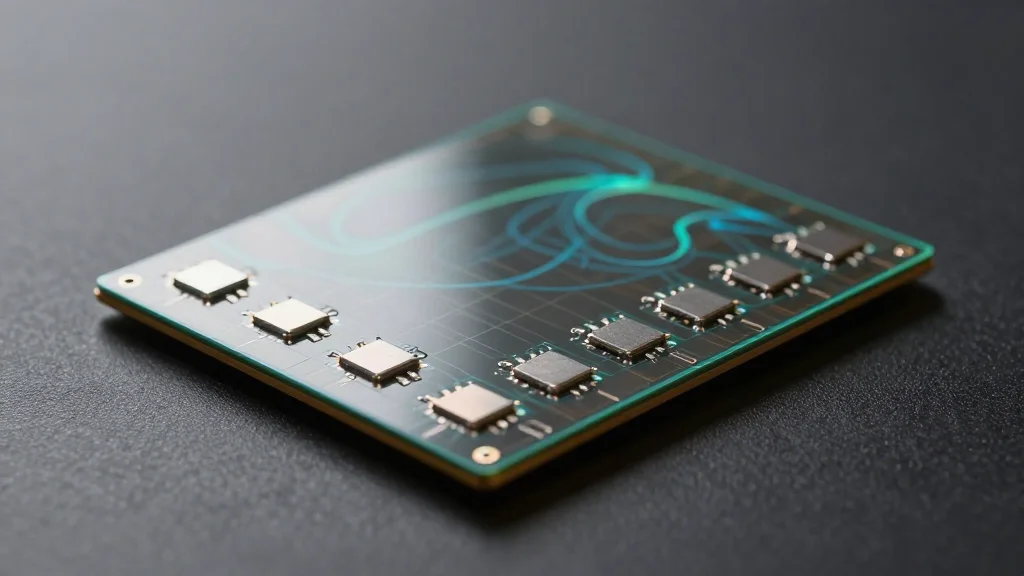
Spintronics P-Computer Ready for Scale-Up
Key Takeaways
- •First silicon‑integrated spintronic p‑bit using 130 nm CMOS.
- •Demonstrated stochastic voltage fluctuations and voltage‑controlled averaging.
- •Enables scaling probabilistic computers beyond hand‑assembled prototypes.
- •Opens hardware avenue for AI and machine‑learning acceleration.
Pulse Analysis
Probabilistic computing has emerged as a compelling alternative to deterministic binary logic, especially for problems that involve exploring vast solution spaces such as combinatorial optimization and deep‑learning inference. At the heart of this paradigm are p‑bits—tiny elements that randomly toggle between 0 and 1, yet can be biased toward a desired probability. Spintronic implementations are attractive because magnetic fluctuations naturally generate the required randomness, offering low‑power operation and compatibility with nanoscale integration. The recent breakthrough demonstrates that these magnetic devices can be co‑fabricated with standard CMOS transistors, bridging a critical gap between laboratory prototypes and commercial silicon foundries.
The team leveraged SkyWater’s 130‑nm CMOS process to build the transistor and interconnect layers, then added superparamagnetic tunnel junctions at Tohoku University’s spintronic fab. This monolithic approach preserves the electrical interface and timing fidelity needed for large‑scale circuits while keeping the entire workflow within the existing semiconductor supply chain. By confirming both stochastic output and voltage‑controlled averaging on a single chip, the researchers validated the core functional requirements of a p‑bit without resorting to hand‑assembled or hybrid packaging techniques that have limited scalability in prior demonstrations.
Industry implications are significant. A manufacturable spintronic p‑bit opens the door to probabilistic accelerators that can be embedded alongside conventional processors, delivering rapid sampling of billions of states with minimal energy overhead. Such accelerators could speed up Monte Carlo simulations, Bayesian inference, and training of stochastic neural networks, all of which are gaining traction in AI research. As the Nanotechnology Xccelerator program continues to provide open‑source designs, we can expect a cascade of prototype chips, followed by volume production that may redefine the performance‑per‑watt landscape for next‑generation computing platforms.
Spintronics p-computer ready for scale-up
Comments
Want to join the conversation?