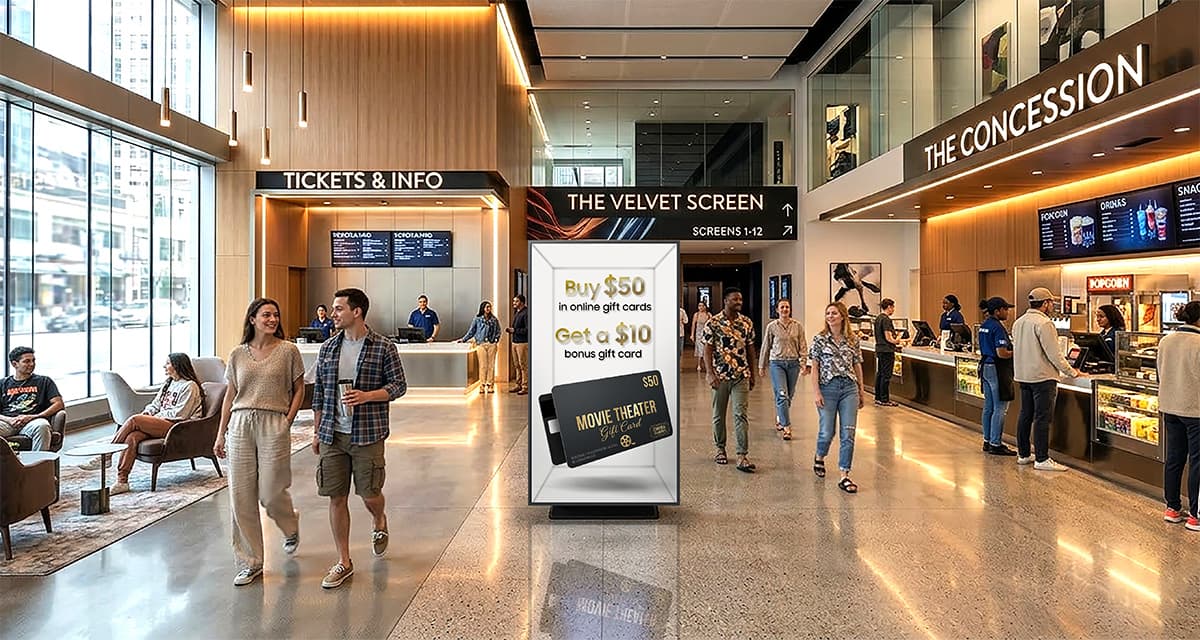
The Movie Poster Gets a Makeover: Samsung’s Spatial Signage Wants to Stop You in Your Tracks
Key Takeaways
- •Samsung’s SM85HX delivers glasses‑free 3D on an 85‑inch, 2‑inch‑deep screen.
- •Wall‑mount design frees premium lobby floor space for concessions and ticketing.
- •Integrated AI Studio converts 2D assets into 3D video for content creation.
- •Programmatic DOOH support lets advertisers bid for premium cinema lobby spots.
- •Smaller 32‑inch model slated for later 2026 expands use cases beyond lobbies.
Pulse Analysis
Cinema lobbies have become the next frontier for revenue growth as exhibitors seek to extend the premium experience beyond the auditorium. Post‑pandemic upgrades have focused on laser projection and luxury seating, yet the lobby remains dominated by static posters and basic digital loops. The global digital signage market, valued at roughly $28.8 billion in 2024 and projected to reach $45.9 billion by 2030, underscores a broader shift toward immersive, interactive displays in high‑traffic public spaces. Samsung’s Spatial Signage taps this momentum, offering a glasses‑free 3D experience that can be installed like a conventional flat‑screen, preserving valuable floor real‑estate for concessions and ticketing.
At the heart of Samsung’s offering is a lenticular 3D Plate that layers tiny cylindrical lenses over a high‑resolution panel, creating depth perception without special eyewear. The system’s AI Studio automatically transforms 2D assets into 3D‑optimized video, lowering the barrier for smaller chains that lack dedicated creative teams. Integrated with Samsung’s VXT platform, the displays support remote monitoring, content scheduling, and programmatic DOOH buying, allowing advertisers to bid for premium placements based on location and demographic data. This combination of hardware elegance and software flexibility positions Spatial Signage as a turnkey solution for cinema operators looking to increase dwell time and ancillary spend.
The commercial upside hinges on converting longer lobby visits into higher concession and ticket sales, a metric that has long driven exhibitor strategy. By delivering eye‑catching, interactive content at decision points—ticket kiosks, concession lines, and entrance corridors—operators can command higher ad rates and potentially explore revenue‑share models with studios. While early adoption remains limited, Samsung’s emphasis on scalability, minimal installation requirements, and compatibility with existing signage ecosystems could accelerate rollout. If the technology proves its ROI, it may set a new standard for immersive out‑of‑home advertising within the entertainment sector, reshaping how cinemas compete with home streaming options.
The Movie Poster Gets a Makeover: Samsung’s Spatial Signage Wants to Stop You in Your Tracks
Comments
Want to join the conversation?