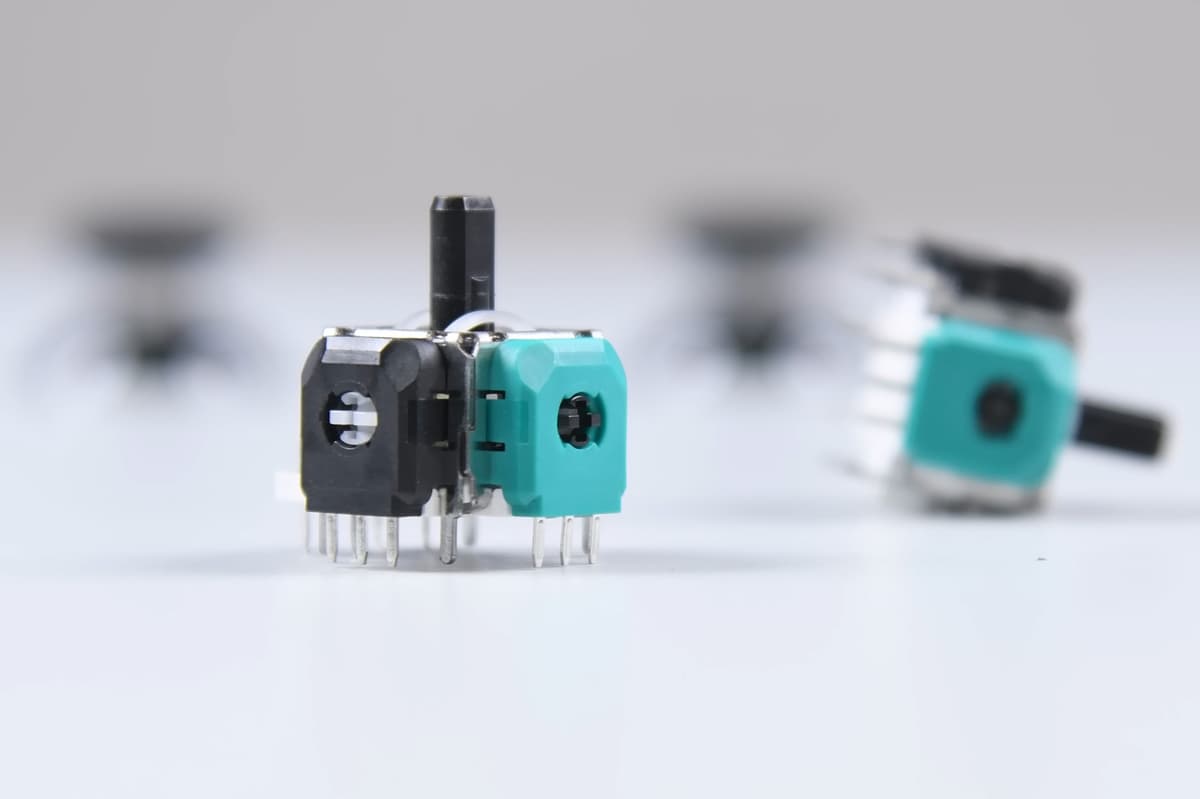
Key Takeaways
- •Potentiometers cause joystick drift due to wear.
- •Hall‑Effect sensors improve but have weak signal.
- •TMR uses quantum tunneling for stronger, low‑power readings.
- •TMR handles stray magnetic fields better than Hall‑Effect.
- •Third‑party controllers ship with TMR; consoles lag.
Summary
The article explains why traditional potentiometer joysticks suffer from inevitable drift and how contactless sensors are the logical replacement. Hall‑Effect sticks improved reliability but generate only micro‑volt signals that require amplification. Tunnel Magnetoresistance (TMR) sensors leverage quantum tunneling to deliver stronger, lower‑power readings and better immunity to stray magnetic fields. While major console makers still use potentiometers, third‑party controllers and DIY modules now offer TMR as the superior solution.
Pulse Analysis
Potentiometer‑based joysticks have long been the weak link in gaming controllers, as the metal wiper physically scrapes a carbon track, leading to wear, spring fatigue, and dust accumulation. This mechanical contact inevitably causes drift, forcing manufacturers to replace entire controllers or rely on costly repairs. The industry’s response has been to move toward contactless sensing, first with Hall‑Effect sensors that detect magnetic fields but produce only micro‑volt outputs, necessitating amplification that adds power consumption and noise.
Tunnel Magnetoresistance (TMR) technology takes the contactless concept further by exploiting quantum tunneling. A magnetic tunnel junction—comprised of a pinned layer, an ultra‑thin magnesium‑oxide barrier, and a free layer—modulates resistance based on electron spin alignment. The resulting signal is orders of magnitude stronger than Hall‑Effect outputs, allowing lower power draw (0.1‑0.3 mA versus 0.5‑2 mA) and superior resistance to temperature variation and stray magnetic fields from haptic motors. These attributes translate into tighter dead zones, reduced jitter, and longer battery life for wireless controllers.
Although console giants have yet to adopt TMR, third‑party manufacturers and aftermarket providers are already shipping TMR‑equipped sticks and replacement modules. Products from GuliKit and collaborations with ASUS demonstrate that the technology is viable for high‑performance gaming rigs. For enthusiasts, DIY retrofits now enable TMR upgrades in existing DualSense and Joy‑Con units, effectively future‑proofing legacy hardware. As the market rewards durability and precision, broader adoption of TMR could pressure major OEMs to abandon potentiometers, ushering in a new era of drift‑free, energy‑efficient gaming controllers.
Comments
Want to join the conversation?