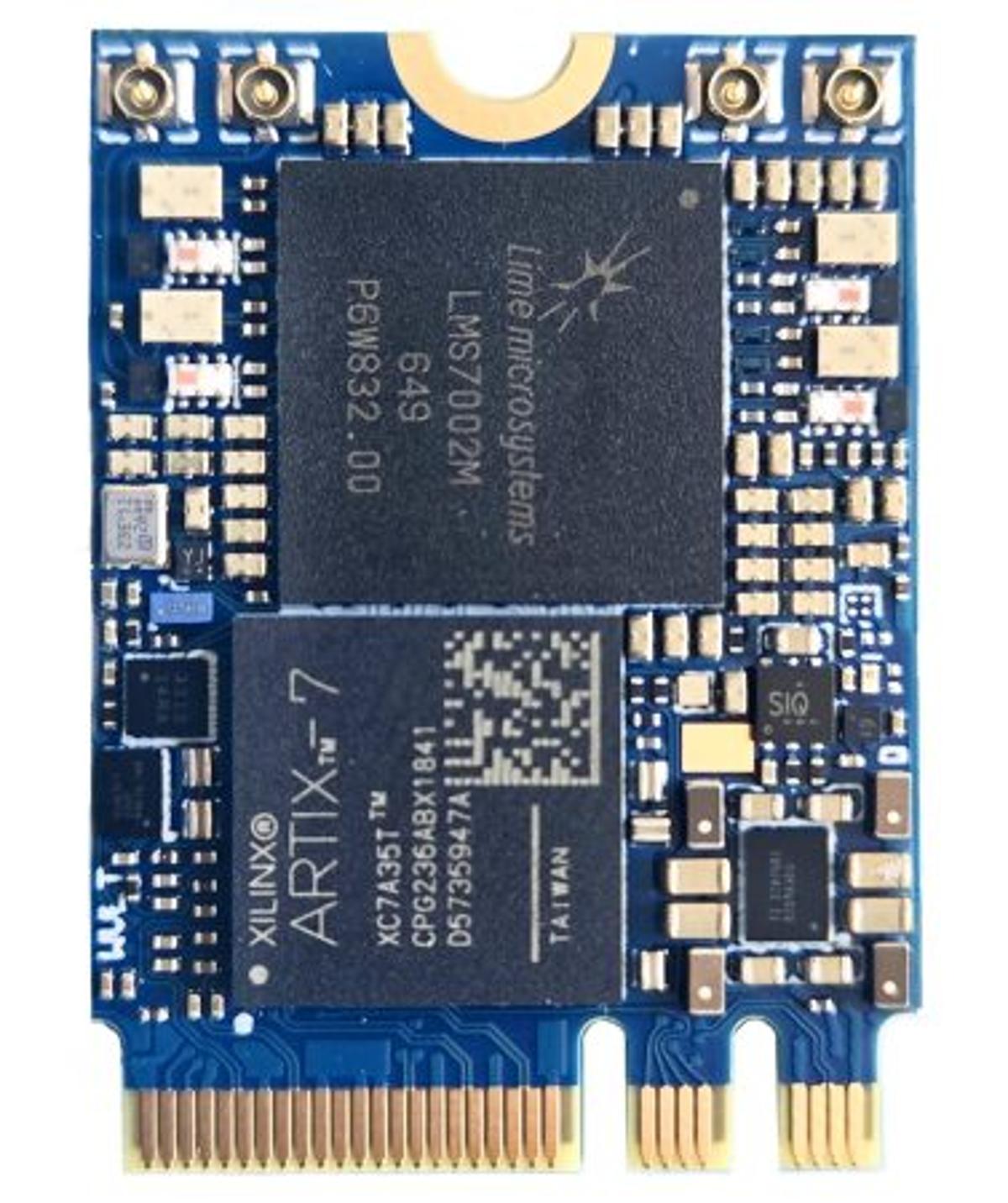
XSDR Packs 2×2 MIMO, Artix-7 FPGA, and 3.8 GHz Tuning Into M.2 2230 Form Factor
•February 14, 2026
0
Why It Matters
Embedding a full‑featured SDR into an M.2 slot eliminates external dongles, enabling high‑performance RF processing in space‑constrained edge platforms. This accelerates development of cellular, spectrum‑analysis, and signal‑intelligence applications on standard compute hardware.
Key Takeaways
- •2×2 MIMO up to 3.8 GHz in M.2 2230.
- •Artix‑7 FPGA handles baseband, supports PCIe 2.0 ×2.
- •Compatible with GNU Radio, SoapySDR, srsRAN, wsdr.io.
- •Pricing starts $549; 8×8 MIMO xMASS costs $4,900.
- •External sync enables phase‑coherent multi‑unit arrays.
Pulse Analysis
The software‑defined radio market has long been dominated by USB dongles and external chassis, which add latency and consume valuable desk space. By integrating a full‑featured SDR into the M.2 2230 form factor, the xSDR bridges the gap between high‑performance RF capability and the compact footprints demanded by modern laptops, tablets, and edge servers. This approach not only reduces cable clutter but also leverages existing M.2 slots, allowing OEMs to embed advanced spectrum‑analysis and communication functions directly onto their platforms without redesigning chassis.
Technically, the xSDR pairs Lime’s LMS7002M transceiver with an Artix‑7 XC7A50T FPGA, delivering a 30 MHz‑3.8 GHz tuning range and 2×2 MIMO operation. Sample rates exceed 80 MSPS in MIMO mode, while the on‑board 26 MHz TCXO ensures sub‑ppm clock stability for precise timing. Dual host interfaces—USB 2.0 and PCIe 2.0 ×2—provide flexible connectivity, and external synchronization ports enable phase‑coherent arrays for advanced beam‑forming or multi‑antenna experiments. The module’s software stack supports industry‑standard tools such as GNU Radio, SoapySDR, and srsRAN, and the wsdr.io web application adds a browser‑based development environment, lowering the barrier to entry for engineers and researchers.
From a business perspective, the xSDR’s pricing strategy positions it competitively against traditional SDR dongles while offering superior integration and scalability. At $549 for a single unit and $4,900 for an 8×8 MIMO xMASS platform, it appeals to both hobbyist developers and enterprise customers seeking to prototype 5G, private‑network, or spectrum‑monitoring solutions. As edge computing proliferates, devices that can embed sophisticated RF processing will become critical, and the xSDR’s M.2 footprint may set a new standard for modular, high‑performance SDR deployment in the coming years.
xSDR packs 2×2 MIMO, Artix-7 FPGA, and 3.8 GHz tuning into M.2 2230 form factor
0
Comments
Want to join the conversation?
Loading comments...