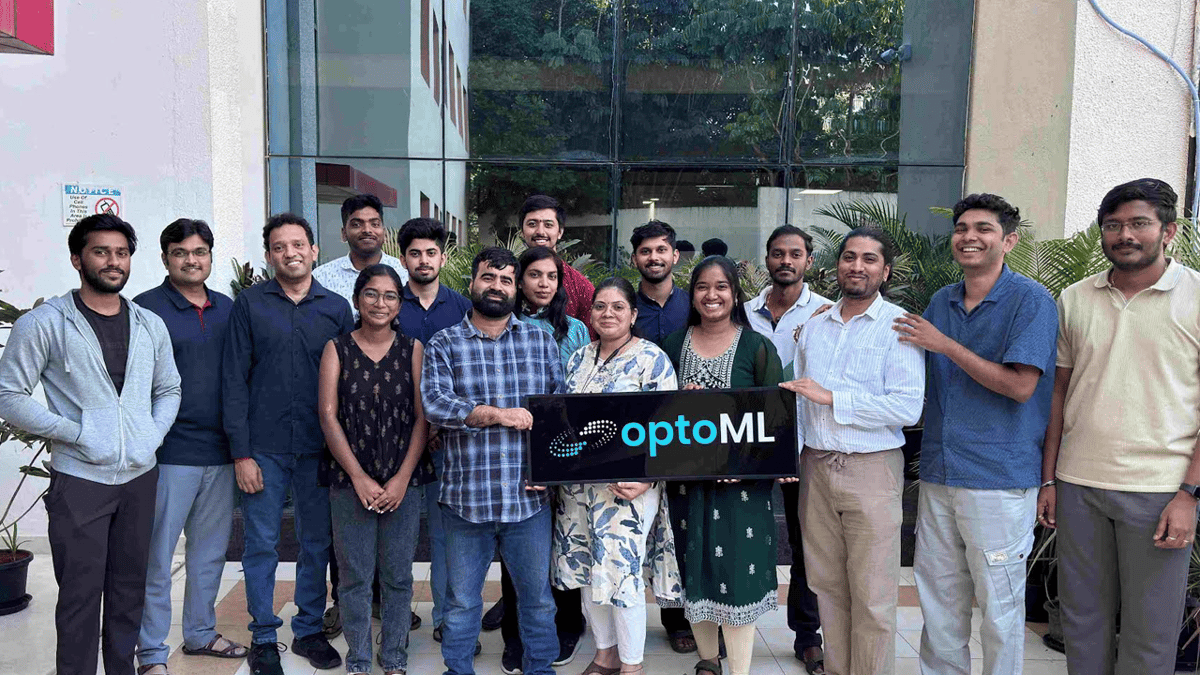
Semiconductor Startup optoML Raises $1.8 Mn in Pre‑Series A Round
•February 24, 2026
•Feb 24, 2026
0
Participants


Why It Matters
The funding accelerates optoML’s go‑to‑market timeline, potentially reshaping energy‑efficient AI hardware across edge and data‑center segments. Success could force traditional chip makers to explore analog‑optical designs.
Key Takeaways
- •Raised $1.8M pre‑Series A led by Bluehill.VC
- •Completed 12 nm tape‑out with TSMC
- •Claims 50× energy efficiency over digital accelerators
- •MoU signed with Kaynes for wafer assembly/testing
- •Targets edge, enterprise, and data‑centre AI workloads
Pulse Analysis
Analog‑in‑memory computing is emerging as a counterpoint to the power‑hungry digital accelerators that dominate today’s AI hardware landscape. By embedding computation directly within memory cells and linking them through optical interconnects, optoML aims to cut data movement latency and dramatically lower energy consumption. This approach is especially attractive for edge devices where thermal budgets and battery life are critical, as well as for large‑scale data‑centers seeking to reduce operational costs.
The $1.8 million pre‑Series A injection, anchored by Bluehill.VC and A99, gives optoML the runway to expand its engineering team and move from tape‑out to silicon validation. The 12 nm FinFET process at TSMC signals that the company is targeting a mature node that balances performance with cost, a strategic choice for early adopters. The MoU with Kaynes Semiconductor further de‑riscos the supply chain, ensuring that wafer assembly and testing can keep pace with the accelerated development schedule.
If optoML’s claims of up to 50× energy efficiency hold up in silicon, the startup could disrupt the AI chip market by offering a viable alternative to GPUs and ASICs for specific workloads. Such a breakthrough would pressure incumbents like Nvidia, Intel, and AMD to incorporate analog‑optical techniques or risk losing market share in power‑constrained segments. Moreover, the success of a fabless model leveraging TSMC’s advanced nodes underscores the growing viability of specialized AI silicon ventures, encouraging more venture capital to flow into deep‑tech semiconductor innovation.
Deal Summary
Fabless semiconductor startup optoML announced a $1.8 million pre‑Series A funding round led by Bluehill.VC and A99. The capital will be used to expand hiring and develop its next‑generation AI‑focused chips after completing a 12 nm tape‑out with TSMC. Founder Saravana Maruthamuthu highlighted the company's analog‑in‑memory compute architecture with optical interconnects.
0
Comments
Want to join the conversation?
Loading comments...