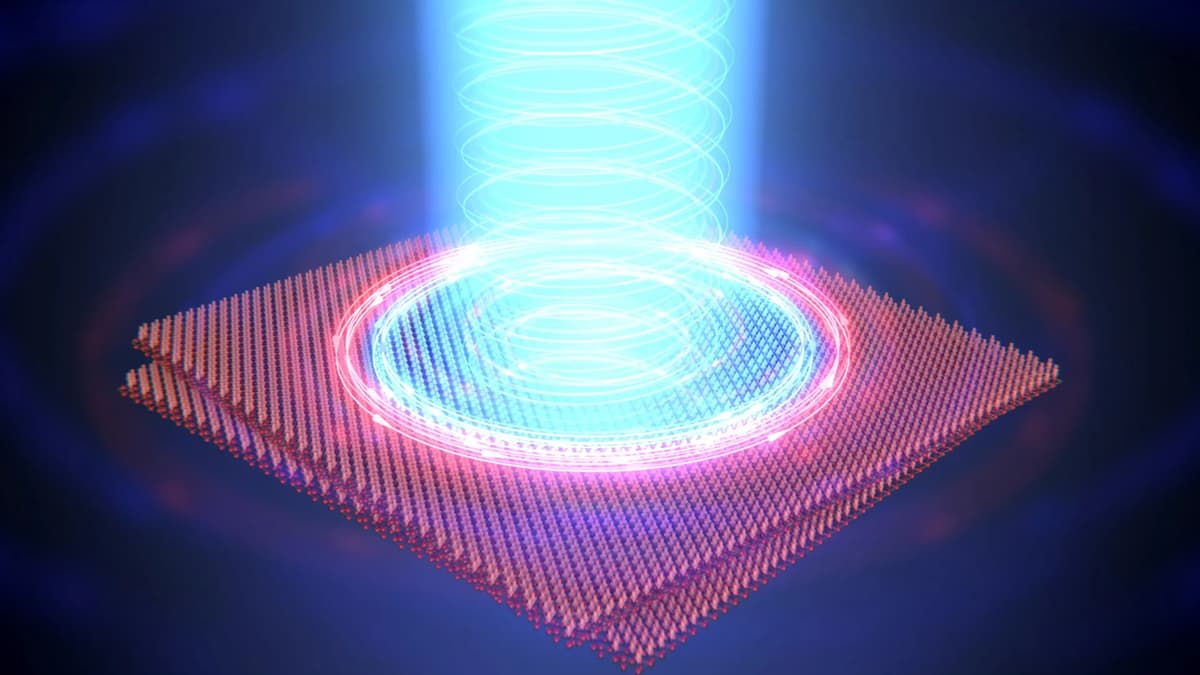
A Flash of Laser Light Flips a Magnet in Major Light-Control Breakthrough
•March 3, 2026
0
Why It Matters
Heat‑free, ultrafast optical control of magnetic bits could transform low‑energy memory and enable on‑chip reconfigurable topological circuits, reshaping future computing architectures.
Key Takeaways
- •Laser pulse flips ferromagnet polarity without heating.
- •Uses twisted bilayer MoTe2 topological states.
- •Enables optical writing of reconfigurable circuits.
- •Demonstrates permanent, collective spin reorientation.
- •Potential for ultra‑fast, low‑energy magnetic memory.
Pulse Analysis
Traditional magnetic memory relies on heating or magnetic fields to flip spin orientation, processes that consume significant energy and limit speed. The new laser‑induced switching technique sidesteps thermal constraints, offering a pathway to ultrafast, energy‑efficient data manipulation. By delivering a precisely timed photon burst, researchers can directly alter the collective spin alignment of a ferromagnet, opening a new class of light‑controlled magnetic devices that operate at the nanoscale.
The core of the discovery lies in a twisted bilayer of molybdenum ditelluride, a quantum material where a slight angular mismatch creates exotic topological states. These states act as a scaffold that couples strongly with electron spins, allowing a single laser pulse to toggle the entire magnetic domain permanently. The team verified the reversal by probing the reflected light of a secondary, weaker laser, confirming that the spin orientation had indeed switched. This approach merges three cutting‑edge concepts—strong electron correlations, topology, and dynamical control—into a single experimental platform.
Looking ahead, the ability to optically write arbitrary magnetic patterns could revolutionize chip design. Engineers may embed miniature interferometers and sensors directly into silicon, leveraging the reconfigurable topological circuits for ultra‑sensitive field detection or quantum information processing. While scaling the technique to industrial volumes remains a challenge, the proof‑of‑concept establishes a compelling route toward photonic‑magnetic hybrid architectures that promise faster, cooler, and more adaptable computing systems.
A flash of laser light flips a magnet in major light-control breakthrough
0
Comments
Want to join the conversation?
Loading comments...