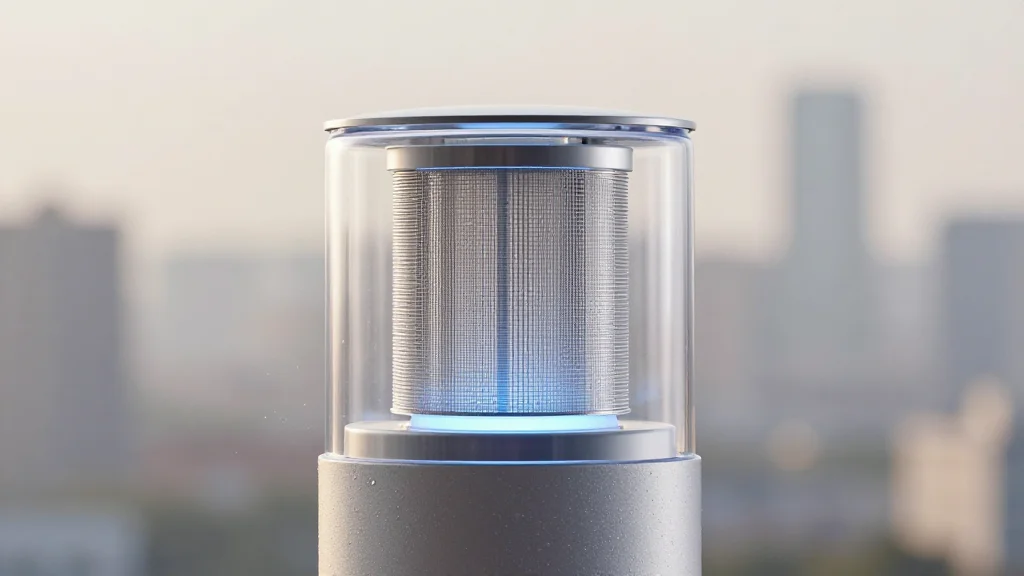
A Reusable Chip for Particulate Matter Sensing
Why It Matters
The chip’s size‑selective filtration and thermal regeneration enable portable, cost‑effective particulate monitoring, addressing a key gap in real‑time air‑quality surveillance. Its reusability could lower operational costs and expand deployment in smart‑city and health‑risk applications.
Key Takeaways
- •SAW sensor integrates porous membrane for PM10 and PM2.5 separation
- •On‑chip microheater cleans particles at ~100 °C, enabling reuse
- •PM2.5 channel sensitivity reaches 0.11 kHz per µg/m³
- •Five‑day test shows >90% response retention for PM10
Pulse Analysis
Air‑quality monitoring has long relied on bulky, expensive instruments that either sacrifice portability or require frequent replacement of sensing elements. Conventional methods such as beta‑ray absorption or light‑scattering provide accurate readings but struggle with size selectivity and long‑term reliability, especially in humid or variable environments. The emergence of surface acoustic wave (SAW) technology offers a pathway to miniaturized sensors, yet earlier designs were limited to single‑use particle capture, curbing their practicality for continuous deployment. By embedding a porous microstructured membrane directly onto the SAW resonator, the new chip achieves intrinsic size discrimination for PM10 and PM2.5, addressing a critical need for precise health‑impact monitoring.
The Ajou University prototype incorporates two filter membranes—approximately 11 µm for PM10 and 3 µm for PM2.5—positioned over 222 MHz SAW resonators on LiNbO₃ substrates. Laboratory chamber tests recorded a PM2.5 sensitivity of 0.11 kHz·(µg·m⁻³)⁻¹ and a PM10 response of 0.218 kHz·(µg·m⁻³)⁻¹ after calibration. Crucially, an integrated microheater raises the chip temperature to about 100 °C, vaporizing adhered particles under vacuum and restoring baseline performance. Over a five‑day endurance trial, the PM10 channel retained more than 90% of its response, while the PM2.5 channel stayed above 80%, demonstrating robust reusability.
From a market perspective, this reusable SAW‑based sensor could disrupt the air‑quality monitoring sector by reducing device footprints and maintenance costs. Portable stations for smart‑city networks, wearable health monitors, and industrial emission controls stand to benefit from a sensor that delivers size‑selective data without frequent cartridge changes. Further field validation will be essential to confirm performance under real‑world temperature, humidity, and pollutant mixtures, but the technology positions itself as a strong candidate for next‑generation, low‑cost particulate monitoring solutions.
A reusable chip for particulate matter sensing
Comments
Want to join the conversation?
Loading comments...