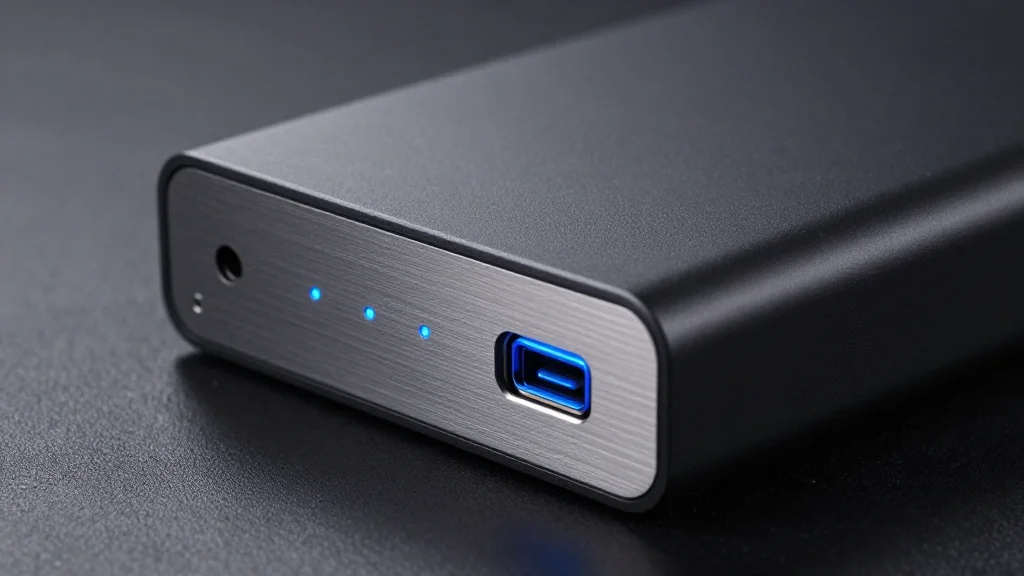
Acasis Unveils Thunderbolt 5 FlowCore Series with 80 Gbps per Bay for AI and 8K Workloads

Companies Mentioned
Why It Matters
The FlowCore Series tackles a long‑standing limitation in external storage: shared bandwidth that throttles performance when multiple drives operate concurrently. By allocating a dedicated 80 Gbps channel to each bay, Acasis offers a hardware solution that aligns with the data‑intensive needs of modern AI model training and 8K video production, both of which are projected to grow sharply in the next five years. If validated, this architecture could reshape purchasing decisions for studios, research labs, and enterprises that previously balanced cost against performance by using internal PCIe arrays or multiple slower enclosures. Moreover, the product’s fanless aluminum design addresses acoustic concerns in professional environments, where silent operation can be as critical as speed. The Kickstarter launch also signals a shift toward community‑driven funding for niche high‑performance hardware, potentially lowering entry barriers for innovative designs that might otherwise be stifled by traditional venture capital expectations.
Key Takeaways
- •Acasis FlowCore Series provides up to 80 Gbps per NVMe bay, eliminating shared‑bandwidth throttling.
- •TB504 Pro offers ten bays and up to 80 TB total capacity, with sustained 6,000 MB/s per drive.
- •Fanless aluminum chassis delivers silent operation for noise‑sensitive studios.
- •Supports RAID 0/1/10 and downstream 80 Gbps Thunderbolt 5 ports for dual 8K monitors.
- •Kickstarter campaign begins May 15, 2026, testing market appetite for high‑end external storage.
Pulse Analysis
Acasis’s per‑bay bandwidth approach could be a game‑changer if it survives real‑world testing. Historically, external enclosures have relied on a single Thunderbolt controller that multiplexes traffic, causing performance cliffs when more than two drives are active. By assigning a dedicated controller to each bay, Acasis sidesteps this bottleneck, but it also raises engineering challenges around power delivery, thermal management, and cost. The fanless aluminum chassis suggests confidence in passive cooling, yet sustained 6,000 MB/s reads and writes will generate heat that may test the limits of passive dissipation, especially in the ten‑bay Pro model.
From a market perspective, the timing aligns with the rapid expansion of AI workloads that demand terabytes of fast storage for model checkpoints and dataset preprocessing. Companies like Nvidia and AMD are pushing larger models, and the storage tier is becoming a critical performance factor. Simultaneously, the broadcast and post‑production sectors are transitioning to 8K pipelines, where raw video streams can exceed 100 Gbps. Acasis’s claim of handling dual 8K‑at‑60 Hz monitors through the storage device itself could simplify workstation cabling and reduce latency, a tangible advantage for editors.
However, the reliance on Kickstarter introduces risk. Crowdfunded hardware often faces production delays, component shortages, and scaling issues that can erode early adopter trust. If Acasis can deliver on schedule and meet its performance specs, it may force established storage vendors—such as Samsung, Western Digital, and G-Technology—to accelerate their own multi‑bay, high‑bandwidth offerings. Conversely, any shortfall could reinforce skepticism around crowdfunded high‑performance peripherals, slowing innovation in this niche. The next quarter will reveal whether the FlowCore Series can bridge the gap between ambitious engineering and reliable delivery.
Acasis Unveils Thunderbolt 5 FlowCore Series with 80 Gbps per Bay for AI and 8K Workloads
Comments
Want to join the conversation?
Loading comments...