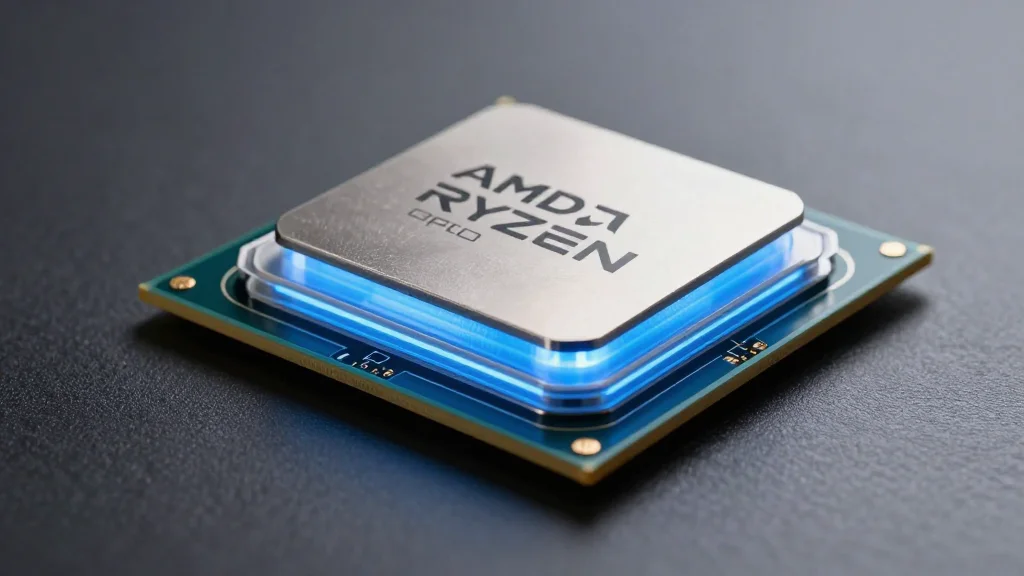
AMD Adds 3D V-Cache to Ryzen Pro 9000 CPUs, Boosting Workstation Performance

Companies Mentioned
Why It Matters
The introduction of 3D V‑Cache to workstation CPUs marks a strategic pivot for AMD, targeting a segment that values raw compute speed and low latency above power savings. By breaking the 65 W barrier, AMD offers a new performance tier that could compel enterprises to reconsider platform choices, especially for workloads where cache latency is a critical bottleneck. The partnership with Lenovo also provides a tangible reference design, helping early adopters gauge real‑world benefits and influencing the broader ecosystem of workstation manufacturers. Furthermore, the move intensifies competition with Intel’s Xeon and upcoming Sapphire Rapids successors, which have focused on scaling core counts and memory bandwidth. AMD’s cache‑centric strategy may force rivals to explore similar vertical stacking techniques or to double down on alternative acceleration paths such as integrated AI accelerators, reshaping the roadmap for high‑performance computing hardware over the next few years.
Key Takeaways
- •AMD adds 3D V‑Cache to Ryzen Pro 9000 series, first time in workstation CPUs
- •Top model Ryzen 9 Pro 9965X3D: 16 Zen 5 cores, 5.5 GHz boost, 128 MB stacked cache, 170 W TDP
- •Cache total reaches 144 MB on flagship, double the non‑V‑Cache variant
- •Launch slated for H2 2026 with Lenovo ThinkStation P4 as first OEM implementation
- •Higher TDP and cache aim to improve 4K/8K editing, 3D modeling, encoding and AI inference
Pulse Analysis
AMD’s decision to migrate 3D V‑Cache from a gaming‑centric narrative to the professional arena reflects a broader industry trend: performance gains are increasingly being extracted from architectural innovations rather than sheer core count. Historically, workstation CPUs have prioritized power efficiency and scalability, but the cache‑first approach offers a different lever for performance, especially in workloads where data locality dictates speed. By stacking an extra 64 MB of L3 cache, AMD reduces the number of costly DRAM accesses, a factor that can shave seconds off render times and accelerate simulation cycles.
The partnership with Lenovo is a calculated move to provide a reference platform that validates the technology under real‑world stress. Lenovo’s ThinkStation line is a staple in design studios and engineering firms; a successful deployment could create a halo effect, prompting other OEMs to adopt the Ryzen Pro 9000 series. This could erode Intel’s dominance in the high‑end workstation market, where Xeon has long been the default. Intel may need to respond either by accelerating its own cache‑stacking research or by emphasizing other differentiators such as integrated AI accelerators and higher memory bandwidth.
Looking ahead, the 170 W TDP ceiling suggests AMD is willing to accept higher cooling and power costs for the sake of performance. Enterprises that can accommodate the thermal envelope—through liquid cooling or advanced chassis designs—will reap the benefits. However, smaller firms or those with strict energy budgets may stick with lower‑TDP options, preserving a market split. The real test will be benchmark data from the ThinkStation P4 and subsequent OEM releases; if the performance uplift aligns with AMD’s claims, the cache‑centric model could become a new standard for workstation CPUs, influencing design choices well beyond 2026.
AMD adds 3D V-Cache to Ryzen Pro 9000 CPUs, boosting workstation performance
Comments
Want to join the conversation?
Loading comments...