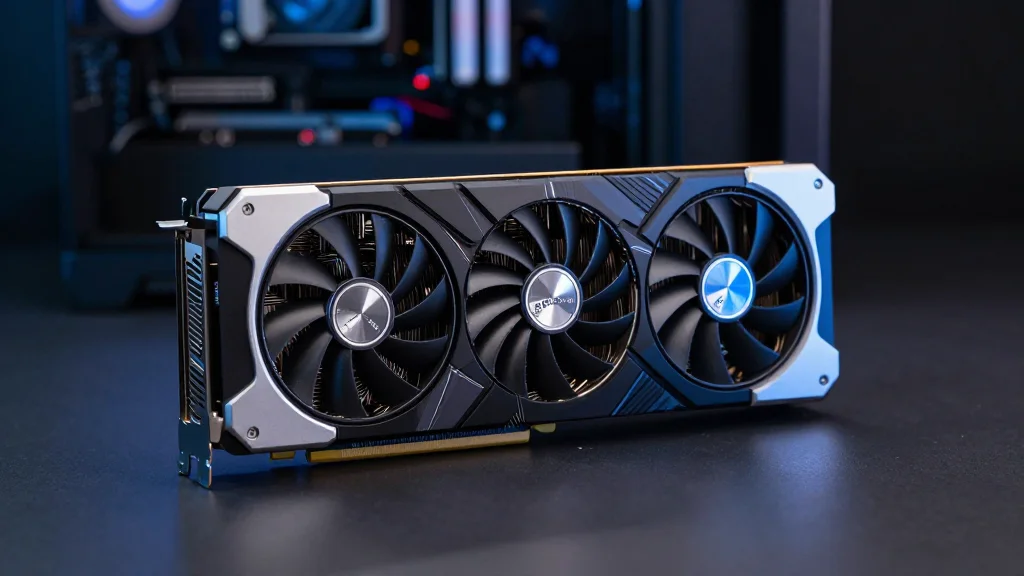
AMD Radeon RX 9070 GRE Shows Strong Value and Overclocking Potential at $549

Companies Mentioned
Why It Matters
The RX 9070 GRE’s launch demonstrates that AMD can still deliver meaningful performance gains in the crowded mid‑range GPU market without resorting to higher VRAM counts that drive up costs. By leveraging higher boost clocks, AMD provides a pathway for enthusiasts to extract extra performance through modest overclocking, a tactic that could become a differentiator as memory prices remain volatile. For gamers and PC builders, the card offers a rare combination of affordability and 1440p capability, potentially shifting market share away from Nvidia’s RTX 50‑series and prompting a price war that benefits consumers. Moreover, the GRE’s worldwide availability after a China‑first rollout reflects AMD’s strategy to normalize global supply chains for its newer RDNA 4 GPUs. As the industry grapples with component shortages and pricing pressures, a stable, competitively priced GPU can anchor the mid‑tier segment, encouraging OEMs to adopt AMD silicon in pre‑built systems and influencing the broader ecosystem of game developers who must support both AMD and Nvidia technologies.
Key Takeaways
- •AMD Radeon RX 9070 GRE launches globally at a $549 suggested retail price.
- •Factory boost clock of 2,790 MHz—higher than the base 2,520 MHz—provides overclocking headroom up to ~3.0 GHz.
- •12 GB GDDR6 VRAM and 48 compute units deliver 1440p performance comparable to Nvidia RTX 5070.
- •Reviewers report 40 fps in Cyberpunk 2077 Ultra ray‑tracing at 1440p, 20‑30 % faster than the RX 9060 XT.
- •The card’s price‑to‑performance ratio challenges Nvidia’s RTX 5060 Ti and could trigger mid‑range price adjustments.
Pulse Analysis
AMD’s decision to ship the RX 9070 GRE with a higher default clock reflects a strategic pivot toward extracting performance through frequency rather than raw silicon count. Historically, AMD’s mid‑range offerings have leaned on larger VRAM buffers to stay competitive, but memory price spikes have forced a rethink. By trimming the compute unit count and VRAM while pushing the clock envelope, AMD delivers a product that meets the performance expectations of 1440p gamers without inflating the bill of materials. This approach mirrors the industry’s broader shift toward efficiency‑first designs, where power and thermal budgets are as critical as raw throughput.
From a market dynamics perspective, the GRE’s $549 price point sits at a sweet spot that could destabilize Nvidia’s pricing hierarchy. Nvidia’s RTX 5060 Ti and RTX 5070 have been priced at $569 and $719 respectively, creating a $150 gap that the GRE comfortably bridges. If AMD can sustain supply and keep the card in stock, retailers may favor the GRE for its value proposition, prompting OEMs to integrate it into pre‑built gaming rigs. This could force Nvidia to either lower its mid‑range prices or accelerate the rollout of next‑gen features—such as DLSS 5—to maintain a premium edge.
Looking forward, the GRE’s success will hinge on two factors: the longevity of its price stability and the ecosystem’s support for AMD’s FSR Redstone upscaling. While FSR has closed much of the gap with Nvidia’s DLSS, the lack of multi‑frame generation (only one AI‑generated frame per cycle) remains a differentiator for Nvidia. If AMD can roll out a multi‑frame generation solution in a future RDNA iteration, the GRE’s overclocking narrative could evolve from a stop‑gap to a long‑term competitive advantage, reshaping the mid‑range GPU landscape for years to come.
AMD Radeon RX 9070 GRE Shows Strong Value and Overclocking Potential at $549
Comments
Want to join the conversation?
Loading comments...