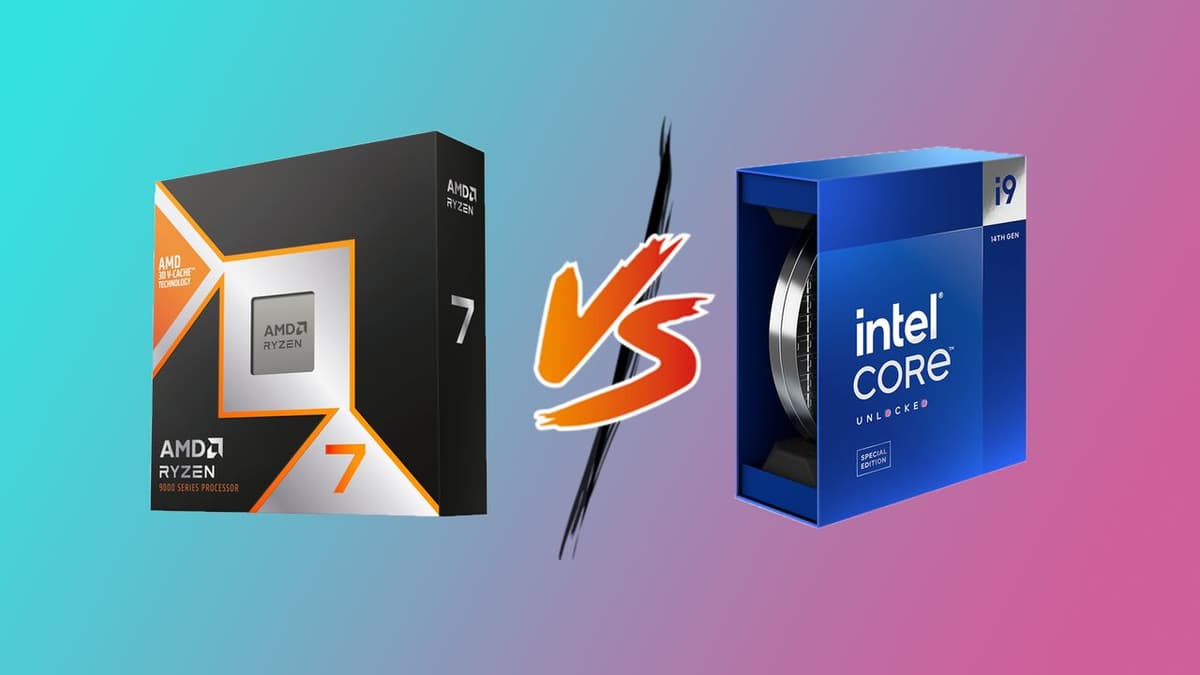
AMD Ryzen 7 9850X3D vs Intel Core I9-14900K Faceoff — Intel’s Raptor Lake Platform Continues to Be Relevant in 2026
•February 28, 2026
0
Companies Mentioned


Why It Matters
The performance split reshapes buying decisions for high‑end PCs, guiding builders toward AMD for gaming efficiency and Intel for raw productivity power. It also signals that Intel’s Raptor Lake platform remains competitive in 2026 despite AMD’s cache advantage.
Key Takeaways
- •AMD 9850X3D beats Intel 14900K in gaming benchmarks
- •Intel 14900K outperforms AMD in multi‑core productivity tasks
- •AMD consumes ~20% less power and runs cooler
- •Intel offers higher overclocking headroom and cheaper DDR4 option
- •AMD provides better value for gaming‑focused enthusiast builds
Pulse Analysis
The introduction of AMD’s Ryzen 7 9850X3D marks the latest evolution of 3D V‑Cache technology, a design that stacks additional cache vertically to reduce memory latency. In 2026, this architectural tweak translates into tangible gains for gamers, especially at 1080p resolutions where frame‑rate ceilings are often limited by CPU cache bandwidth. By pairing the chip with high‑end GPUs like the RTX 5090, reviewers observed an average 23.9% uplift in FPS across fifteen titles, confirming that AMD’s cache‑centric approach still delivers a competitive edge in the gaming segment.
Intel’s Core i9‑14900K continues to leverage its hybrid architecture, combining eight performance cores with sixteen efficiency cores to excel in heavily threaded workloads. This design yields roughly a 50% advantage over the Ryzen 7 9850X3D in multi‑core benchmarks such as Cinebench R23 and POV‑Ray, making the chip a strong candidate for content creators, engineers, and developers who prioritize raw compute throughput. Moreover, Intel’s mature overclocking ecosystem, supported by XTU’s AI‑assist and extensive voltage controls, provides enthusiasts with a broader performance ceiling, while the platform’s compatibility with DDR4 memory can lower overall build costs when legacy RAM is still affordable.
For system integrators and DIY builders, the data underscores a clear segmentation: choose AMD’s 9850X3D for a cooler, more power‑efficient gaming rig with superior frame rates, and opt for Intel’s 14900K when multi‑threaded productivity, overclocking flexibility, and potential cost savings on DDR4 are paramount. As both manufacturers iterate on their respective architectures, the rivalry ensures that high‑end desktop platforms remain vibrant, offering consumers nuanced choices rather than a single dominant solution.
AMD Ryzen 7 9850X3D vs Intel Core i9-14900K faceoff — Intel’s Raptor Lake platform continues to be relevant in 2026
0
Comments
Want to join the conversation?
Loading comments...