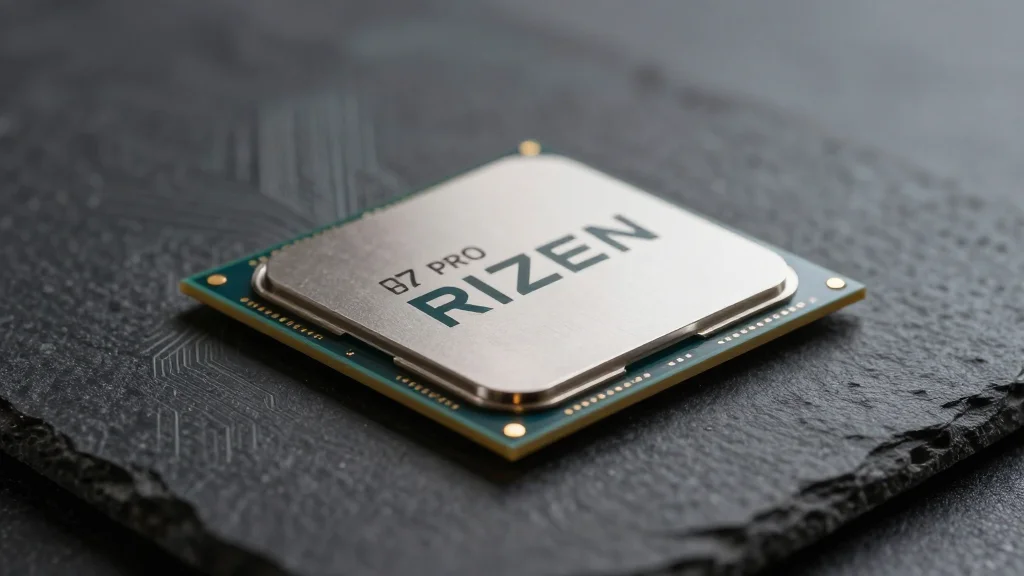
AMD Ryzen 7 PRO 9755 Surfaces With Slight Multi-Core Performance Gain
Companies Mentioned
Why It Matters
The 9755 gives OEMs a fresh performance tier for commercial desktops, helping AMD differentiate its Ryzen PRO lineup against Intel’s enterprise offerings. The incremental boost can translate into measurable efficiency gains for multi‑threaded business applications.
Key Takeaways
- •Ryzen 7 PRO 9755 offers 2.7% multi‑core performance boost over 9745.
- •Both CPUs share 8 cores, 65 W TDP, and similar clock specs.
- •Small uplift likely stems from silicon binning or firmware tuning.
- •Targeted at enterprise workstations needing sustained parallel workloads.
- •AMD expands Ryzen PRO 9000 lineup beyond currently listed models.
Pulse Analysis
AMD’s Ryzen PRO series has become a cornerstone for OEMs seeking enterprise‑grade stability, manageability, and long‑term support. The recent appearance of the Ryzen 7 PRO 9755 in PassMark’s database signals that AMD is quietly extending its 9000‑series portfolio beyond the three models officially listed on its website. By adding a new SKU that slots between the 9745 and the higher‑end 9965X3D, AMD offers channel partners a finer granularity of performance options, which can be crucial when matching hardware to specific workload requirements in corporate environments.
Performance data shows the 9755 delivering a 2.7% uplift in multi‑threaded CPU Mark scores while maintaining near‑identical single‑thread results to the 9745. Because the core count, cache hierarchy, and 65 W power envelope remain unchanged, analysts attribute the gain to silicon binning—selecting higher‑quality dies—or to firmware‑level clock optimizations. Such marginal improvements are typical in the mature Zen 4 architecture and can provide tangible benefits for virtualization, rendering, or large‑scale compilation tasks where every percentage point of throughput reduces overall processing time and energy consumption.
For enterprise buyers, the 9755’s modest performance edge offers a compelling upgrade path without a significant cost or power penalty. It reinforces AMD’s strategy to compete more directly with Intel’s vPro‑enabled Xeon W and Core i9 workstation chips, where incremental performance differences often drive procurement decisions. As AMD continues to populate the Ryzen PRO lineup, OEMs can expect a broader selection of validated, long‑support platforms, enabling IT departments to future‑proof deployments while maintaining predictable total cost of ownership. The 9755 thus represents both a technical refinement and a strategic move to deepen AMD’s foothold in the commercial desktop market.
AMD Ryzen 7 PRO 9755 Surfaces With Slight Multi-Core Performance Gain
Comments
Want to join the conversation?
Loading comments...