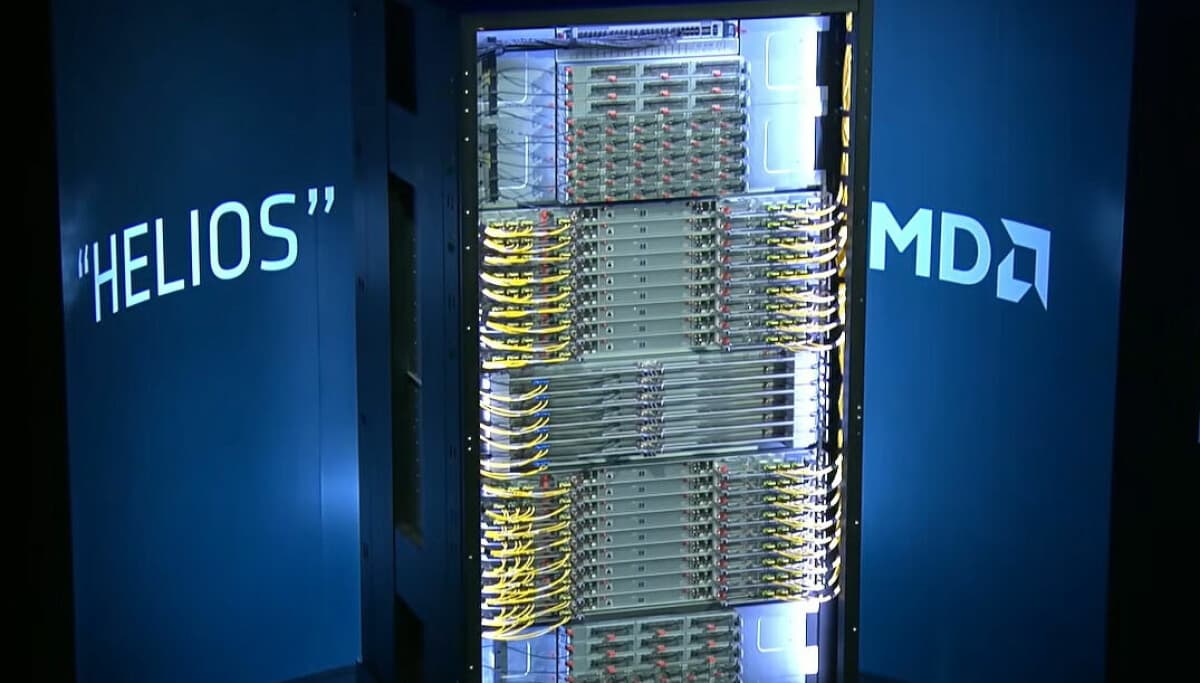
AMD Says “Helios” Racks And MI400 Series GPUs On Track For 2H 2026
•February 23, 2026
0
Why It Matters
Helios positions AMD to compete directly with Nvidia, AWS and Google in high‑performance AI rack‑scale infrastructure, potentially expanding its data‑center revenue stream. Timely delivery validates AMD’s recent strategic investments and could shift market dynamics in AI compute.
Key Takeaways
- •Helios racks target 2H 2026 engineering samples
- •MI455X GPU accelerators power up to 128 GPUs
- •AMD partnered with Sanmina for NPI manufacturing
- •Thermal risk mitigated via dummy hot‑plate simulations
Pulse Analysis
The AI acceleration market is increasingly dominated by rack‑scale solutions that deliver exaflop‑class performance. Nvidia’s Oberon, AWS Trainium and Google’s TPU families have set a high bar, prompting rivals to accelerate their own offerings. AMD’s Helios system, built around the Altair MI400 series, aims to provide up to 2.9 exaflops of AI compute, 31 TB of HBM4 memory and 43 TB/s of bandwidth, directly challenging the incumbent players and expanding the ecosystem of GPU‑centric data centers.
Technically, Helios distinguishes itself through a rigorous validation pipeline. AMD engineers employ dummy hot‑plates to emulate CPU and GPU thermal loads long before silicon returns from fabs, allowing early retirement of thermal risks. The design integrates Ultra Accelerator Link, Ultra Ethernet, and ROCm software stack, ensuring tight CPU‑GPU coupling and flexible scaling. By leveraging Sanmina as the New Product Introduction (NPI) partner, AMD compresses development cycles while maintaining strict quality controls across component, rack and shipping stages, a model essential for high‑volume AI hardware.
From a business perspective, the Helios launch validates AMD’s $4.9 billion acquisition of ZT Systems and its subsequent divestiture of the manufacturing arm to Sanmina. Successfully delivering rack‑scale systems on schedule will diversify AMD’s revenue beyond traditional CPUs and discrete GPUs, tapping the fast‑growing AI infrastructure market. If Helios meets performance and cost targets, it could accelerate AMD’s market share gains, pressure pricing in the AI hardware segment, and reinforce its position as a full‑stack data‑center solutions provider.
AMD Says “Helios” Racks And MI400 Series GPUs On Track For 2H 2026
0
Comments
Want to join the conversation?
Loading comments...