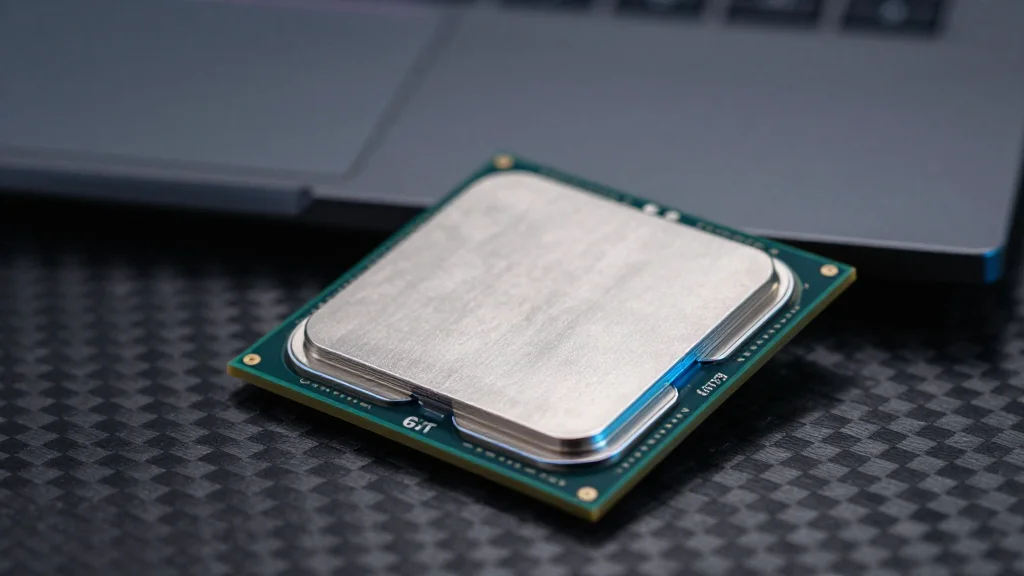
AMD's Ryzen 9 9955HX3D Powers Acer Nitro 16, Claiming Fastest Mobile Gaming CPU

Companies Mentioned
Why It Matters
The Ryzen 9 9955HX3D represents AMD’s first foray into a cache‑centric performance strategy for laptops, a tactic previously reserved for desktop and workstation CPUs. By stacking 64 MB of L3 cache, AMD directly addresses the latency bottlenecks that have limited mobile gaming performance, potentially redefining the performance‑per‑watt calculus for high‑end notebooks. The launch also intensifies the competition between AMD, Intel, and NVIDIA, forcing each to innovate beyond raw GPU horsepower and consider CPU architecture as a decisive factor in gaming experiences. For OEMs, the partnership with Acer demonstrates a willingness to integrate bleeding‑edge silicon into mainstream gaming lines, not just flagship or boutique models. If the Nitro 16 can deliver the promised frame‑rate gains without overheating or draining the battery, it could accelerate the adoption of 3D V‑Cache across a broader range of devices, influencing future design choices for both gaming and professional mobile workstations.
Key Takeaways
- •AMD's Ryzen 9 9955HX3D features 16 Zen 5 cores and 64 MB of 3D V‑Cache, claimed as the fastest mobile gaming CPU
- •Benchmarks show a 16% average frame‑rate increase and 17% improvement in 1% lows across 29 games at 1080p
- •Acer Nitro 16 pairs the CPU with an RTX 5070 Ti GPU, 32 GB DDR5‑5600 RAM, and a 240 Hz 16‑inch WQXGA display
- •Advanced cooling: dual‑fan, quad‑intake, quad‑exhaust system with vector heat pipes to manage the 120 W TDP
- •Launch slated for August 2026 in North America and EMEA; pricing not yet disclosed
Pulse Analysis
AMD’s decision to embed second‑generation 3D V‑Cache into a mobile processor is a strategic pivot that could reshape the performance hierarchy in gaming laptops. Historically, AMD’s advantage lay in multi‑core efficiency, while Intel leveraged higher clock speeds and NVIDIA supplied the GPU muscle. By targeting memory latency—a critical factor for consistent frame delivery—AMD is carving out a niche where raw GPU horsepower alone is insufficient. This mirrors the desktop arena, where AMD’s Ryzen 9 7950X3D set new gaming records, but extending the concept to a 120 W TDP mobile envelope is technically demanding. The Nitro 16’s elaborate cooling solution suggests AMD and Acer are willing to accept higher manufacturing costs to preserve performance, a gamble that will be judged against the laptop’s final price.
The competitive response will be telling. Intel’s upcoming Core Ultra 9‑based laptops are expected to feature higher clock speeds and integrated Xe‑based graphics, but they lack the cache depth AMD now offers. NVIDIA’s dominance in the GPU market means that most high‑end laptops will still pair Intel or AMD CPUs with NVIDIA GPUs; the differentiator will shift to how well the CPU can feed the GPU. If AMD’s cache‑centric approach translates into smoother gameplay and lower power draw, OEMs may prioritize similar architectures, potentially prompting Intel to explore larger on‑die caches or hybrid memory solutions.
From a market perspective, the Nitro 16 could broaden the appeal of AMD‑powered gaming laptops beyond enthusiasts who already favor the brand. By delivering measurable performance gains in mainstream titles, AMD may attract a wider segment of gamers who are price‑sensitive but still demand high frame rates. However, the lack of disclosed pricing leaves a critical variable unresolved. Should the Nitro 16 command a premium that eclipses comparable Intel‑NVIDIA configurations, its impact could be muted. Conversely, a competitive price point would force rivals to reevaluate their value propositions, potentially accelerating the adoption of advanced cache technologies across the laptop ecosystem.
AMD's Ryzen 9 9955HX3D Powers Acer Nitro 16, Claiming Fastest Mobile Gaming CPU
Comments
Want to join the conversation?
Loading comments...