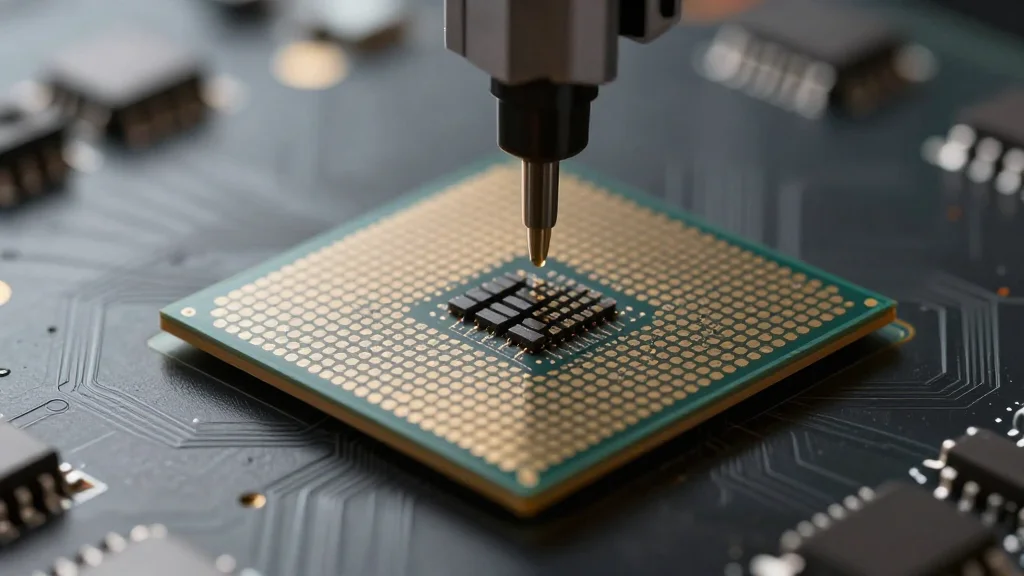
An AI Agent Just Designed a Complete RISC-V CPU From Scratch in 12 Hours
Why It Matters
The achievement proves that autonomous AI agents can compress the traditional chip‑design cycle from months to hours, potentially reshaping hardware development economics and speed. It also signals a shift toward AI‑first design workflows that could lower entry barriers for new semiconductor players.
Key Takeaways
- •Verkor's AI designed a RISC‑V core in 12 hours
- •Design Conductor orchestrates LLMs to produce GDSII from specs
- •VerCore runs at 1.48 GHz, scores 3,261 CoreMark
- •CPU validated only in simulation, not fabricated yet
- •AI-driven chip design could accelerate hardware development cycles
Pulse Analysis
The emergence of an autonomous AI agent capable of delivering a full RISC‑V CPU design in half a day marks a watershed moment for semiconductor engineering. Design Conductor, rather than being a single model, acts as a coordination layer that steers large language models through the entire design workflow—specification parsing, RTL generation, synthesis, placement, and routing—without human intervention. By compressing a process that traditionally spans weeks or months into a single workday, the technology promises to slash development costs and democratize access to advanced chip design tools.
VerCore’s technical profile underscores both the promise and the current limits of AI‑driven hardware creation. The five‑stage, in‑order pipeline operates at 1.48 GHz and registers a CoreMark score of 3,261, placing it on par with legacy entry‑level CPUs rather than cutting‑edge processors. Validation was confined to simulation using the Spike ISA emulator and the academic ASAP7 predictive PDK, which models a 7 nm‑class process but does not guarantee manufacturability. Consequently, while the design demonstrates functional correctness, real‑world silicon performance, power, and yield remain unproven until fabrication.
Industry analysts see this development as a catalyst for a broader AI‑first design paradigm. Startups can now leverage AI agents to iterate rapidly on architecture ideas, reducing reliance on costly EDA licenses and large engineering teams. However, challenges persist, including ensuring design reliability, meeting stringent security standards, and integrating AI outputs with physical manufacturing constraints. As AI models become more adept at handling complex verification and layout tasks, the semiconductor ecosystem is likely to evolve toward hybrid human‑AI workflows, accelerating time‑to‑market and fostering innovation across the chip supply chain.
An AI agent just designed a complete RISC-V CPU from scratch in 12 hours
Comments
Want to join the conversation?
Loading comments...