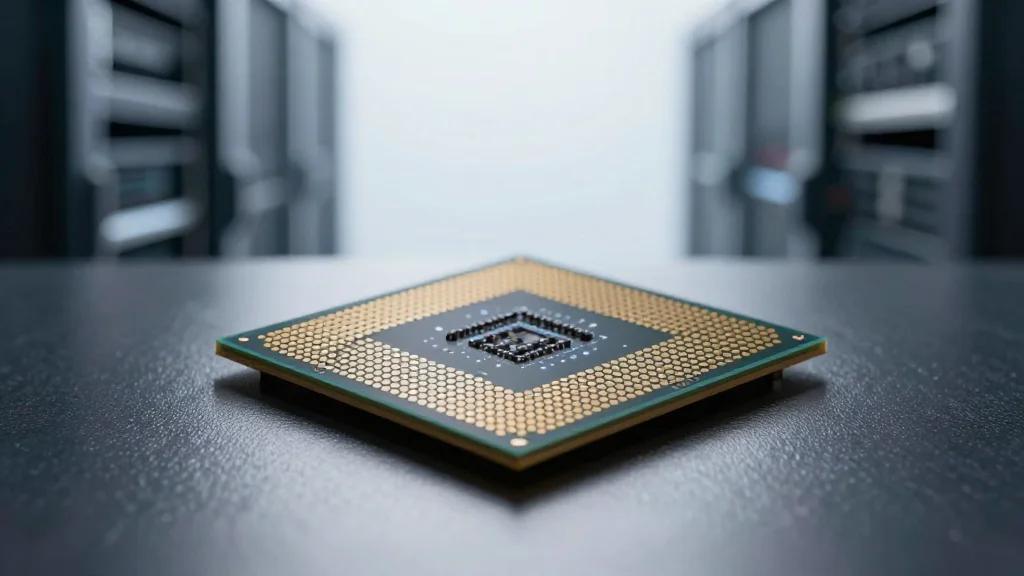
Arm Unveils First Data‑Center CPU, the AGI Chip, to Power Agentic AI



Why It Matters
Arm’s entry into production silicon for data centers directly addresses the bottlenecks that AI developers face today: power constraints, limited rack space and the need for sophisticated workload orchestration. By providing a purpose‑built CPU that integrates with its existing IP ecosystem, Arm reduces the engineering burden on partners, enabling faster deployment of large‑scale AI services. The collaboration with Meta also validates the chip’s suitability for the most demanding AI workloads, potentially accelerating adoption across cloud providers and enterprise AI stacks. The move reshapes the competitive dynamics of the AI hardware market. Intel and AMD have long dominated the data‑center CPU space, while Nvidia focuses on GPUs and specialized accelerators. Arm’s flexible, licensing‑centric model now offers a third option that blends customizability with ready‑made silicon, which could attract customers seeking a balance between performance, power efficiency and design freedom. If the AGI CPU meets its promised efficiency targets, it may spur a broader shift toward heterogeneous compute architectures that rely on a central, low‑power CPU to coordinate diverse accelerators.
Key Takeaways
- •Arm introduced the Arm AGI CPU, its first data‑center processor, co‑developed with Meta.
- •The new chip adds a production silicon tier to Arm’s 35‑year IP licensing model.
- •Designed to address power, space and coordination challenges of large‑scale agentic AI.
- •Meta serves as lead partner, optimizing the CPU for massive AI inference workloads.
- •Arm plans limited shipments later in 2026 with broader availability in 2027.
Pulse Analysis
Arm’s strategic pivot to production silicon reflects a broader industry trend: the convergence of general‑purpose CPUs and specialized AI accelerators into tightly coupled heterogeneous systems. Historically, Arm’s strength lay in licensing low‑power designs for mobile and embedded devices, while data‑center CPUs were the domain of x86 incumbents. By delivering the AGI CPU, Arm is effectively bridging that gap, offering a CPU that is both power‑efficient and capable of orchestrating complex AI pipelines. This could lower the total cost of ownership for AI workloads, as customers can rely on a single vendor for both the orchestration layer and the IP needed to build custom accelerators.
The partnership with Meta is a litmus test for the chip’s real‑world performance. Meta’s AI workloads are among the most demanding, requiring sustained inference at scale across globally distributed data centers. If the AGI CPU can meet Meta’s throughput and efficiency targets, it will serve as a compelling reference design for other cloud providers. Moreover, the collaboration signals confidence that Arm’s architecture can compete on performance per watt—a critical metric as data‑center operators grapple with rising energy costs and sustainability mandates.
Looking forward, the success of the AGI CPU will hinge on ecosystem adoption. Arm must convince silicon partners to integrate the CPU with their own accelerators and memory solutions, preserving the flexibility that has defined its business model. Should the platform gain traction, we could see a new wave of AI‑centric servers that blend Arm’s low‑power CPU with Nvidia‑style GPUs, Google‑style TPUs or emerging RISC‑V accelerators, creating a truly modular compute stack. This modularity could accelerate innovation cycles, reduce time‑to‑market for AI services, and ultimately reshape the hardware foundation of the next generation of agentic AI.
Arm Unveils First Data‑Center CPU, the AGI Chip, to Power Agentic AI
Comments
Want to join the conversation?
Loading comments...