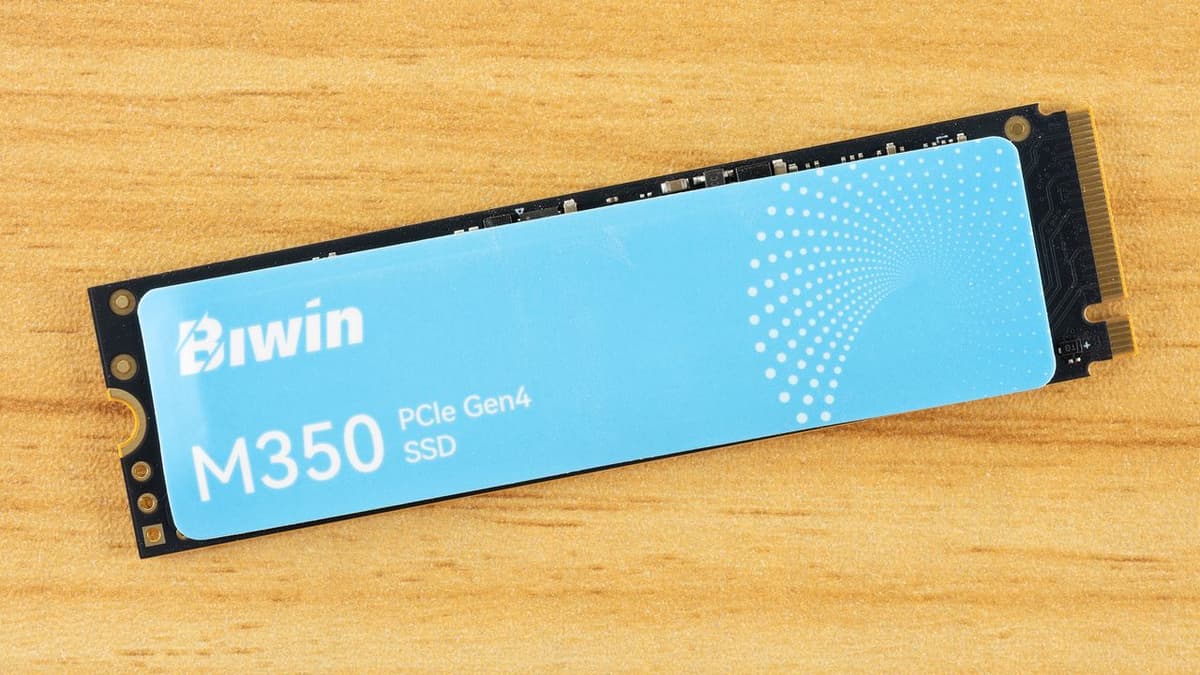
Biwin M350 2TB SSD Review: A Better Budget Alternative?
Companies Mentioned
Why It Matters
By delivering PCIe 4.0 performance at a sub‑$150 price point, the M350 expands affordable high‑speed storage for laptops and secondary drives, pressuring incumbent brands. Its power efficiency and warranty also make it attractive for mobile and budget‑conscious users.
Key Takeaways
- •Biwin M350 offers PCIe 4.0 speeds up to 5.2 GB/s read
- •QLC flash delivers lower sustained write performance than competitors
- •DRAM‑less design with HMB keeps power draw under 6.6 W
- •Five‑year warranty and 400 TBW per terabyte match budget SSD norms
- •Single‑sided M.2 form factor suits thin laptops
Pulse Analysis
The SSD market has accelerated toward PCIe 4.0, yet most high‑speed drives still carry premium price tags that deter cost‑sensitive buyers. QLC NAND, with its higher bit‑per‑cell density, offers manufacturers a path to lower bill‑of‑materials, but historically it has suffered from sluggish sustained writes and limited endurance. As laptop thickness constraints tighten, a single‑sided M.2 solution that balances speed, power draw, and price becomes increasingly valuable. Biwin’s M350 enters this niche, promising flagship‑class read rates while keeping the total cost of ownership modest.
The M350 pairs Micron’s 232‑layer QLC flash with Silicon Motion’s SM2268XT2 controller, a DRAM‑less chip that relies on Host Memory Buffer (HMB) for cache. In practice, the drive delivers 5,200 MB/s sequential reads and up to 600 K IOPS random writes on the 2 TB model, rivaling many TLC‑based competitors in burst scenarios. Power consumption stays under 6.6 W, an advantage for thin‑and‑light notebooks. However, sustained writes plateau at 4.8 GB/s, and the lack of onboard DRAM can cause latency spikes during prolonged transfers, a trade‑off typical of budget QLC drives.
For consumers upgrading older laptops or adding secondary storage to a desktop, the M350 offers a compelling blend of speed and efficiency at a price likely under $150 for the 2 TB capacity. Its five‑year warranty and 400 TBW per terabyte endurance align with industry expectations for QLC, mitigating reliability concerns for everyday workloads. OEMs may also adopt the drive to meet thin‑form‑factor designs without inflating BOM costs. While power users should still consider TLC or NVMe 3.0 alternatives for intensive write tasks, the M350 solidifies Biwin’s reputation as a serious budget SSD contender.
Biwin M350 2TB SSD Review: A Better Budget Alternative?
Comments
Want to join the conversation?
Loading comments...