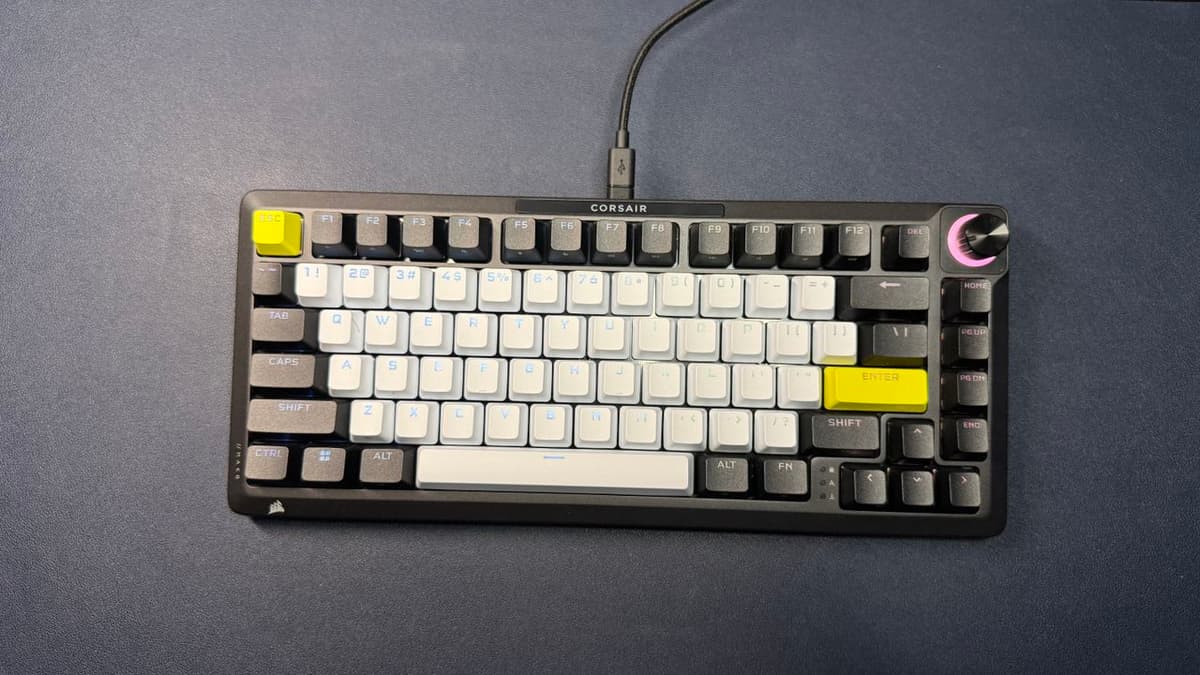
Corsair Makr Pro 75 Review: Not DIY-Priced (or DIY)
•February 21, 2026
0
Companies Mentioned

Why It Matters
The Makr Pro 75 illustrates how major OEMs are targeting the high‑end enthusiast segment, but its premium pricing forces buyers to weigh brand convenience against cheaper DIY alternatives, shaping competitive dynamics in the mechanical‑keyboard market.
Key Takeaways
- •$250 price, upgrades exceed $350 total.
- •Magnetic MGX switches offer 8 000 Hz polling.
- •Aluminum case, gasket‑mounted PCB, double‑shot PBT caps.
- •Typing feel stiff, sound bright and crisp.
- •Competitors deliver similar specs for $70‑$200.
Pulse Analysis
Magnetic‑switch keyboards have moved from niche hobbyist projects to mainstream products, driven by demand for ultra‑low latency and modularity. Corsair’s Makr Pro 75 leverages Hall‑Effect technology to deliver 8 000 Hz polling, a feature once reserved for boutique builds. The board’s aluminum chassis, gasket‑mounted PCB, and detachable braided USB‑C cable signal a shift toward premium materials, positioning the product as a ready‑made alternative for users who lack the time or expertise to assemble a custom rig.
In practice, the Makr Pro 75’s specifications sit squarely between high‑end DIY kits and entry‑level gaming keyboards. Its MGX Hyperdrive switches are pre‑lubed, linear, and adjustable, offering a tactile experience comparable to enthusiast models like Lemokey’s L5 HE 8K, which retails for roughly $199. However, the Makr’s $250 base price—and optional LCD ($49.99) and wireless ($79.99) upgrades—inflate the total cost well above $350. Competitors such as the Magger 68 provide similar magnetic switch performance for under $70, underscoring a price‑performance gap that may deter cost‑conscious buyers.
For the broader market, Corsair’s approach highlights a strategic gamble: capture premium‑segment users who value brand support and out‑of‑the‑box readiness, while risking alienation of the DIY community that prioritizes value and customization. As more manufacturers release magnetic keyboards, price competition is likely to intensify, potentially driving down costs and encouraging feature parity. Consumers will need to assess whether the convenience of a fully assembled, branded board justifies its premium over comparable, self‑built solutions.
Corsair Makr Pro 75 Review: Not DIY-priced (or DIY)
0
Comments
Want to join the conversation?
Loading comments...