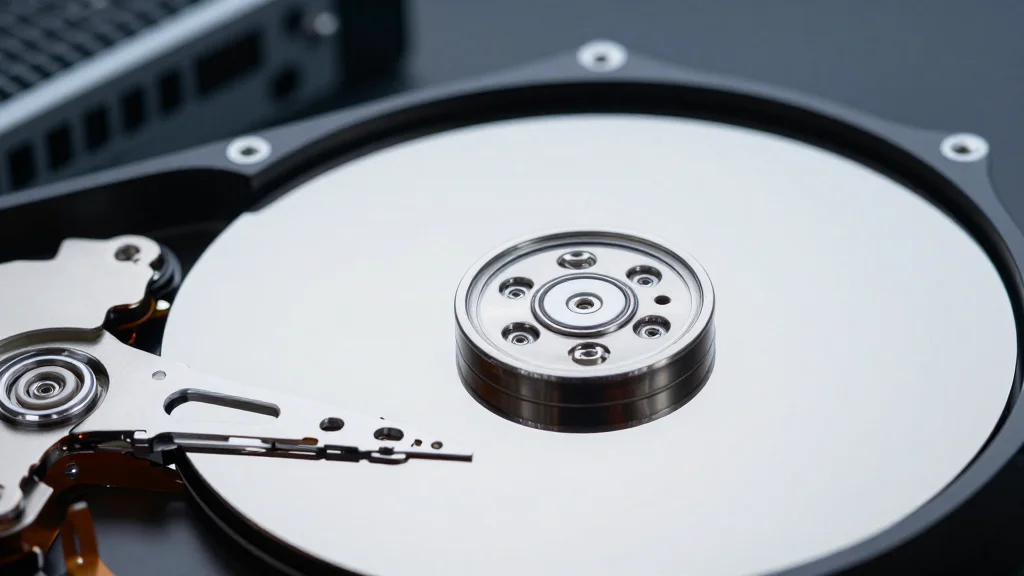
Discovering Hard Disk Physical Geometry Through Microbenchmarking (2019)

Companies Mentioned
Why It Matters
Understanding HDD physical geometry enables more accurate performance modeling, capacity planning, and failure prediction, which are critical for data‑center efficiency and storage‑system design.
Key Takeaways
- •Microbenchmarks can map RPM, sector angles, and track boundaries of HDDs.
- •Full‑stroke seeks require 1.3–3.6 revolutions; short‑stroking yields modest gains.
- •Modern drives have diverse layouts, skew up to 72°, variable zone sizes.
- •Acoustic Management slows long seeks up to 55%; short seeks unchanged.
- •Geometry measurements expose surface count and defect patterns across 45 MB–5 TB HDDs.
Pulse Analysis
Hard‑disk drives remain the workhorse for high‑capacity storage, yet their internal architecture is opaque to most system administrators. By applying microbenchmarking techniques—precise timing of sector reads—engineers can reverse‑engineer key physical parameters such as rotational speed, sector angular position, and track boundaries. This granular view goes beyond traditional throughput and latency metrics, revealing how many recording surfaces a drive possesses, the exact pitch between tracks, and the distribution of defective sectors. Such data empowers storage architects to fine‑tune placement strategies, predict wear patterns, and select drives that align with specific workload characteristics.
The study also highlights how modern HDDs have diverged from legacy design assumptions. Full‑stroke seeks now span 1.3 to 3.6 revolutions, meaning that even short random accesses incur significant mechanical latency. While short‑stroking—confining data to outer tracks—can shave a modest 20 % off random IOPS, the benefit dwindles compared to solid‑state alternatives. Moreover, contemporary drives employ a variety of track layouts, from head‑first to seek‑first schemes, and exhibit skew angles up to 72°, reflecting sophisticated zone‑bit recording and density optimization. Acoustic Management further complicates performance profiling by deliberately throttling long seeks to reduce audible noise, a factor that must be accounted for in latency‑sensitive environments.
For enterprises, these insights translate into actionable decisions. Accurate geometry profiling helps in building realistic performance models, optimizing RAID configurations, and improving predictive failure analysis by pinpointing defect clusters. As storage densities continue to climb—drives now pack billions of sectors into nanometer‑scale tracks—microbenchmark‑driven diagnostics become essential tools for maintaining reliability and extracting maximum value from legacy HDD investments while planning migrations to newer storage technologies.
Discovering Hard Disk Physical Geometry Through Microbenchmarking (2019)
Comments
Want to join the conversation?
Loading comments...