DRAM Revenue Soars 81% to $97 Bn as AI Server Demand and Supply Constraints Push Memory Prices Higher
Companies Mentioned
Why It Matters
The price and supply dynamics create a rare profit window for memory makers, while raising cost pressures for downstream tech firms that rely on DRAM. This shift reshapes capital allocation across the semiconductor ecosystem and signals sustained upside for AI‑focused hardware providers.
Key Takeaways
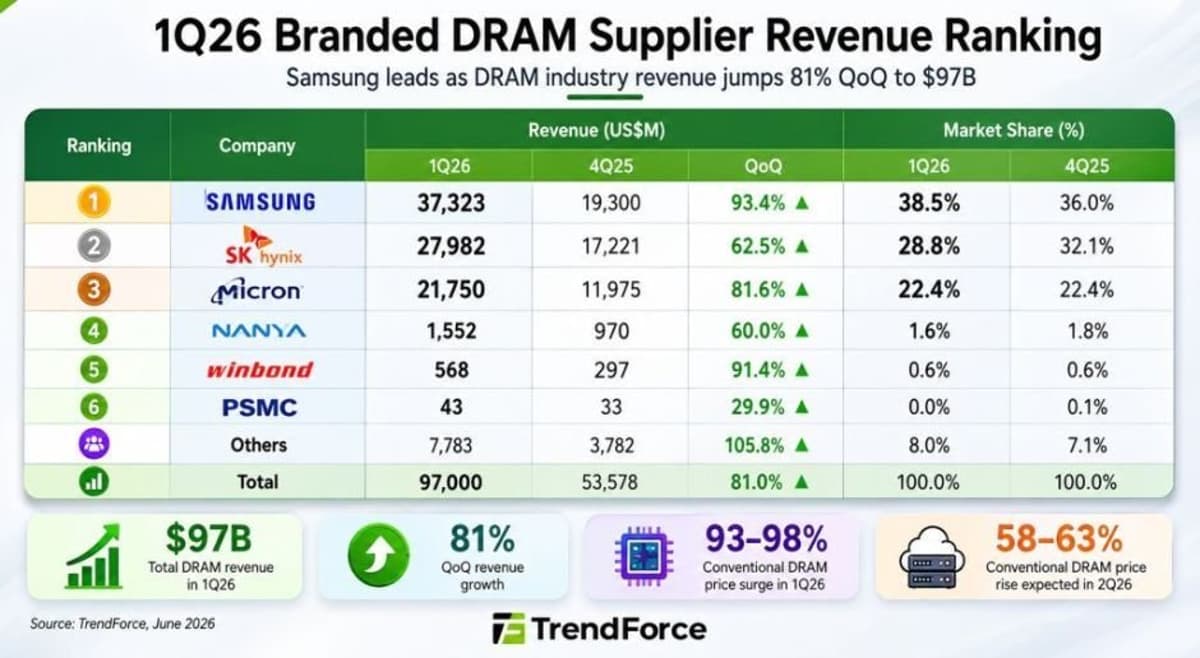
- •DRAM Q1 2026 revenue hit $97 bn, up 81% YoY
- •Samsung led with $37.3 bn revenue, 38.5% market share
- •AI server demand drives 93‑98% jump in contract prices
- •Supply tightness forces manufacturers to prioritize high‑capacity RDIMMs
- •Prices forecast to rise another 58‑63% in Q2 2026
Pulse Analysis
The 2026 first‑quarter DRAM boom reflects a broader transformation in data‑center architecture, where AI workloads are migrating from pure training to inference at scale. Cloud operators are loading general‑purpose servers with larger memory footprints to support diverse models, inflating demand for a wide range of RDIMM products beyond niche high‑bandwidth offerings. This shift has propelled contract prices upward, delivering the steepest price gains the sector has seen in a decade and reinforcing memory as a strategic commodity for AI infrastructure.
Supply constraints are intensifying as fab capacity expansions lag behind demand. Leading vendors such as Samsung, SK Hynix, and Micron are channeling production capacity toward premium server‑grade DRAM, which carries higher margins, while PC and smartphone manufacturers face dwindling inventories. The resulting scarcity forces downstream OEMs to absorb higher component costs or defer product launches, potentially slowing consumer‑grade device cycles. Meanwhile, smaller players like Nanya and Winbond are capitalizing on niche DDR4/DDR3 price spikes, illustrating how differentiated product mixes can capture upside in a tight market.
Looking ahead, the confluence of sustained AI investment, limited fab ramp‑up time, and aggressive pricing strategies suggests that DRAM profitability will remain elevated throughout 2026. Investors should monitor capacity‑expansion announcements and licensing deals—such as PSMC’s partnership with Micron—as leading indicators of future supply elasticity. Companies that can balance high‑margin server memory production with flexible, cost‑effective solutions for consumer devices are poised to capture the most value as the memory market continues its AI‑driven renaissance.
DRAM Revenue Soars 81% to $97 bn as AI Server Demand and Supply Constraints Push Memory Prices Higher
Comments
Want to join the conversation?
Loading comments...