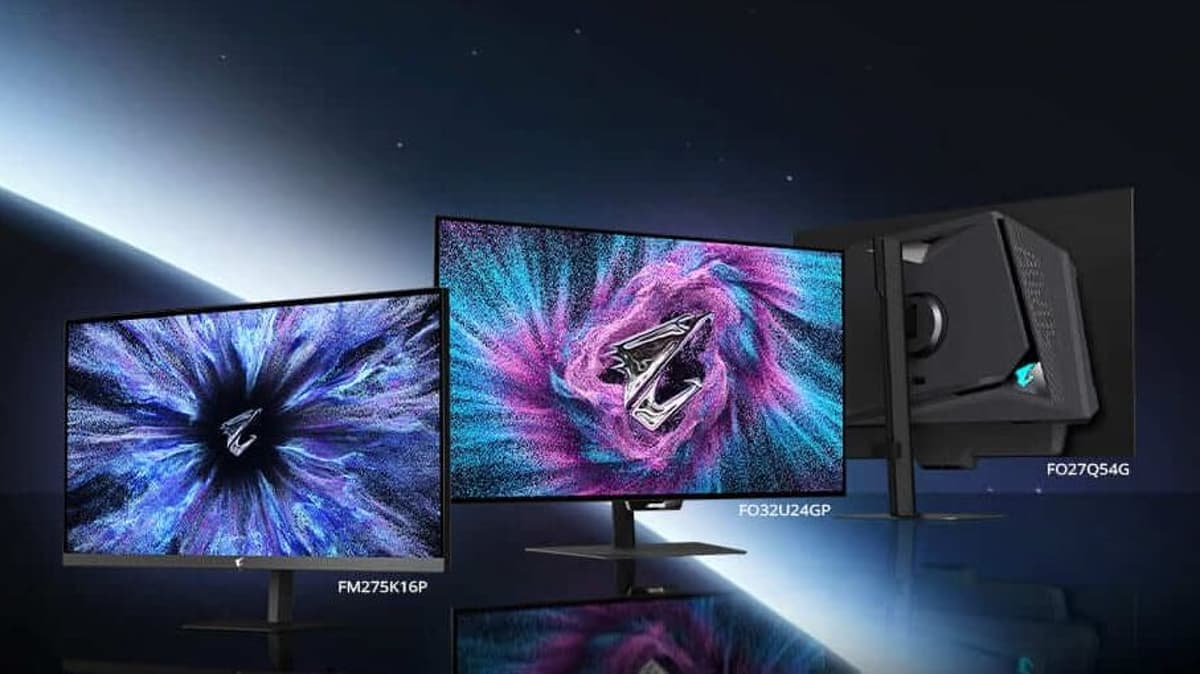
Gigabyte Debuts Fourth-Gen Tandem WOLED and Multi-Mode Mini LED Gaming Monitors — 27 to 32 Inches, up to 480 Hz, and up to 5K Resolution
Why It Matters
These monitors push refresh‑rate and brightness limits, giving competitive gamers and content creators unprecedented visual performance, and signal Gigabyte’s aggressive push into premium display technology.
Key Takeaways
- •FO32U24GP offers 240 Hz 4K, 480 Hz at 1080p
- •0.03 ms response time and 1,500 nits peak brightness
- •Dual‑mode monitors use DisplayPort 2.1 UHBR20 for 80 Gbps bandwidth
- •FM275K16P provides 5K 165 Hz, 4K 220 Hz, QHD 330 Hz
- •Mini‑LED model has 2,304 local dimming zones, 1,250 nits HDR
Pulse Analysis
Gigabyte’s latest Aorus Elite line showcases how display manufacturers are leveraging both OLED and Mini‑LED technologies to meet the insatiable demand for higher frame rates and richer colors. The FO32U24GP’s dual‑mode capability, which doubles refresh rates when dropping resolution, caters to esports athletes who prioritize fluid motion over pixel density. Coupled with a 0.03 ms response time and 1,500 nits brightness, the panel promises minimal motion blur and vivid HDR experiences, positioning it against rivals like Samsung’s Odyssey and ASUS’s ROG series.
The inclusion of DisplayPort 2.1 UHBR20 in the premium models underscores Gigabyte’s focus on future‑proof bandwidth, essential for Nvidia’s RTX 50‑series GPUs that can push 8K at high refresh rates. By offering a cost‑effective FO32U24G variant without UHBR20, the company addresses price‑sensitive segments while still delivering the core OLED performance. Meanwhile, the FM275K16P’s Mini‑LED architecture, featuring 2,304 local dimming zones and 1,250 nits HDR peak, illustrates a shift toward hybrid solutions that balance OLED’s contrast with Mini‑LED’s brightness scalability.
For professional gamers and creators, these monitors translate into tangible productivity gains. Higher refresh rates reduce input latency, improving reaction times in fast‑paced titles, while expansive DCI‑P3 coverage ensures color‑critical work remains accurate. As the industry moves toward multi‑mode displays that can adapt resolution and refresh dynamically, Gigabyte’s portfolio signals a broader trend: manufacturers will increasingly prioritize flexibility, longevity tools, and connectivity standards that accommodate next‑gen graphics hardware.
Gigabyte debuts fourth-gen Tandem WOLED and multi-mode Mini LED gaming monitors — 27 to 32 inches, up to 480 Hz, and up to 5K resolution
Comments
Want to join the conversation?
Loading comments...