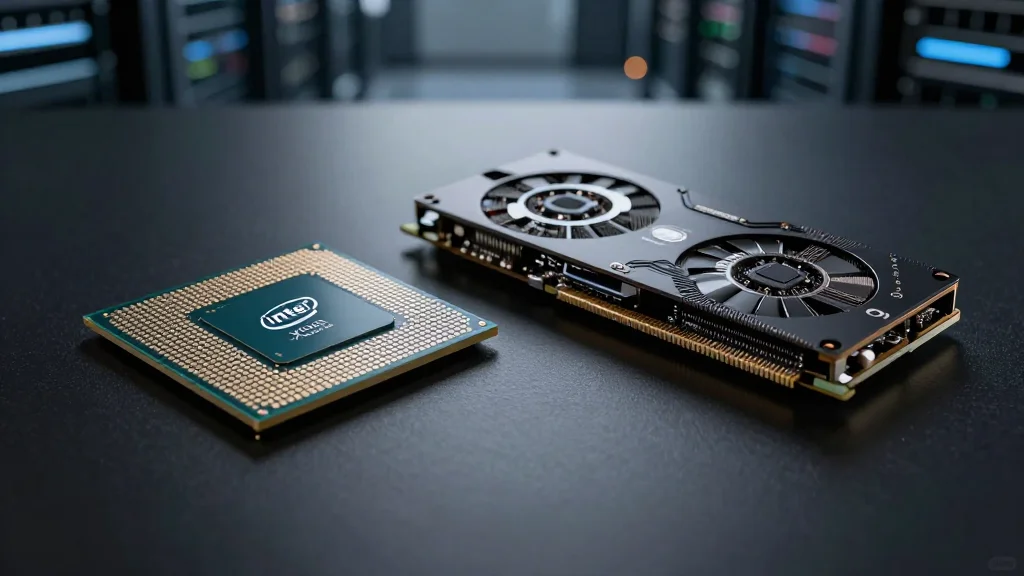
Google Cloud Expands Intel Xeon 6 Partnership, Boosting AI Hardware Rollout

Companies Mentioned
Why It Matters
The deeper Intel‑Google partnership reshapes the competitive dynamics of AI infrastructure. By adding high‑performance CPUs to its AI stack, Google can mitigate reliance on a single accelerator vendor, offering customers a more heterogeneous compute environment that may lower total cost of ownership. For Intel, the deal provides a high‑visibility reference customer that could accelerate adoption of its Xeon 6 line across other hyperscalers and enterprise clouds, helping the company reclaim relevance in a market where GPUs have eclipsed CPUs for AI workloads. The move also signals a broader industry shift toward balanced architectures. As AI models become more complex, workloads increasingly demand a mix of CPU‑intensive preprocessing, GPU‑heavy training, and low‑latency inference. Cloud providers that can seamlessly blend these resources are likely to win larger enterprise contracts, making the Intel‑Google collaboration a strategic lever in the race for AI compute supremacy.
Key Takeaways
- •Google Cloud will integrate Intel's Xeon 6 CPUs for AI training and inference across multiple data‑center regions.
- •Intel CEO Lip‑Bu Tan emphasized the need for "balanced systems" to scale AI workloads.
- •The partnership aims to improve performance‑per‑watt by up to 30% for mixed‑precision AI tasks.
- •Google's shares rose alongside Intel's after the announcement, reflecting investor confidence.
- •The deal adds a CPU‑centric layer to Google's AI stack, challenging Nvidia's dominant accelerator position.
Pulse Analysis
Intel's renewed focus on AI through the Xeon 6 line reflects a strategic pivot from its traditional server market to a more specialized compute niche. Historically, CPUs have been sidelined in AI discussions, with GPUs and custom ASICs taking the spotlight. By securing Google Cloud—a leading hyperscale provider—as a flagship customer, Intel gains a powerful validation that could unlock further contracts with other cloud giants like Microsoft Azure and Amazon Web Services. The "balanced systems" narrative also addresses a real pain point: the supply chain volatility that has plagued GPU manufacturers, especially during the recent semiconductor shortages.
From Google's perspective, the partnership is a risk‑mitigation play. While its custom TPUs excel at matrix multiplication, many AI pipelines still rely on CPU‑heavy stages such as data ingestion, feature engineering, and model serving. Adding Xeon 6 processors allows Google to offload these tasks to a proven, high‑performance CPU platform, freeing TPU and GPU capacity for the most compute‑intensive phases. This diversification could translate into more competitive pricing for enterprise customers, who often balk at the premium associated with GPU‑only solutions.
Looking ahead, the Intel‑Google alliance may force Nvidia to accelerate its own roadmap or deepen its collaborations with other cloud providers. If Google can demonstrate cost and performance advantages with a heterogeneous stack, it could set a new industry benchmark that reshapes procurement decisions across the AI ecosystem. The next 12 months will reveal whether the Xeon 6 integration delivers the promised efficiency gains and whether competitors can match Intel's renewed momentum.
Google Cloud expands Intel Xeon 6 partnership, boosting AI hardware rollout
Comments
Want to join the conversation?
Loading comments...