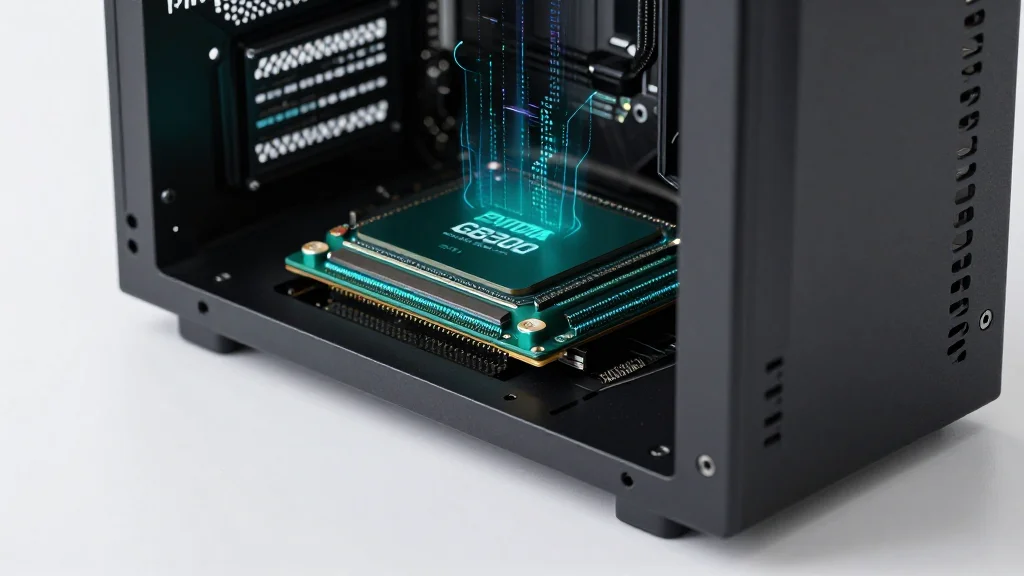
HP Launches GB300 Grace Blackwell AI Workstation with 784 GB Memory

Companies Mentioned

Why It Matters
The ZGX Fury GB300 marks a shift toward bringing data‑center‑level AI performance to the desktop, potentially redefining how enterprises deploy and manage large language models. By integrating Nvidia's GB300 superchip with a Windows‑centric ecosystem, HP lowers the barrier for organizations that need to keep sensitive data on‑premise while still accessing cutting‑edge AI capabilities. If the platform gains traction, it could accelerate the adoption of on‑premise AI across sectors such as finance, healthcare, and manufacturing, where data privacy and latency are critical. The move also intensifies competition among OEMs to offer turnkey AI solutions, prompting faster innovation and price competition in the high‑performance workstation market.
Key Takeaways
- •HP's ZGX Fury GB300 workstation features Nvidia's GB300 Grace Blackwell superchip and up to 784 GB unified memory.
- •The system can handle inference workloads of up to one trillion parameters on Windows.
- •Pricing is expected to align with Nvidia's DGX Station, ranging from $94,000 to under $200,000.
- •Launch slated for Q4 2026, coinciding with Nvidia's DGX Station release.
- •Targeted at enterprise AI developers, the workstation aims to replace cloud‑based inference for sensitive workloads.
Pulse Analysis
HP's entry into the AI‑centric workstation arena reflects a broader industry trend: moving massive models from the cloud to the edge. Historically, only a handful of vendors could deliver petaflop‑scale compute in a form factor that fits under a desk. By leveraging Nvidia's GB300 Grace Blackwell chip, HP sidesteps the need to develop its own silicon while still offering a differentiated product that integrates tightly with Windows—a platform that dominates enterprise desktops.
The strategic timing is notable. Computex 2026 showcased a convergence of AI hardware announcements, and Nvidia's simultaneous GTC keynote underscored a partnership model where OEMs act as distribution channels for Nvidia's superchips. HP's pricing strategy, likely mirroring the DGX Station, suggests the company is not chasing volume but rather aiming for high‑margin, high‑value contracts with organizations that cannot outsource AI workloads due to regulatory or latency constraints.
Looking ahead, the success of the GB300 will hinge on software support and ecosystem development. HP's promise of integrated Windows and Linux toolchains, along with open‑source AI frameworks, could lower adoption friction. However, competitors like Dell and MSI are rolling out comparable solutions, and cloud providers continue to lower the cost of remote inference. HP must therefore demonstrate clear total‑cost‑of‑ownership benefits—such as reduced data transfer fees, compliance advantages, and faster time‑to‑insight—to persuade enterprises to invest in a $100k‑plus workstation. If it can, the GB300 could become a reference architecture for on‑premise AI, reshaping procurement decisions for years to come.
HP launches GB300 Grace Blackwell AI workstation with 784 GB memory
Comments
Want to join the conversation?
Loading comments...