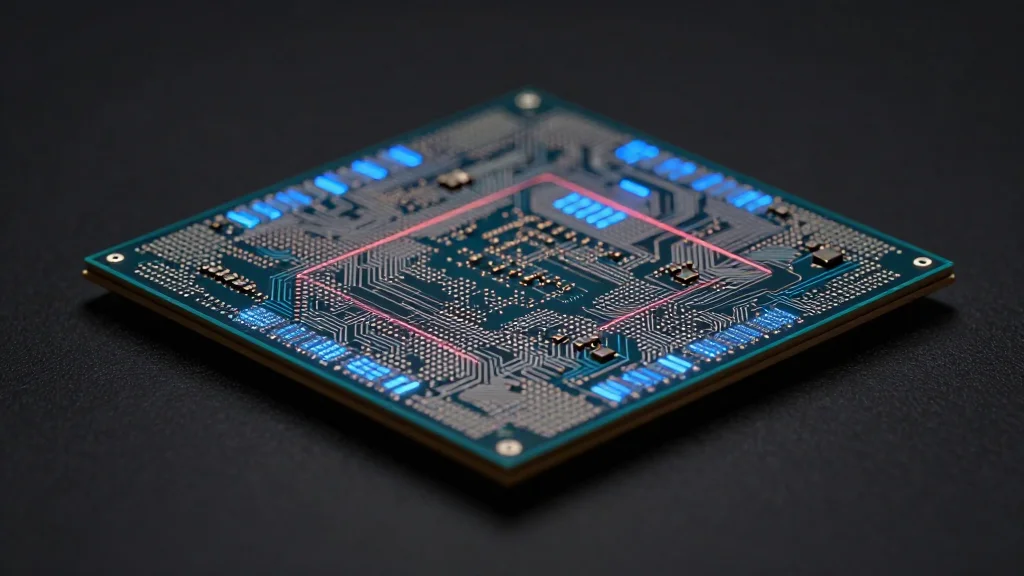
Imec Adds High-Density MIMCAPs, Passive Modeling and Laser-Assisted Bonding to 300mm RF Silicon Interposer Platform
Companies Mentioned
Why It Matters
Merging III‑V performance with Si‑CMOS scalability reduces system cost, size, and power while unlocking sub‑THz applications, giving designers a predictable path to heterogeneous integration. The platform’s manufacturability promises faster time‑to‑market for next‑generation high‑frequency products.
Key Takeaways
- •MIMCAP density up to 100× higher than typical III‑V on‑chip capacitors
- •Modeling framework predicts passive behavior up to ~300 GHz without re‑simulation
- •Laser‑assisted bonding aligns chiplets within 600 nm, rotation <0.05°
- •RF insertion loss stays below 0.1 dB at 140 GHz, 0.2 dB at 325 GHz
- •Platform targets low‑volume production for mmWave, sub‑THz wireless and data‑center links
Pulse Analysis
The drive toward mmWave and sub‑THz communications is reshaping both wireless infrastructure and data‑center interconnects. Traditional monolithic approaches struggle with the power, loss, and cost penalties of scaling to these frequencies. Heterogeneous integration—pairing high‑gain III‑V chiplets with a silicon interposer—offers a pragmatic route, leveraging the mature Si‑CMOS ecosystem for routing and passive functions while preserving the superior electronic properties of materials like InP, GaAs, and GaN.
Imec’s latest platform upgrades address three critical bottlenecks. First, its new MIMCAP architecture uses a high‑k aluminium‑hafnium‑oxide dielectric and 3‑D oxide studs to boost capacitance density dramatically, freeing valuable chiplet real estate for active circuits. Second, a predictive modeling framework now spans up to 300 GHz, allowing designers to iterate passive layouts without exhaustive EM simulations, accelerating development cycles. Third, laser‑assisted bonding provides sub‑micron alignment and minimal thermal impact, enabling dense, passives‑rich stacks while maintaining RF integrity, as evidenced by reflections better than ‑15 dB across the 110‑170 GHz band.
The commercial implications are significant. By delivering a turnkey, low‑volume‑ready solution, Imec lowers the barrier for startups and established OEMs to prototype and qualify sub‑THz products, from 5G‑Advanced radios to optical‑to‑electrical converters for data‑center links. As standards evolve toward terahertz‑band operation, the ability to integrate III‑V performance with silicon’s cost‑effective manufacturing will become a decisive competitive advantage, positioning the platform as a foundational building block for the next wave of high‑frequency technology.
Imec adds high-density MIMCAPs, passive modeling and laser-assisted bonding to 300mm RF silicon interposer platform
Comments
Want to join the conversation?
Loading comments...