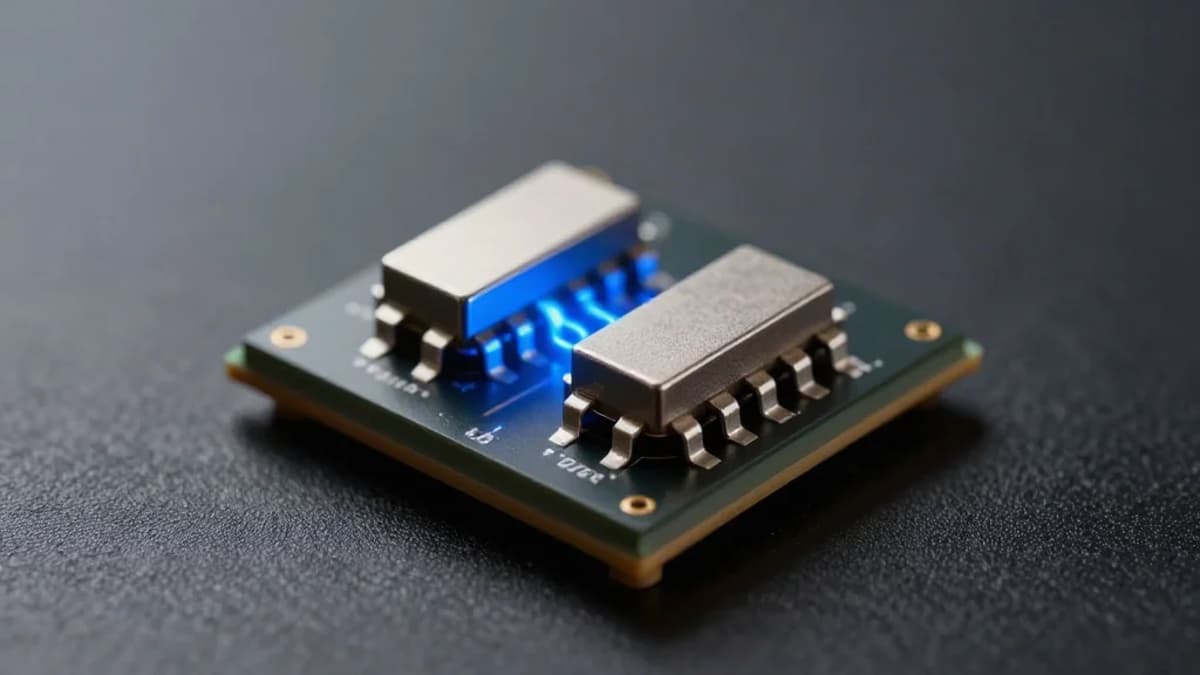
Infineon Adds to CoolGaN Drive HB 600V G5 Product Family
•February 27, 2026
0
Why It Matters
By consolidating key GaN functions into a single footprint, Infineon accelerates time‑to‑market for high‑efficiency power converters, lowering design risk and cost for industrial and consumer applications.
Key Takeaways
- •Four new 600 V GaN half‑bridge ICs launched.
- •Integrated drivers cut external components, simplify PCB layout.
- •98 ns propagation delay enables ultra‑fast switching.
- •6 mm×8 mm TFLGA‑27 package supports heatsink‑less designs.
- •Targets low‑power motor drives and SMPS efficiency gains.
Pulse Analysis
Gallium‑nitride (GaN) continues to reshape power conversion by delivering higher switching frequencies and lower losses than silicon. Industry analysts predict the GaN market to exceed $10 billion by 2028, driven by demand for compact, high‑efficiency solutions in electric vehicles, data centers, and consumer electronics. Infineon’s CoolGaN line has been a cornerstone of this shift, offering discrete switches and integrated modules that balance performance with reliability. The latest HB 600V G5 family builds on this momentum, providing a turnkey half‑bridge that abstracts much of the traditional design complexity associated with GaN.
The new devices combine two 600 V GaN transistors with integrated high‑ and low‑side gate drivers, a bootstrap diode, and a single 12 V supply. This architecture delivers a 98 ns propagation delay and tight turn‑on/off timing, enabling designers to push switching frequencies into the megahertz range without sacrificing stability. The TFLGA‑27 package, featuring exposed pads, spreads heat efficiently, often eliminating the need for external heatsinks. For low‑power motor‑drive modules and switched‑mode power supplies, the reduced external component count translates directly into smaller magnetics, thinner PCBs, and lower bill‑of‑materials.
Strategically, the HB 600V G5 launch reinforces Infineon’s position as a leading GaN supplier, addressing a key barrier to adoption: system‑level integration. By offering a ready‑to‑use solution that merges performance and ease of implementation, Infineon helps OEMs accelerate development cycles and mitigate risk, fostering broader GaN uptake across both industrial and consumer segments. As efficiency standards tighten and form‑factor constraints tighten, such integrated GaN modules are likely to become the default choice for next‑generation power architectures.
Infineon adds to CoolGaN Drive HB 600V G5 product family
0
Comments
Want to join the conversation?
Loading comments...