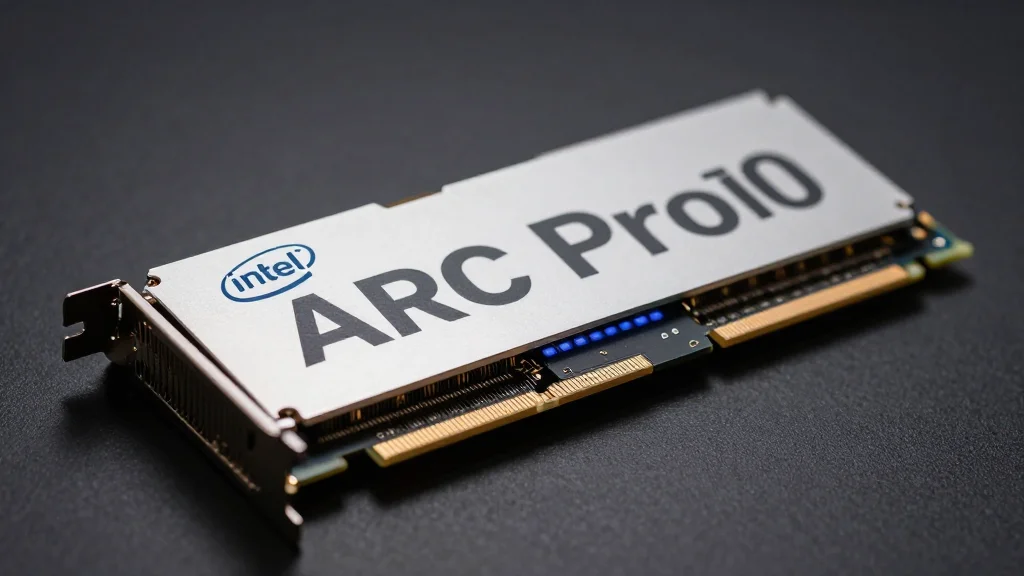
Intel Arc Pro B70 GPU Doubles Performance Over B580, Challenges RTX 5060 Ti

Companies Mentioned
Why It Matters
The Arc Pro B70's performance marks the first time Intel's professional GPU line has demonstrably closed the gap with Nvidia's entry‑level RTX 5060 Ti, a benchmark that could shift purchasing decisions in cost‑sensitive workstation markets. Larger VRAM capacity and competitive raster throughput make the B70 attractive for workloads such as 3D rendering, scientific visualization, and AI model training, where memory bandwidth often dictates real‑world productivity. If Intel can maintain this trajectory, the competitive dynamics of the workstation GPU segment could evolve from a near‑monopoly by Nvidia to a more contested arena, potentially driving down prices and spurring innovation in driver optimization and software tooling across the ecosystem.
Key Takeaways
- •Arc Pro B70 delivers 32.5% higher average raster performance than Arc B580 at 1440p.
- •B70 achieves 90 FPS in Cyberpunk 2077, outpacing RTX 5060 Ti's 79 FPS.
- •In combined raster and ray‑tracing tests, RTX 5060 Ti leads by only 2.9% over B70.
- •Ray‑tracing performance shows B70 1% ahead of RTX 5060 Ti on average.
- •B70's 32 GB VRAM and Battlemage silicon position it for high‑memory professional workloads.
Pulse Analysis
Intel's Arc Pro B70 represents a strategic inflection point for the company's GPU ambitions. Historically, Intel's foray into discrete graphics has been hampered by driver maturity and a lack of ecosystem support, limiting adoption beyond enthusiast segments. The B70's benchmark results suggest that the company has finally aligned silicon capability with a use case—high‑VRAM, workstation‑focused workloads—where the performance gap to Nvidia is less pronounced. By delivering a card that can compete with the RTX 5060 Ti on price‑to‑performance grounds, Intel may entice small‑to‑mid‑size studios and engineering firms that have been price‑constrained by Nvidia's premium pricing.
From a market dynamics perspective, the B70's emergence could force Nvidia to reconsider its pricing strategy for entry‑level workstation GPUs. Nvidia has historically leveraged its dominant driver stack and software suite to justify higher margins; a credible Intel alternative could erode that premium, especially if Intel continues to expand its driver support for professional applications. Moreover, the B70's success may accelerate Intel's roadmap, prompting faster rollout of next‑gen Battlemage GPUs with even more Xe‑cores and higher memory bandwidth, further compressing the performance gap.
The broader implication for the hardware industry is the validation of a multi‑vendor GPU ecosystem in the professional segment. Competition tends to drive innovation, and Intel's progress could catalyze improvements in power efficiency, AI acceleration, and cross‑vendor software standards. For end users, the key takeaway is that the next few quarters may bring more choices, better pricing, and potentially faster adoption of GPU‑accelerated workflows across a wider range of industries.
Intel Arc Pro B70 GPU Doubles Performance Over B580, Challenges RTX 5060 Ti
Comments
Want to join the conversation?
Loading comments...