Intel Launches 288‑core Xeon 6+ on 18A, the First 2nm‑class Server CPU

Companies Mentioned
Why It Matters
The Xeon 6+ redefines the performance‑per‑watt equation for server CPUs, giving data‑center operators a path to scale AI workloads without the power and cooling penalties of adding more GPUs. By centralizing orchestration on a high‑core‑count CPU, Intel aims to reduce latency and improve deterministic performance for agentic AI, which relies on rapid, concurrent request handling. Beyond immediate efficiency gains, the launch signals a broader industry pivot: CPUs are being engineered not just for traditional compute but as the backbone of AI systems that blend inference, data movement and networking. This could reshape vendor roadmaps, prompting rivals to prioritize core density and integrated accelerators over raw clock speed alone.
Key Takeaways
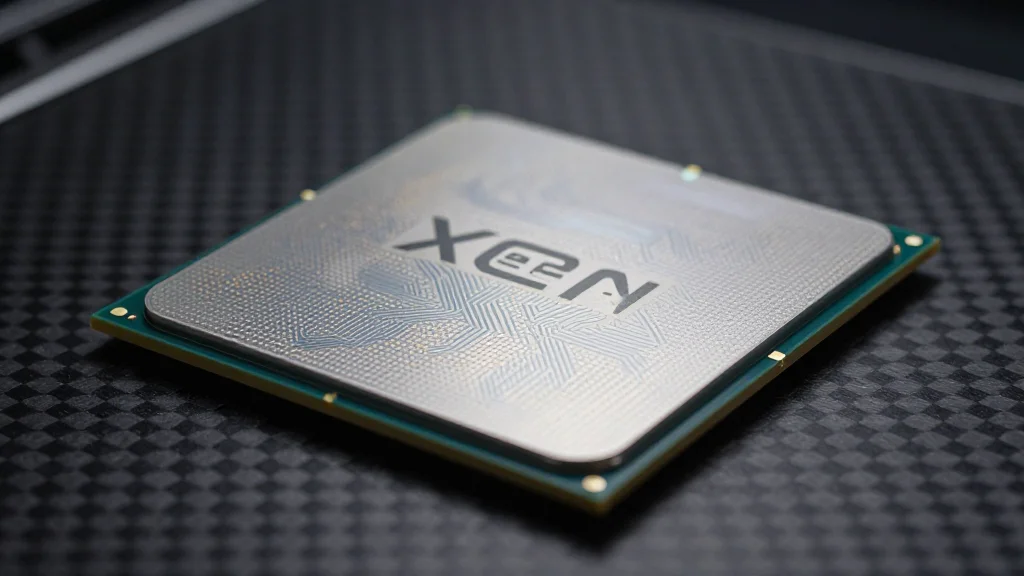
- •Intel unveiled the 288‑core Xeon 6+ built on the 18A (2nm‑class) process.
- •Up to 2.5× performance increase and 45 % better performance‑per‑watt versus the prior generation.
- •Chip uses a hybrid tile stack: twelve 24‑core 18A tiles plus three Intel 3 tiles for memory and cache.
- •Includes 16 on‑die accelerators for cryptography, compression and load‑balancing.
- •Competes directly with Nvidia’s 256‑core Vera CPUs and Arm’s 136‑core AGI CPU.
Pulse Analysis
Intel’s Clearwater Forest Xeon 6+ arrives at a moment when AI workloads are fragmenting into two camps: massive GPU‑driven training clusters and a growing class of agentic applications that demand low‑latency, high‑concurrency processing. By delivering unprecedented core density on a single socket, Intel is betting that the latter segment will expand faster than the former, especially in edge and hyperscale cloud environments where power budgets and rack space are at a premium.
Historically, Intel’s Xeon line has been the workhorse of enterprise servers, but the rise of specialized accelerators eroded its cache. The Xeon 6+ counters that trend by embedding 16 purpose‑built accelerators directly into the I/O dies, effectively blurring the line between CPU and accelerator. This integration could lower data‑movement overhead, a critical factor for agentic AI that shuffles data between storage, compute and network layers thousands of times per inference.
Competitors now face a strategic dilemma. Nvidia’s Vera CPUs, while powerful, still lag in core count and rely heavily on external networking solutions. Arm’s AGI CPU takes a similar approach but sacrifices wide vector units to save die area. Intel’s decision to retain a familiar socket and leverage existing motherboard designs lowers the barrier to adoption, potentially accelerating market penetration. If early benchmarks validate the claimed 2.5× performance uplift, the Xeon 6+ could become the de‑facto platform for AI orchestration, forcing rivals to either double down on GPU‑centric designs or pursue comparable high‑core‑count CPUs with integrated networking. The next six months will be a litmus test for whether core density alone can shift the balance of power in the data‑center AI ecosystem.
Intel launches 288‑core Xeon 6+ on 18A, the first 2nm‑class server CPU
Comments
Want to join the conversation?
Loading comments...