Jay Forrester Filed the First Practical Computer RAM Patent 75 Years Ago This Week — His Magnetic Core Memory Patent Would Be Granted Five Years Later
Companies Mentioned
Why It Matters
Core memory’s reliability and scalability enabled real‑time computing for defense and commercial systems, accelerating the computer age. The historic patent settlement highlighted the strategic value of hardware IP, shaping modern technology licensing practices.
Key Takeaways
- •Forrester filed magnetic core memory patent May 11, 1951.
- •Core memory powered MIT's Whirlwind and later SAGE defense network.
- •IBM settled $13 million patent dispute, largest payout then.
- •Patent granted 1956 after five-year delay; Forrester earned $1.5 million.
- •Core memory dominated computer RAM for two decades.
Pulse Analysis
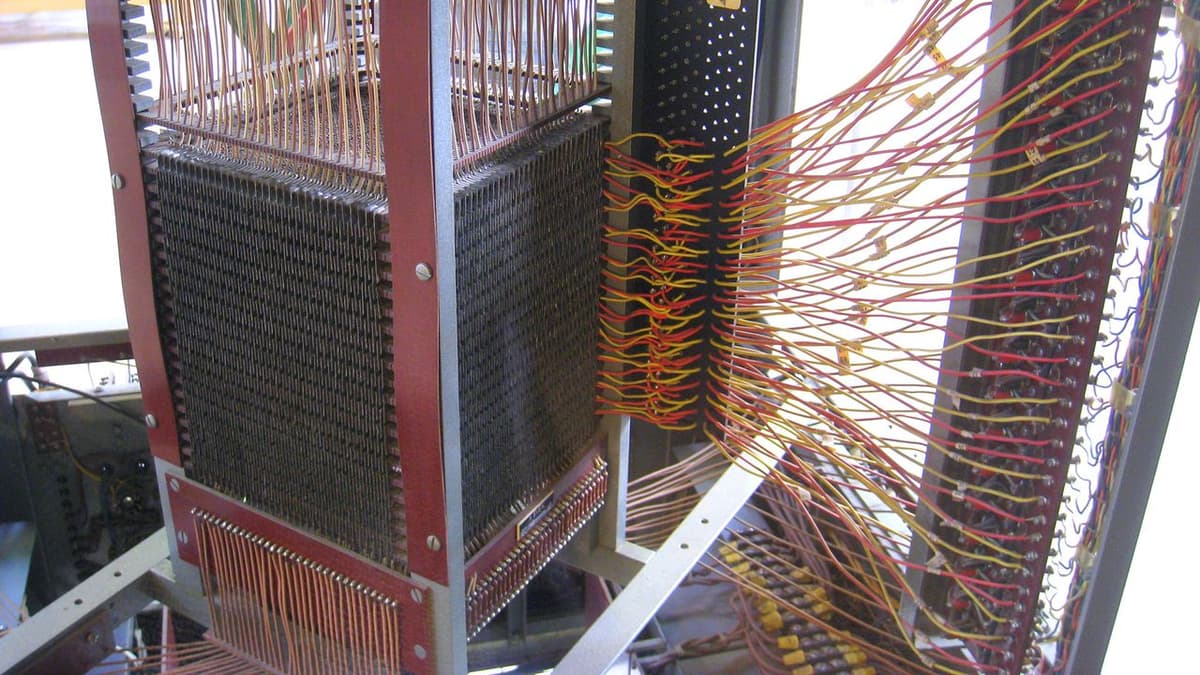
The early 1950s marked a turning point in computer engineering as vacuum‑tube memory proved fragile and slow for emerging real‑time applications. Jay Forrester’s coincident‑current magnetic core design replaced volatile tubes with ferrite rings that could be magnetized to store binary bits. By threading intersecting wires through a three‑dimensional grid, the system addressed millions of bits with a modest wire count, delivering unprecedented reliability and speed that made large‑scale digital processing feasible.
When the Whirlwind computer incorporated Forrester’s core banks in 1953, it demonstrated that real‑time tracking of aircraft could be achieved, directly feeding into the Semi‑Automatic Ground Environment (SAGE) network. SAGE’s 23 radar installations across North America relied on core memory’s fast, random access to process incoming data streams, a capability that kept the system operational well into the 1980s. The technology quickly spread to commercial mainframes, becoming the industry standard for RAM throughout the 1960s and 1970s, and laying the groundwork for later semiconductor memories.
The patent’s five‑year approval lag sparked a high‑stakes legal clash with IBM, RCA, and Harvard’s An Wang. After exhaustive evidence gathering, IBM settled for $13 million in 1964—then the largest patent award—while Forrester pocketed $1.5 million. The case underscored how foundational hardware innovations can become valuable intellectual‑property assets, a lesson that resonates in today’s semiconductor patent wars. Forrester’s legacy endures not only in the memory architectures that succeeded core memory but also in the strategic importance placed on protecting hardware inventions.
Jay Forrester filed the first practical computer RAM patent 75 years ago this week — his Magnetic Core Memory patent would be granted five years later
Comments
Want to join the conversation?
Loading comments...