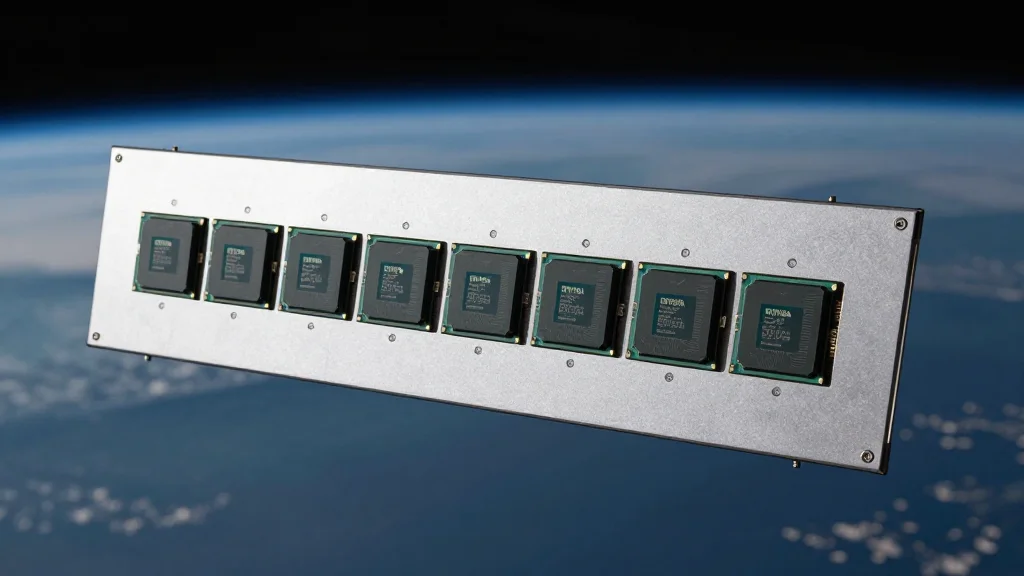
Kepler Communications Deploys 40‑GPU Orbital Cluster, Adds Sophia Space as First Software Partner

Companies Mentioned

Why It Matters
The Kepler‑Sophia partnership demonstrates that sophisticated compute workloads can be executed reliably in low‑Earth orbit, a capability that could reshape how satellite data is processed. By moving inference‑heavy AI models from ground stations to the edge of space, latency‑sensitive applications—such as real‑time SAR imaging for defense or rapid disaster‑response mapping—gain speed and resilience. Moreover, the venture offers a potential workaround for regions facing data‑center construction bans, positioning orbital compute as a strategic asset for both commercial and government users. If the test succeeds, it could catalyze a wave of niche satellite‑based compute services, prompting larger players to consider hybrid architectures that blend terrestrial and orbital processing. This would diversify the hardware supply chain, increase demand for space‑qualified GPUs, and accelerate standards for laser‑linked inter‑satellite networking.
Key Takeaways
- •Kepler’s constellation now hosts 40 Nvidia Orin edge processors across ten satellites – the largest GPU cluster in orbit.
- •Customer count rises to 18; Sophia Space becomes the newest partner to run software on six GPUs.
- •Kepler’s laser‑communication links enable low‑latency data transfer between satellites and ground stations.
- •Sophia is developing passively‑cooled space computers to avoid heavy active‑cooling systems.
- •U.S. military interest in on‑orbit processing for missile‑defense radar underscores defense relevance.
Pulse Analysis
Kepler’s incremental strategy—deploying modest GPU clusters now and scaling later—contrasts sharply with the grand‑scale visions of SpaceX’s Starlink‑based data centers or Blue Origin’s orbital factories. By focusing on inference workloads that run continuously, Kepler sidesteps the power‑inefficiency that plagues traditional training‑heavy GPUs, making its architecture economically viable in the power‑constrained orbital environment. This niche positioning could allow Kepler to capture early‑stage contracts from defense and remote‑sensing firms that need real‑time processing but cannot afford the latency of downlink‑only architectures.
The partnership with Sophia Space also signals a broader shift toward software‑centric value creation in space hardware. Historically, satellite manufacturers have sold hardware and launch services; now, the ability to upload and execute proprietary operating systems in orbit becomes a differentiator. If Sophia’s passively‑cooled design proves functional, it could lower the mass and cost barriers for future orbital compute nodes, encouraging a modular ecosystem where third‑party software providers plug into existing constellations.
Looking ahead, the key risk remains the reliability of laser‑linked inter‑satellite networks and the thermal management of GPUs in the harsh space environment. Successful in‑orbit demonstrations will likely attract venture capital, spurring a new wave of startups focused on orbital edge AI. Conversely, any failure could reinforce the prevailing view that large‑scale space data centers are still a decade away. For now, Kepler’s 40‑GPU cluster stands as a tangible proof point that hardware‑intensive AI workloads can be moved off‑planet, opening a fresh frontier for the hardware industry.
Kepler Communications Deploys 40‑GPU Orbital Cluster, Adds Sophia Space as First Software Partner
Comments
Want to join the conversation?
Loading comments...