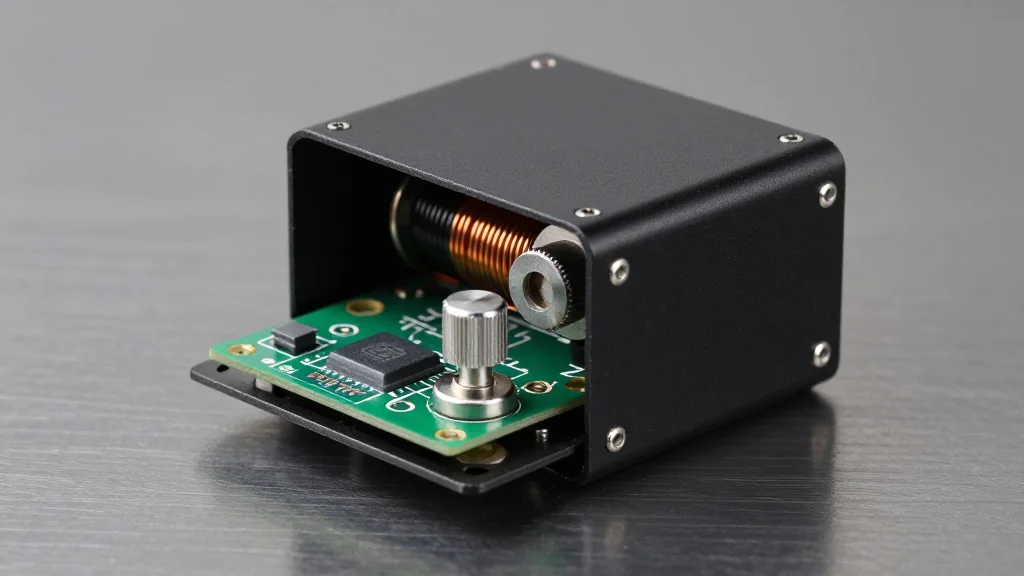
Linearly Variable Two-Wire Loop Current Generator
Why It Matters
Linear control eliminates manual correction tables, improving calibration speed and accuracy for critical process‑automation equipment.
Key Takeaways
- •Linear loop current proportional to potentiometer voltage
- •Supports source or sink loads up to 500 Ω without recalibration
- •Adjustable range 0.5 mA–23.5 mA with 30 mA safety limit
- •Uses op‑amp U1A and multiplier factor of 100 for scaling
- •Multiturn pot enables precise, smooth current setting
Pulse Analysis
The two‑wire loop current generator is a staple in process‑industry testing, providing a simulated 4‑20 mA signal that mimics real sensor output. Calibration of current‑to‑pressure (I/P) converters, distributed control system (DCS) analog inputs, and programmable logic controller (PLC) modules relies on a stable, repeatable current source. Traditional designs often deliver a non‑linear relationship between the adjustment knob and the resulting loop current, forcing technicians to apply correction tables or perform time‑consuming recalibrations. A linearly adjustable source eliminates that friction, delivering a direct, proportional link between the user‑set voltage and the loop current.
The circuit presented by Ramalingam achieves linearity by feeding a voltage set point (Vset) from a multiturn potentiometer (RV1) into an operational amplifier (U1A) that drives the loop through a resistor network. With R4/R6 fixed at 99, the equation simplifies to Io = (Vset / R5) × 100, meaning each millivolt change at the pot translates into a predictable 0.1 mA shift in loop current. The design also incorporates a 5 V regulator (U3), a current‑limit transistor stage (Q1/Q2) capped at roughly 30 mA for safety, and the ability to handle either source or sink loads up to 500 Ω without re‑biasing the network.
From a business perspective, the linear generator reduces downtime during field commissioning and lowers the risk of calibration errors that can cascade into production losses. Its wide load tolerance makes it compatible with legacy I/P converters as well as modern smart actuators, supporting seamless integration across heterogeneous control architectures. Engineers can further customize the range by swapping R3, R2, and R5 values, extending the solution to specialty applications such as high‑precision flow‑meter testing or battery‑management system validation. In short, the design delivers a cost‑effective, plug‑and‑play tool that strengthens quality‑control loops across the automation sector.
Linearly variable two-wire loop current generator
Comments
Want to join the conversation?
Loading comments...