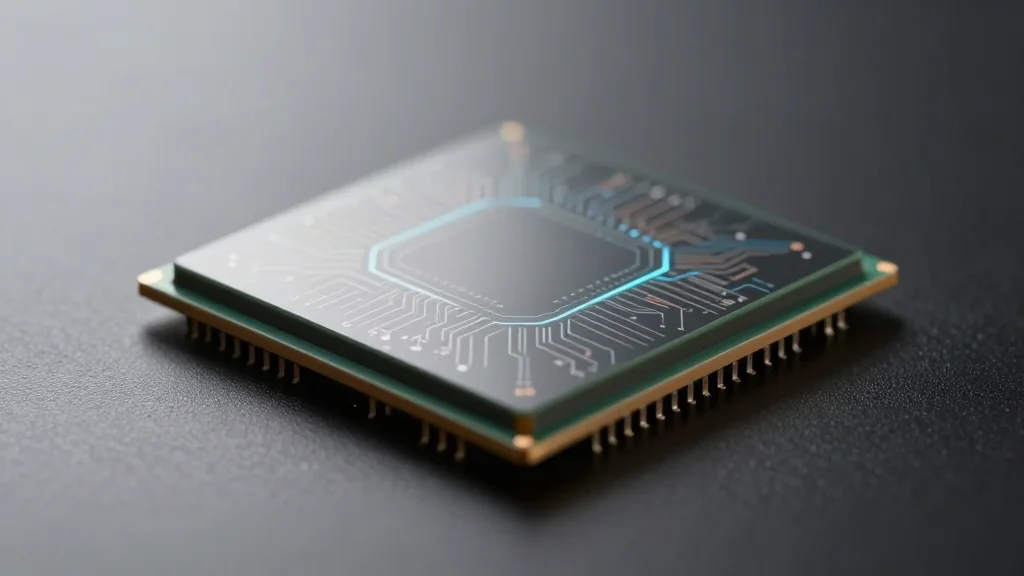
MaxLinear Unveils Panther V AI Inference Accelerator at Dell Tech World

Companies Mentioned
Why It Matters
Panther V addresses a critical choke point in AI inference—data movement across storage, memory and compute—by embedding compression and security functions directly in silicon. As inference workloads shift from experimental pilots to continuous, revenue‑driving services, reducing latency and power consumption becomes a competitive differentiator for hyperscale data centers. By offering a solution that improves utilization without adding hardware cost, MaxLinear could reshape procurement decisions and accelerate the adoption of inference‑first architectures. The $5 billion market estimate signals a sizable opportunity for niche players that can deliver efficiency gains beyond the raw compute power of GPUs. If Panther V delivers on its latency promises, it may spur a broader industry focus on data‑movement acceleration, prompting rivals to integrate similar capabilities or partner with connectivity specialists. This could lead to a new wave of hardware co‑design where AI models, storage stacks and networking fabrics are jointly optimized.
Key Takeaways
- •MaxLinear unveiled Panther V at Dell Technologies World 2026 in Las Vegas.
- •Panther V integrates compression, encryption and integrity checks in silicon to cut inference latency.
- •Vikas Choudhary highlighted data movement as the primary bottleneck for real‑time AI services.
- •Company estimates a $5 billion addressable market for purpose‑built inference accelerators.
- •Demo booth (204) will showcase integration with RAG architectures and Dell reference designs.
Pulse Analysis
MaxLinear’s Panther V arrives at a moment when AI inference is transitioning from a niche, batch‑oriented task to a continuous, latency‑sensitive service. Historically, the industry has focused on scaling GPU compute, but the diminishing returns of raw FLOPS in inference workloads have exposed the inefficiencies of shuttling data between storage, memory and processors. By moving compression, encryption and integrity validation into a dedicated accelerator, Panther V reduces the number of memory hops and CPU interventions, directly translating into lower GPU idle time and faster time‑to‑first‑token. This architectural shift mirrors the broader trend of domain‑specific accelerators that offload ancillary tasks, a strategy that has proven effective in networking (e.g., SmartNICs) and storage (e.g., NVMe‑offload engines).
From a market perspective, the $5 billion TAM cited by MaxLinear is modest compared with the multi‑hundred‑billion AI spend forecast, but it represents a high‑margin niche where differentiation hinges on efficiency rather than sheer performance. If early adopters—particularly hyperscalers with massive inference fleets—validate the claimed latency reductions, Panther V could become a standard component in AI‑optimized server designs, much like Intel’s QuickAssist has for encryption workloads. The partnership with Dell, a leading OEM for enterprise servers, gives MaxLinear a direct pipeline to integrate the chip into reference platforms, accelerating time‑to‑market.
Looking ahead, the real test will be benchmark transparency and ecosystem support. MaxLinear’s promise of “no increase in power or infrastructure cost” must be substantiated against competing solutions from NVIDIA’s TensorRT‑accelerated inference engines and AMD’s MI series. Moreover, software stack compatibility—especially with popular inference frameworks and emerging RAG pipelines—will determine adoption velocity. Should Panther V deliver measurable cost‑per‑token savings, it could trigger a wave of data‑center redesigns that prioritize data‑movement efficiency, reshaping the hardware economics of AI services for the next decade.
MaxLinear Unveils Panther V AI Inference Accelerator at Dell Tech World
Comments
Want to join the conversation?
Loading comments...