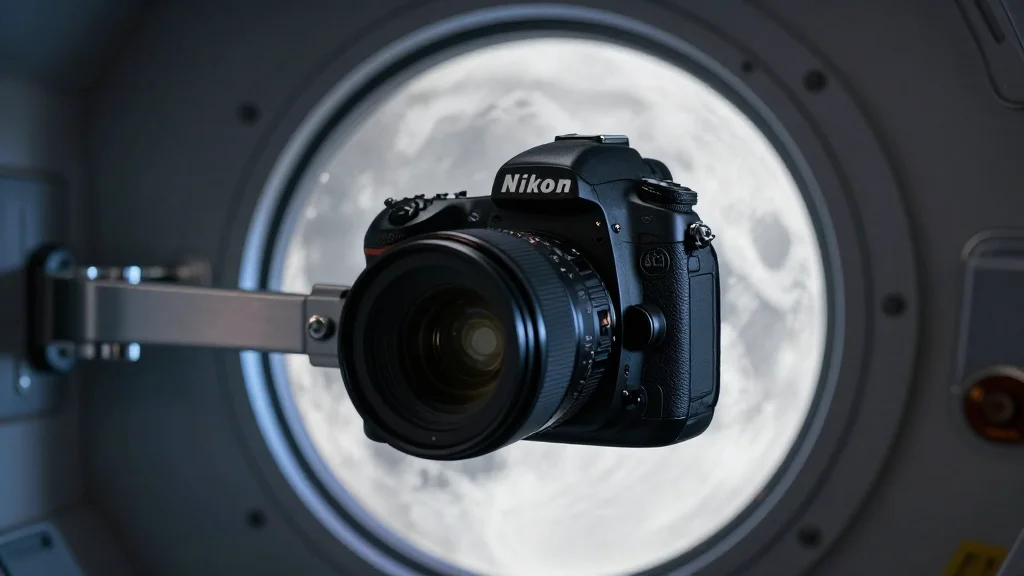
NASA Picks Nikon D5 DSLR as Primary Camera for Artemis II Mission

Companies Mentioned

NASA
Nikon
7731
Why It Matters
The selection of a consumer DSLR for a deep‑space mission challenges the conventional wisdom that space hardware must be custom‑engineered from the ground up. By validating the Nikon D5’s performance in the harsh environment of a lunar flyby, NASA demonstrates that proven commercial technology can meet NASA’s exacting standards, potentially reshaping procurement strategies across the agency. This decision also highlights a broader trend toward cost‑effective, rapid‑deployment solutions in the aerospace sector, where budget constraints and accelerated timelines pressure agencies to reconsider legacy approaches. For the hardware industry, NASA’s endorsement of the D5 could boost confidence in the durability of high‑end consumer cameras, spurring manufacturers to develop space‑qualified accessories and firmware updates. It may also inspire new partnerships between camera makers and space agencies, opening a niche market for ruggedized, mission‑ready imaging equipment that bridges the gap between consumer expectations and aerospace requirements.
Key Takeaways
- •NASA selected the Nikon D5 DSLR as the primary camera for Artemis II
- •The D5 offers a 20.8‑MP full‑frame sensor and ISO up to 102,400, validated for vacuum and extreme temperatures
- •NASA also carries a Nikon Z9 mirrorless camera for supplemental imaging
- •Choosing the D5 saves an estimated $3‑4 million versus a custom space‑grade camera
- •The camera will be used during the planned late‑2026 launch and three‑day lunar flyby
Pulse Analysis
NASA’s choice to equip Artemis II with a Nikon D5 DSLR reflects a pragmatic shift toward leveraging mature, commercial technology for mission‑critical tasks. Historically, NASA has invested heavily in bespoke hardware to guarantee performance under space conditions, but the agency’s budgetary pressures and the desire for faster development cycles have made off‑the‑shelf solutions increasingly attractive. The D5’s track record in extreme terrestrial environments, combined with rigorous pre‑flight qualification, provides a compelling risk‑mitigation case that outweighs the modest weight penalty compared with mirrorless alternatives.
From a market perspective, this decision could catalyze a new segment of “space‑ready” consumer electronics. Camera manufacturers may respond by offering hardened variants, radiation‑tolerant components, and firmware that supports remote operation in low‑gravity environments. Such offerings would not only serve government programs but also commercial spaceflight operators seeking cost‑effective payloads for orbital tourism and research. The ripple effect could lower entry barriers for smaller players, fostering a more competitive ecosystem.
Looking ahead, the success of the D5 on Artemis II will likely influence hardware selection for Artemis III and subsequent lunar surface missions. If the camera delivers high‑quality imagery without failure, NASA may formalize a procurement pathway that prioritizes proven commercial platforms, reserving custom development for truly unique scientific instruments. This could accelerate the cadence of deep‑space missions, reduce overall program costs, and democratize access to space‑grade imaging technology.
NASA Picks Nikon D5 DSLR as Primary Camera for Artemis II Mission
Comments
Want to join the conversation?
Loading comments...