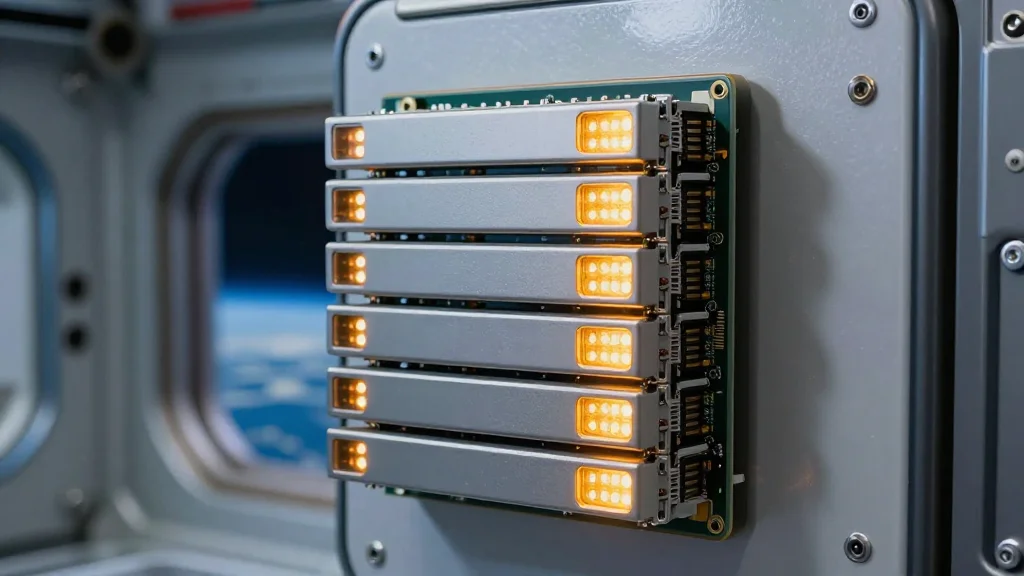
NASA's Artemis II Orion Uses Eight‑CPU Redundant Computer for Fault‑tolerant Navigation

Why It Matters
The Artemis II computer architecture redefines reliability standards for human spaceflight. By proving that a spacecraft can survive multiple simultaneous hardware failures, NASA sets a benchmark that commercial and governmental programs will need to match to ensure crew safety on longer missions to the Moon, Mars and beyond. For the broader hardware ecosystem, the mission showcases the viability of triple‑modular redundancy, deterministic networking and autonomous fault recovery at scale. These technologies are directly applicable to high‑availability sectors such as autonomous vehicles, aerospace defense and critical infrastructure, where a single point of failure can have catastrophic consequences.
Key Takeaways
- •Eight processors run identical instructions in lockstep, creating a fault‑tolerant 8‑CPU system
- •System can lose three flight‑control modules in 22 seconds and remain operational
- •Triple‑redundant memory corrects single‑bit errors on every read
- •Time‑triggered Ethernet distributes a shared time reference across three network planes
- •Backup Flight Software runs on separate hardware to guard against common‑mode software failures
Pulse Analysis
NASA’s decision to embed eight synchronized processors in Orion reflects a strategic shift from minimalistic, single‑point‑failure designs to a philosophy where redundancy is built into every layer of the avionics stack. Historically, spaceflight computers were constrained by mass, power and radiation limits, leading to the iconic Apollo Guidance Computer’s modest capabilities. Advances in semiconductor fabrication, radiation‑hardening techniques, and deterministic networking now allow engineers to multiply processing power without proportionally increasing risk.
From a market perspective, the Artemis II architecture could accelerate the adoption of aerospace‑grade multi‑core processors and fault‑tolerant memory modules in commercial satellite constellations. Companies that previously offered only single‑flight‑computer solutions may need to redesign their products to stay competitive, especially as private firms target lunar and Martian missions where repair opportunities are nonexistent. Moreover, the deterministic Ethernet approach aligns with trends in automotive and industrial IoT, where time‑sensitive networking is becoming a standard requirement.
Looking forward, the real test will be how the eight‑CPU system performs under sustained radiation exposure during Artemis III’s surface operations. If the architecture proves resilient, it will likely become the de‑facto template for all crewed deep‑space vehicles, influencing procurement decisions for the next decade of exploration. Conversely, any failure could prompt a reevaluation of redundancy strategies, perhaps favoring software‑centric fault detection over hardware duplication. Either outcome will shape the engineering playbook for humanity’s next steps beyond low Earth orbit.
NASA's Artemis II Orion uses eight‑CPU redundant computer for fault‑tolerant navigation
Comments
Want to join the conversation?
Loading comments...